

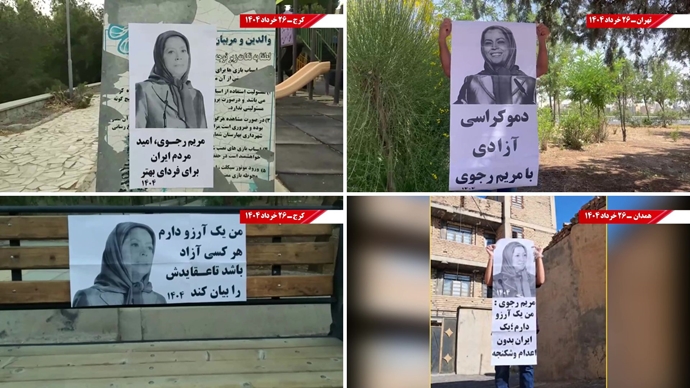

On June 16, a coordinated campaign of defiance swept across Iran as the People’s Mojahedin Organization of Iran (PMOI/MEK) Resistance Units marked the anniversary of a major political victory against the clerical regime. In cities from Tehran to Shiraz, activists displayed posters and banners bearing messages of freedom and democracy, reaffirming their commitment to overthrowing the theocracy.
These acts were not merely symbolic. They commemorated the anniversary of the failed June 17, 2003, plot, when the French government, in a deal with the Iranian regime, attempted to dismantle the Iranian Resistance on European soil. The ultimate failure of that plot, and the continued growth of the Resistance Units inside Iran today, tells a powerful story of resilience. It proves that the regime’s efforts to silence the opposition—whether through international political maneuvers or brutal domestic repression—have been defeated by an organized and unwavering movement for a free Iran.
June 16—Iran
PMOI Resistance Units mark the anniversary of the failed June 17, 2003, coup against the Iranian Resistance. At the time, the French government, at the request of the Iranian regime, cracked down on the offices of the Iranian Resistance and the homes of its… pic.twitter.com/Q924uVPLiM— People's Mojahedin Organization of Iran (PMOI/MEK) (@Mojahedineng) June 17, 2025
A legacy of resilience against appeasement
On June 17, 2003, in a stark example of the policy of appeasement, some 1,300 French anti-terrorism police raided the offices of the National Council of Resistance of Iran (NCRI) and the homes of its supporters. The operation, based on baseless allegations of terrorism provided by the mullahs’ regime, was a politically motivated attempt to curry favor with Tehran.
What followed was a 14-year legal and political battle. The Iranian Resistance, supported by international lawmakers, jurists, and human rights figures, fought to expose the truth. Finally, in September 2014, the French judiciary permanently closed the case, stipulating that there was no evidence for any of the charges, from terrorism to financial wrongdoing.
The court explicitly acknowledged that the resistance of the PMOI was legitimate and not terrorism. The plot, intended to cripple the resistance, ended in a humiliating defeat for the Iranian regime and its appeasers, and a resounding victory for justice.
Tehran
Maryam Rajavi is the Iranian people's hope for a better tomorrow pic.twitter.com/ECSJ27tGqS— People's Mojahedin Organization of Iran (PMOI/MEK) (@Mojahedineng) June 17, 2025
The Resistance today: a nationwide network of defiance
The same spirit of persistence that secured victory in the French courts now fuels the Resistance Units operating deep inside Iran. On June 16, these agile cells demonstrated their nationwide reach and clear vision for Iran’s future. In Tehran, Karaj, Isfahan, and Mashhad, banners went up with images of Maryam Rajavi, declaring, “Democracy, Freedom, with Maryam Rajavi.”
The messages broadcast a future starkly different from the present. In Shiraz, a poster declared, “What our people want is a democratic republic.” In Hamedan, another echoed NCRI President-elect Maryam Rajavi’s vision: “I have a dream; an Iran without execution and torture.” In Isfahan and other cities, she was hailed as “the Iranian people’s hope for a better tomorrow” and a “symbol of resistance against the mullahs’ regime.”
Tehran
Maryam Rajavi is the Iranian people's hope for a better tomorrow pic.twitter.com/r2Cw8xnfDj— People's Mojahedin Organization of Iran (PMOI/MEK) (@Mojahedineng) June 17, 2025
These activities directly challenge the regime’s authority on its own turf. A powerful message displayed in Isfahan affirmed the right of the Iranian people to fight back, stating, “Rebellious youth have the right to defend themselves [against the regime’s repressive forces].” This highlights the core mission of the Resistance Units: to break the atmosphere of fear and organize the people’s desire for change into effective action.
A clear message for the future
The widespread and coordinated actions of the PMOI Resistance Units serve as the most powerful refutation of the regime’s long-standing propaganda that the opposition has no popular support inside Iran. This organized network, composed of Iranians from all walks of life, has become the backbone of the pro-democracy movement.
As the regime’s own officials and state media now openly admit, the Resistance Units are the primary force capable of organizing protests and transforming widespread discontent into nationwide uprisings. Their activities on June 16 are more than just a commemoration of a past victory. They are a declaration that the struggle continues, waged every day on the streets of Iran. They signal that the force that defeated the regime’s international conspiracies two decades ago is now leading the charge for its overthrow from within, paving the way for the free, democratic, and secular republic the Iranian people have long demanded.