

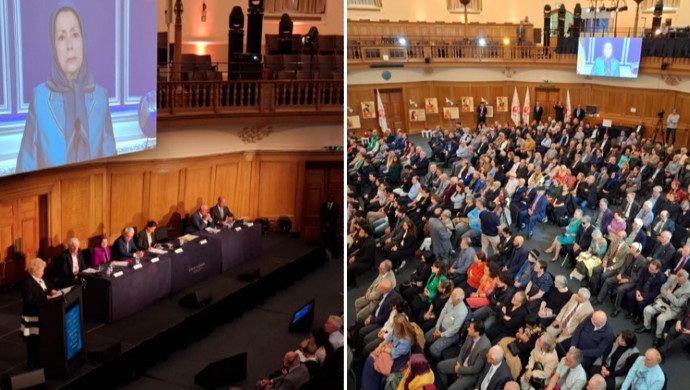

In the historic Church House in Westminster, the site of the first-ever United Nations Security Council meeting, a major international conference was held on October 11, 2025, to mark the World Day Against the Death Penalty. The event brought together a distinguished assembly of parliamentarians, legal experts, human rights advocates, and dignitaries from across the globe. They convened to address the alarming surge in executions in Iran, demand accountability for the regime’s crimes against humanity, and voice their support for the Iranian people’s struggle for a democratic republic. The conference provided a powerful platform for exposing the regime’s brutal tactics and outlining a path forward for a free Iran.
A vision of defiance and a future without executions
In her keynote address delivered online to the conference, Maryam Rajavi, the president-elect of the National Council of Resistance of Iran (NCRI), paid tribute to the victims of the regime’s execution machine and condemned the “religious tyranny ruling Iran.” She framed the escalating use of the death penalty as a desperate measure by a “failed regime, now teetering on the brink of collapse” in the face of popular uprisings.
October 10, World day against the death penalty
Urgent campaign to #StopExecutionsInIran
On this #WorldDayAgainstTheDeathPenalty, I pay tribute to all those who were executed for their struggle for freedom.https://t.co/3Zx8JmydlY pic.twitter.com/K2G92Zb5i6— Maryam Rajavi (@Maryam_Rajavi) October 11, 2025
Mrs. Rajavi highlighted the recent executions of political prisoners, including PMOI members Behrouz Ehsani and Mehdi Hassani, and the imminent threat to 17 others facing the same fate. She challenged the regime’s opaque and unjust judicial process, daring the mullahs to open their trials to the public and allow international observers to investigate.
She stressed that while the regime sought to shape Iran’s destiny with the gallows, the Iranian Resistance has forged a new path toward freedom. Looking to the future, she presented a clear alternative based on justice and human dignity, stating, “Our plan for the future calls for an Iran without executions and torture.” In a direct call to world powers, she urged a shift in foreign policy: “Make your relations with this regime conditional on the immediate halt of executions.”
An unprecedented wave of state-sanctioned killing
Speaker after speaker expressed grave concern over the dramatic spike in executions, which they characterized as a tool of political repression. Baroness O’Loan informed the conference that “every three and a half hours, a person is executed in Iran,” a statistic that underscores the sheer scale of the crisis. She noted that since Masoud Pezeshkian took office in July 2024, over 1,820 executions had been reported, with the true number likely higher.
Baroness O'Loan: The regime targets NCRI and @Mojahedineng supporters and members with false charges like “waging war against God.” It fears an organized resistance offering a democratic alternative and a path to real change.#StopExecutionsInIranhttps://t.co/J1ZSIRNIpU
— NCRI-FAC (@iran_policy) October 11, 2025
John Bercow, former Speaker of the House of Commons, provided further stark figures, stating, “In 284 days of 2025, 1,200 people [have been] executed at the behest of the fascist state… That is more than four people a day, every day, knowingly, in cold blood, calculatedly slaughtered.” He described the situation as “sick, performative, egregious bestiality” designed not to deliver justice but to “terrorize people, intimidate people, indeed about breaking people.”
Political prisoners in the crosshairs
A central theme of the conference was the specific targeting of political prisoners, particularly supporters of the People’s Mojahedin Organization of Iran (PMOI/MEK). Ingrid Betancourt, former Colombian senator and presidential candidate, spoke passionately about the “17 men and women, prisoners of conscience, freedom fighters… [who] await execution.” She stated their crime was “to support the MEK, the Iranian opposition movement fighting for the right of Iranian people to choose democracy.”
.@IBetancourCol: This six-decade struggle shows the MEK is not just a political movement—it is a moral force, rooted in values that transcend time and borders. The regime fears you because truth always threatens and defeats tyranny.#StopExecutionsInIran
https://t.co/7mfp9W3xQB— NCRI-FAC (@iran_policy) October 11, 2025
The conference paid tribute to those recently executed, such as Behrouz Ehsani and Mehdi Hassani, who, as Mrs. Rajavi recounted, were executed on charges of PMOI membership after refusing to renounce their beliefs under torture. The case of Somayeh Rashidi, a political prisoner who died after being deliberately denied medical care, was also raised as an example of the regime’s cruelty.
Ms. Betancourt drew special attention to the case of Maryam Akbari Monfared, who has been imprisoned for 16 years for supporting a democratic Iran and seeking justice for her four siblings executed by the regime. She quoted from one of Monfared’s letters from prison: “Justice stands stronger than love, even higher than a mother’s love for her children, and precisely because I love my children, I have risen in the name of justice.” This, Betancourt said, is the “moral testimony of a woman who has turned grief into strength and pain into purpose.”
Warnings of a repeat of the 1988 massacre
A chilling and recurrent warning throughout the conference was the regime’s open signaling of its intent to repeat the 1988 massacre, during which 30,000 political prisoners, the vast majority PMOI members, were systematically executed. Baroness O’Loan cited a shocking editorial from the state-run Fars News Agency on July 8, which “praised the 1988 atrocity as a successful historical experience, saying that it should be repeated.”
.@JavaidRehman: #UNGA must include in its annual Iran resolution explicit references to #1988Massacre and the ongoing crimes against humanity—murder, torture, and enforced disappearances of political prisoners continuing today.#StopExecutionsInIran
https://t.co/YQPYmNA1xs— NCRI-FAC (@iran_policy) October 11, 2025
Javaid Rehman, the former UN Special Rapporteur on the situation of Human Rights in Iran, provided a powerful legal context to these threats in a video message. He stated that his final report in July 2024 documented how the 1988 massacre amounted to “crimes against humanity of murder and extermination, as well as genocide.” He warned that the regime’s current actions and rhetoric indicate an “intention is to repeat the atrocity crimes committed against the Iranian people in 1988.” He concluded with a stark message: “The international community failed to act in 1988. It must not fail again.”
The urgent need for international accountability
Speakers unanimously called for an end to the culture of impunity that has enabled the Iranian regime to continue its crimes for over four decades. Dame Theresa Villiers, a former UK Member of Parliament, outlined a clear set of demands for the UK government and the international community. “The UK government needs to take more practical and concrete steps to end impunity,” she declared. “That means referring Iran’s atrocious human rights record to the UN Security Council. UK ministers should be pressing for an international tribunal in which to prosecute the men responsible for these heinous crimes.”
Dame Theresa Villiers: The mullahs are not just a danger in Iran. Their support and weapons to proxy groups across the #MiddleEast make them a fundamental threat to regional stability—and a persistent, unpredictable danger to the UK and its interests.
https://t.co/nweYklEv6K— NCRI-FAC (@iran_policy) October 11, 2025
Baroness O’Loan echoed this call, urging the UK government to “end impunity by referring the regime’s human rights record and the perpetrators to the UN Security Council for prosecution in the International Criminal Court” and to “apply the universal jurisdiction to prosecute perpetrators.” Dowlat Norouzi, the NCRI Representative in the UK, also demanded that the world community “remove impunity and to have Khamenei and Mohseni-Eje’i, the head of the mullahs’ judiciary, face justice.”
A threat beyond Iran’s borders
The conference also highlighted that the regime’s repression at home is inextricably linked to its destabilizing actions abroad, posing a direct threat to global peace and security. Dame Theresa Villiers cited the UK Parliament’s Intelligence and Security Committee (ISC) report, which concluded that “the Iranian government uses assassination as an instrument of state policy” and has made “at least 15 attempts at murder or kidnap against British nationals or UK-based individuals since just the beginning of 2022.”
Senator @GiulioTerzi: This regime persecutes political prisoners and has a long record of torture, killings, and mass murders. In the summer of 1988, at least 30,000 PMOI members were executed.#StopExecutionsInIran
https://t.co/5SqAOEm468— NCRI-FAC (@iran_policy) October 11, 2025
Italian Senator Giulio Terzi described Iran as “the ugliest pariah of the international community, a terrorist state spreading terrorism around the world.” He pointed to the regime’s clandestine nuclear program, first exposed by the NCRI, and its military support for Russia, noting, “The IRGC is providing lethal drones and missiles to the Russian army.” These actions, speakers argued, necessitate a firmer international stance, beginning with the proscription of the Islamic Revolutionary Guard Corps (IRGC) as a terrorist organization.
A clear alternative: The NCRI’s ten-point plan
Amid the condemnation of the regime, the conference presented a clear and democratic alternative for Iran’s future. The NCRI’s Ten-Point Plan, authored by Mrs. Rajavi, was repeatedly endorsed as a viable blueprint for a post-theocracy Iran. Dame Villiers described it as “a blueprint for a democratic, non-nuclear, secular republic, a polity which upholds the rule of law, respects gender equality and protects minority communities.”
Azadeh Hosseini, a teacher whose uncles were executed by the regime, voiced her “deep admiration for Madame Maryam Rajavi and her Ten-Point Plan,” calling it a “democratic, secular, and humane vision for the future of Iran.”
Azadeh Hosseini: Two of my uncles, Gholam Hossein and Abbas, were executed in the 1980s massacre of political prisoners. Their only crime was supporting @Mojahedineng, fighting for freedom, democracy, and a better future for Iran.#StopExecutionsInIran
https://t.co/WYkAjJ1DBj— NCRI-FAC (@iran_policy) October 11, 2025
Rejecting all forms of dictatorship
A resounding message from the speakers and attendees was the rejection of both the current theocracy and the past monarchical dictatorship. John Bercow forcefully dismissed the regime’s attempts to portray its opponents as monarchists, declaring the slogan “No to the Shah, no to the Mullahs” as a simple and clear articulation of the movement’s goal. “What we want is freedom, democracy, justice, the rule of law, gender equality, a non-nuclear republic, a separation between state and faith,” he said.
This position was rooted in the personal histories of many attendees. Neda Zabeti, a 20-year-old law student whose five family members were executed, stated, “Let us say no to dictatorship. No Shah, no Mullah. Long live freedom and long live democracy.” Azadeh Hosseini shared that her uncles were political prisoners under the Shah before being executed by the mullahs, leading her to repeat, “no to Shah and no to Mullahs.” Senator Terzi affirmed this as the only viable path, stating, “Neither with the mullahs, nor with the Shah. There is a third option: the National Council of Resistance of Iran and its Ten-Point Plan.”
Neda Zabeti: Five of my family members were executed, and many more faced arrest and torture. Latif, Effat, Mohammad, and Nosrat Ramezani—Mohammad and Nosrat were murdered together on May 2, 1982. Their memory lives on in our fight for freedom.
https://t.co/GDIPXN2YMM— NCRI-FAC (@iran_policy) October 11, 2025
The enduring power of resistance
The conference concluded with a powerful affirmation of the Iranian people’s right to resist and the certainty of their ultimate victory. The role of the PMOI’s Resistance Units inside Iran was lauded as a key driver of change. Dowlat Norouzi reported that in 2024, these units “carried out at least 39,000 activities in 135 cities.”
Omid Ebrahimi, a young doctor and a representative of the younger generation, spoke of this internal movement with pride: “They are the Resistance Units, the rebellious youth who dare to say no to dictatorship and yes to freedom and a Democratic Republic… Their courage gives life to the hope for a free Iran.”
NCRI UK Rep @DowlatNowrouzi: For over 4 decades, this brutal regime has hidden its barbarism behind the name of God & Islam. @Mojahedineng never bowed—they sacrificed everything for democracy, freedom, and a just, democratic Iran.#StopExecutionsInIranhttps://t.co/dppzXRbYwA
— NCRI-FAC (@iran_policy) October 11, 2025
In a final, optimistic message, John Bercow encapsulated the spirit of the event: “You can sometimes dim the flame of freedom. You cannot extinguish the natural desire of peoples across the globe to be free. Freedom will prevail in Iran… I bet you, like me and like everybody on the platform, would want to rush to be on the first plane to Tehran to celebrate the triumph of democracy and to celebrate the leadership of Mrs. Maryam Rajavi.”