

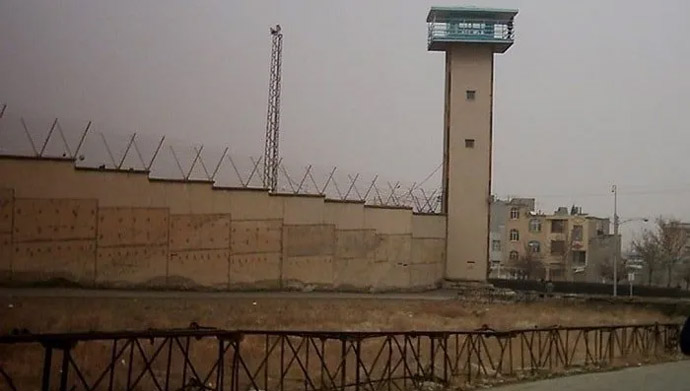

On September 13, 2026, Iranian state media broadcast the demolition of Gohardasht Prison in Karaj in the presence of Heydar Asiabi, head of the Prisons Organization. Asiabi said the work had begun on orders from the judiciary chief and that the prison walls would be demolished within less than a month to prepare the site for residential or commercial development.
Gohardasht, however, was one of the regime’s main centers for the torture of political prisoners in the 1980s and a principal execution site during the 1988 massacre. After Evin, the highest number of prisoners in Tehran were hanged there. The demolition therefore marks an escalation: after years of destroying graves and burial grounds, the regime is now eliminating one of the massacre’s best-documented crime scenes.
A decades-long pattern of erasure
The destruction of Gohardasht follows a pattern documented across Iran. In August 2025, Plot 41 of Tehran’s Behesht-e Zahra cemetery, containing the graves of thousands of PMOI members executed in 1981, was leveled with heavy machinery. Tehran officials later acknowledged that the area had been turned into a parking lot.
https://twitter.com/HanifJazayeri/status/2099905485876941042
In June 2017, authorities vandalized graves of PMOI victims in Tabriz, pouring about 10 centimeters of cement over the grounds. Mass-grave sites in Mashhad were also targeted. In Ahvaz, graves connected to the 1988 massacre were demolished under the pretext of constructing a boulevard, while further destruction was reported in 2020 as authorities sought to build a road over a mass-grave area. In 2021, the Iranian Resistance warned of efforts to alter and destroy graves at Khavaran.
These incidents make clear that Gohardasht is not an isolated redevelopment project but the latest episode in a longstanding assault on the physical record of executions and mass burials.
Why Gohardasht matters
Gohardasht is particularly important because survivors preserved detailed information about the prison long before its demolition. The death corridor, Death Commission room, execution hall, torture chambers, and other parts of the prison were recorded through testimony, sketches, memoirs, and later three-dimensional reconstructions.
That evidence became central during the Swedish prosecution of former Gohardasht prison official Hamid Noury. PMOI survivors presented a model of the prison and a 3D reconstruction showing the death corridor, Death Commission room, and execution hall. Prosecutors also presented a list of 444 prisoners executed at Gohardasht.
After a 92-session trial, a Stockholm court sentenced Noury to life imprisonment on July 14, 2022, for serious crimes against international law and murder. On December 19, 2023, the Swedish Appeals Court upheld the sentence.
The significance is clear: the regime is demolishing a site whose internal geography and role in the massacre have already been preserved and examined in judicial proceedings abroad.
An attack on truth and the families
The destruction of graves also prolongs the suffering of families who were never told where their relatives were buried. A 2017 UN communication referred to the desecration of mass-grave sites in Ahvaz and Mashhad containing the remains of at least 184 and 170 people, respectively, executed during the 1988 massacre.
In July 2024, then-UN Special Rapporteur Javaid Rehman called for an international investigative and accountability mechanism to gather and preserve evidence for future prosecutions. His findings also stressed that enforced disappearance remains a continuing crime while authorities conceal the fate of the disappeared and the facts remain unclarified.
The bulldozers cannot erase the record
Destroying Gohardasht can remove physical features relevant to future investigations. It cannot erase survivor testimony, victim lists, prison diagrams, memoirs, three-dimensional reconstructions, or the judicial record created in Sweden.
The Noury case demonstrated that evidence concerning crimes committed decades earlier inside an Iranian prison could still be examined by a foreign court and lead to a conviction under universal-jurisdiction principles. The demolition of the prison therefore cannot undo what has already entered the historical and judicial record.
The international community must act
Repeated warnings have not stopped the destruction—from Tabriz, Mashhad, Ahvaz, Khavaran, and Behesht-e Zahra to Gohardasht. The United Nations and relevant international bodies must press for the preservation of what remains of Gohardasht and other suspected execution and burial sites, document alterations already made, and support mechanisms that preserve evidence and pursue accountability.
Condemnation after the evidence has disappeared is not enough. Protecting these sites is part of the international community’s responsibility to secure truth and accountability for crimes against humanity. The destruction of Gohardasht demonstrates the consequences of continued inaction towards the regime’s crimes against the Iranian people.
But the regime cannot return these crimes to secrecy by demolishing walls or paving over graves. The physical crime scene may be damaged or destroyed; the case for accountability remains.