


On the anniversary of the death of Ebrahim Raisi, the executioner of Iranian political prisoners, Ali Khamenei, the regime’s supreme leader, organized 120,000 ceremonies at enormous expense to try to boost the morale of the executioners, Islamic Revolutionary Guard Corps (IRGC) members, and demoralized Basij paramilitary forces within his crisis-ridden rule.
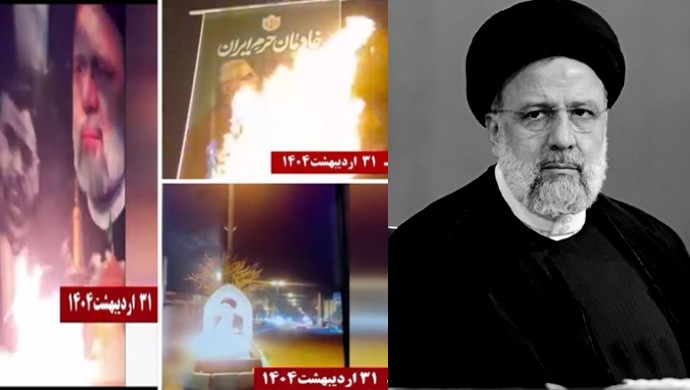
However, Iran’s rebellious youth carried out fiery operations, disrupting the regime’s staged events for Raisi, who served as an executioner judge, head of the Judiciary, and president within the regime.
In this series of courageous operations, the rebellious youth, following the path of the martyrs of the struggle for freedom, set fire to images and symbols of Raisi in Tehran, Mashhad, Isfahan, Ahvaz, Rasht, Kerman, Urmia, Gorgan, Birjand, Neyshabur, Aligudarz, Borujerd, Lahijan, Dorud, and Sarpol-e Zahab.
With their fiery operations, the rebellious youth demonstrated that the Raisi’s name is synonymous with his role as a bloodthirsty member of Khomeini’s “death commission” responsible for the genocide of the PMOI members and the massacre of 30,000 political prisoners in 1988, and as the head of the regime’s judiciary during the killing of over 1,500 martyrs in the November 2019 uprising.
This fact is so deeply ingrained in society that on state-run television programs marking the anniversary of Raisi’s death (May 2025), regime leaders and members of his cabinet reluctantly and with lamentations acknowledged the hated reputation of “the executioner of ’88” (a reference to Raisi’s role in the 1988 massacre) and how Raisi’s name has become synonymous with executions and massacres.
In one of the regime’s television programs on the anniversary of the death of Raisi the executioner (May 20, 2025), Mohsen Mansouri, Raisi’s acting head of the presidential office, said: “Many phrases were coined in those years that, let me tell you, were an injustice to him, for example, they called him Ayatollah Execution.”
Mehdi Esmaeili, the regime’s Minister of Culture and Islamic Guidance, also referring to the popularization of slogans such as “Neither executioner nor charlatan” during the staged presidential elections of 2017, said: “The first time these keywords of murder and 40 years of execution and such were said in a public gathering in an indoor sports hall in Hamedan, and this was officially brought into the debates and electoral disputes, and the Supreme Leader said after the elections that they had swapped the places of the executioner and the martyr.”
Raisi himself, when confronted in an interview with CBS television in which he was asked if he was repentant for his membership in the death commission, said in utmost helplessness and desperation: “What document do you have for this matter, other than the claim made by the Mojahedin? At the time it is claimed, I was in the position of deputy prosecutor… I have always been a defender of human rights. These are the ones who martyred 17,000 people in our country.”
The disgrace of Khamenei’s spectacles on the death anniversary of Raisi became so acute that a regime insider, while acknowledging the public’s hatred for these nauseating displays, wrote: “They want to hold 120,000 ceremonies for Mr. Raisi, those who are unable to write 120 positive and well-reasoned lines describing his management period… This huge budget spent on such ceremonies, whose pockets does the profit go into? Which poor child benefits from it? In my opinion, it’s better to give them dry bread than for these actions to make the nation angry and full of hatred” (Ham-Mihan newspaper, May 18, 2025).
The desperate regime, from the 120,000 ceremonies and nauseating propaganda aimed at canonizing the “executioner of ’88”, reaped nothing but failure, disgrace, and hatred. The rebellious youth, with their fiery attacks on the symbols and images of the executioner of the massacre during these hateful spectacles, demonstrated that the fire of the people’s anger and fury against the regime of executioners will never be extinguished.