

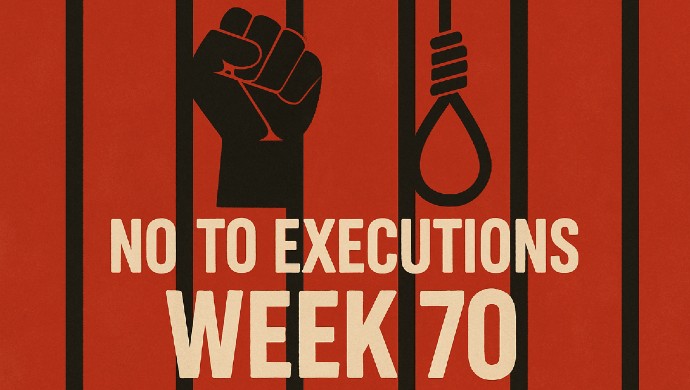

The “No to Executions Tuesdays” campaign, a defiant movement led by political prisoners and prisoners of conscience across Iran, marked its 70th consecutive week on Tuesday, May 27, 2025. The campaign announced its expansion to include Fardis Prison in Karaj, bringing the total number of participating penitentiaries to 45, even as the Iranian regime significantly escalates its use of capital punishment.
In their statement for the 70th week, the prisoners highlighted the grim reality: “With the utmost sorrow and regret, the taking of prisoners’ lives in the prisons of the ruling tyranny has not only not stopped, but the statistics of this ‘government-sanctioned murder of imprisoned citizens’ continue to rise.”
The prisoners’ statement detailed an unprecedented wave of executions during the Iranian month of Ordibehesht (April 21 – May 21, 2025), asserting that “the oppressive apparatus of the mullahs’ regime sent over 170 imprisoned compatriots to the gallows; an unprecedented and horrifying statistic showing that two prisoners were executed in Iran every nine hours.” The statement also noted that approximately 19% of these executions targeted “oppressed Baluch compatriots, who face double oppression and discrimination.”
This surge in state-sanctioned killings continued into late May. According to a statement from the National Council of Resistance of Iran (NCRI) dated May 26, 2025, at least 11 prisoners were executed between May 19 and May 26. Among them was Setareh Taherloo, a female prisoner executed in Damghan Prison on Monday, May 19.
Despite the heightened repression, the “No to Executions Tuesdays” campaign, which began in January 2024, continues to demonstrate remarkable resilience and organization. Prisoners engage in various forms of protest, most notably hunger strikes. In a display of creative resistance, the statement highlighted that “women prisoners, members of this campaign in Evin Prison, gather every Tuesday concurrently with the families’ gatherings and chant the slogan ‘No to Executions.'”
The prisoners also commended the “praiseworthy solidarity inside and outside the prisons” and expressed hope that “the slogan ‘No to Executions’ resonates in the streets and at protest gatherings of various segments of society.”
The prisoners’ statement argues that the executions are not merely judicial sentences but serve a political purpose. “It is completely clear that every death sentence in Iran has a political aspect and is not merely the punishment of an accused; because every accused is a victim of the corrupt and inefficient ruling structure,” the statement reads. “At the same time, there is no fair trial process in the judicial and security apparatus of the government. The main goal of these executions is to create fear and terror in society and to prevent popular uprisings; because with the intensification of crises in the country, repression and executions have also found an upward trend.”
The campaign statement announced that in its 70th week, prisoners in the following 45 prisons would continue their hunger strikes:
Evin Prison (women’s ward, wards 4 and 8), Qezelhesar Prison (units 3 and 4), Karaj Central Prison, Greater Tehran Prison, Khorin Prison in Varamin, Choubindar Prison in Qazvin, Arak Prison, Khorramabad Prison, Yasouj Prison, Asadabad Prison in Isfahan, Dastgerd Prison in Isfahan, Sheiban Prison in Ahvaz, Sepidar Prison in Ahvaz (men’s and women’s wards), Nezam Prison in Shiraz, Adelabad Prison in Shiraz (men’s and women’s wards), Zahedan Prison (women’s ward), Borazjan Prison, Ramhormoz Prison, Behbahan Prison, Bam Prison, Kahnuj Prison, Tabas Prison, Mashhad Prison, Gonbad-e Kavus Prison, Qaemshahr Prison, Rasht Prison (men’s and women’s wards), Rudsar Prison, Havigh Prison in Talesh, Azbaram Prison in Lahijan, Dizel Abad Prison in Kermanshah, Ardabil Prison, Tabriz Prison, Urmia Prison, Salmas Prison, Khoy Prison, Naqadeh Prison, Miandoab Prison, Mahabad Prison, Bukan Prison, Saqqez Prison, Baneh Prison, Marivan Prison, Sanandaj Prison, Kamyaran Prison, and Fardis Prison in Karaj.
The unwavering commitment of these prisoners, expanding their protest network even as the regime intensifies its deadly crackdown, underscores a profound and deeply rooted resistance to state brutality within Iran’s prisons. Their organized defiance serves as a powerful testament to the ongoing struggle for human rights and dignity in the face of overwhelming state-sponsored violence.