

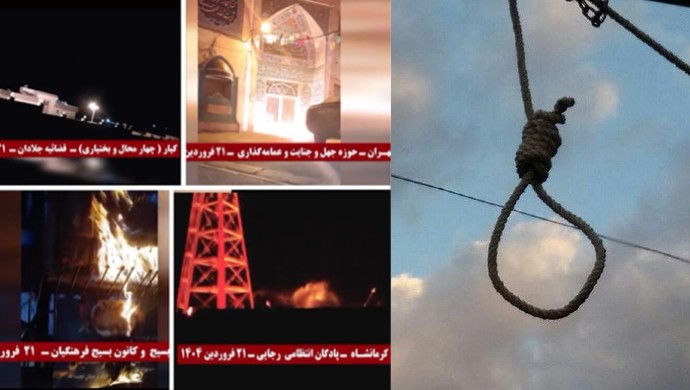

Amidst internal and external crises and on the verge of negotiations with the US, Iran’s regime executed dozens of prisoners. Among them were five political prisoners and three female prisoners. On Wednesday, April 9, 2025 alone, at least 15 prisoners were hanged in the prisons of Qezel Hesar in Karaj, Shahrud, Gonabad, Gonbad-e Kavus, Kermanshah, Shiraz, Qom, and Ahvaz.
On Thursday, April 10, 2025, the heroic rebellious youth of Iran carried out 20 daring operations targeting the regime’s apparatus of execution, the Islamic Revolutionary Guard Corps (IRGC), and its Basij paramilitary force. By setting fire to symbols of the regime’s suppression and crime, they delivered a fiery response to the criminal execution of five political prisoners in Mashhad after 10 years of imprisonment.
The rebellious youth emphasized that “The retribution against the executioner regime and the torturers of Vakilabad prison in Mashhad by the brave children of Iran is definite and certain,” and struck at the centers of the inhumane regime as follows:
- Four incendiary attacks at a regime building in Kiar (Chaharmahal and Bakhtiari province)
- Four incendiary attacks at the Rajaei security forces base in Kermanshah
- Incendiary attack at the Nabi Akram center of fundamentalism and crime in Tehran
- Incendiary at a center of fundamentalism and terrorism in Tehran
- An incendiary attack against a regime building in Filabad, Chaharmahal and Bakhtiari province
- Setting fire to a Basij center and the Basij center for suppressing educators in Tehran
- Setting fire to the Basij base for suppressing students in Mashhad
- Setting fire to a Basij base in Kerman
- Setting fire to the Basij unit for suppressing students in Hamadan
- Setting fire to an IRGC headquarters in Bushehr
- Setting fire to the foundation of corruption and plundering run by the regime and IRGC in Kohgiluyeh
- Setting fire to government billboards, signs, and banners bearing images of regime founder Ruhollah Khomeini, Supreme Leader Ali Khamenei, Ebrahim, Qassem Soleimani, and regime proxies in Tehran, Kerman, Kermanshah, Ilam, Neyshabur, Birjand, Semnan, and Malayer
The execution of five political prisoners after 10 years of imprisonment and torture, alongside the current president Masoud Pezeshkian’s request for US investment in Iran, represents the flip side of the deadlock and irremediable state of the mullahs’ regime. This crisis-ridden and fractured regime continues its existence by relying on executions and suppression, and has executed more than a thousand people since Pezeshkian took office in July 2024.
The five executed political prisoners, in letters sent to international authorities in 2022, had provided a report detailing the unjust sentences, the tortures they endured, and the pressures exerted on their families. In a letter addressed to the UN Secretary-General and Javaid Rehman (the then-UN Special Rapporteur on human rights in Iran), they wrote, among other things:
“We are worn out under the brutal torture of these criminals.
“Spraying pepper spray inside (the buttocks), which for several years has afflicted prisoners with incurable diseases, is one of the tortures inflicted by these unmanly, un-Muslim enemies of humanity.
“Daily summons of our families, insistence on divorce, threats of rape and murder of our children by intelligence agents, and thousands of other oppressions and injustices…”
The regime, on the verge of negotiations, fearing the explosive state of society and seeking to prevent a popular uprising, has accelerated the pace of criminal executions.
The heroic rebellious youth, with 20 fiery responses to the regime’s rule of execution and massacre show to the executioner regime that it has no escape from its inevitable overthrow.