

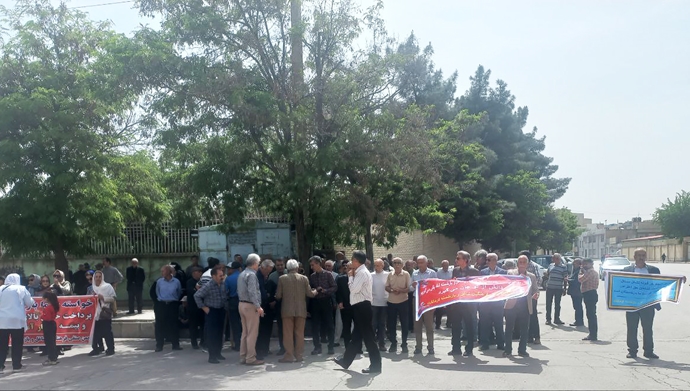

On International Workers’ Day, Iran’s streets were not scenes of celebration but arenas of outrage. Workers, teachers, retirees, students, and ordinary citizens rose up in multiple cities to voice their deep frustration with a regime that has brought them nothing but poverty and betrayal. From north to south, from cities to countryside, the message was clear: the Iranian people have had enough. The tragic bloodshed in Bandar Abbas has ignited a unified cry against injustice and governmental negligence.
Citizens gathered in Qazvin in front of government offices to protest the government’s failure to implement the National Housing Project. They chanted, ‘Housing is our right, not a favor,’ demanding transparency and accountability after months of broken promises.
May 1—Iran
Protest by teachers and educators in Harsin, Eslamabad-e-Gharb, Kermanshah, Tehran, and Shiraz, demanding better rights and wages despite security threats, including phone intimidation and summons by authorities.#IranProtestspic.twitter.com/uoN98Colaw— People's Mojahedin Organization of Iran (PMOI/MEK) (@Mojahedineng) May 1, 2025
Despite threats and summons by security agencies, teachers held rallies in front of local education offices, demanding dignity and fair treatment. Their messages were resolute: ‘Don’t congratulate us on Teacher’s Week—give us our rights,’ and ‘The teacher does not obey silence; he demands justice.’
In Kermanshah, a rare but powerful joint protest saw workers, teachers, and retirees come together to challenge marginalization, poverty, and discrimination. Chants included: “From mines to ports – death zones for workers,” and “Worker, teacher – unity, unity.”
May 1—Kermanshah, western Iran
Protest by retired teachers outside the Ministry of Education offices, coinciding with International Workers' Day and Teacher's Day, demanding better pensions and calling for release of imprisoned activists.#IranProtestspic.twitter.com/xNpzpYNhtA— People's Mojahedin Organization of Iran (PMOI/MEK) (@Mojahedineng) May 1, 2025
Truck drivers staged a silent motorcade through Isfahan with black flags and no horns, honoring their colleagues who died in the Bandar Abbas disaster.
Bakers protested outside the governor’s office in Rasht, furious over economic neglect. One protester shouted: “God’s curse on the corrupt officials! What have we done to deserve this oppression?”
May 1—Rasht, northern Iran
Bakers hold protest rally in front of Gilan provincial governorate.#IranProtestspic.twitter.com/s1jHBnm0G4— People's Mojahedin Organization of Iran (PMOI/MEK) (@Mojahedineng) May 1, 2025
Another symbolic protest saw truck drivers in Kermanshah mourning their fallen comrades in Bandar Rajaei. One said, “We didn’t just lose colleagues—we lost brothers. That explosion represented neglect, corruption, and injustice.”
Students at Noshirvani University held a candlelight vigil to honor victims of the Bandar Abbas explosion. They raised placards of solidarity and declared, “The university is alive because the people are alive,” proving academia is not detached from resistance.
May 1—Babol, northern Iran
Students at Noshirvani University in Babol lit candles and held signs to mourn victims of the recent massive explosion at Bandar Abbas.pic.twitter.com/sIzWzmMP5g— People's Mojahedin Organization of Iran (PMOI/MEK) (@Mojahedineng) May 1, 2025
What happened in Iran on this International Workers’ Day was not a series of isolated protests, but a national uprising of voices screaming for justice. From silent processions to student vigils, every corner of the country echoed one demand: enough tyranny and starvation. The tragedy of Bandar Abbas became a national wound, and the IRGC stands clearly blamed in the eyes of the people. It is evident that the public’s patience has eroded, and what remains is a burning anger—ready to erupt and shake the foundations of the regime.