

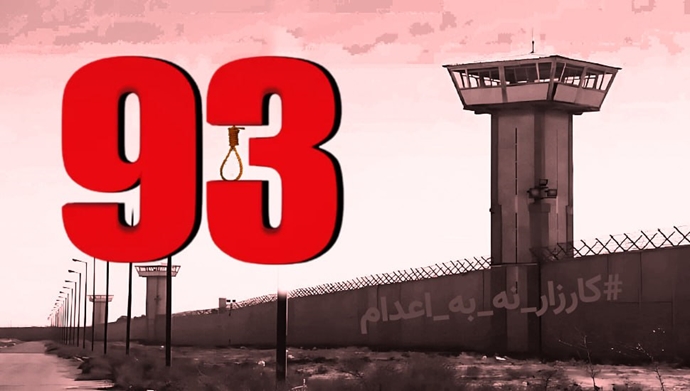

On November 4, 2025, the “No to Executions Tuesdays” campaign entered its 93rd consecutive week, with prisoners on hunger strike across 54 of Iran’s most notorious prisons. This powerful act of defiance from within the regime’s dungeons was mirrored by simultaneous street protests in dozens of cities, as citizens risked their safety to demand an end to the state-sanctioned killings that have dramatically escalated in recent weeks.
The campaign’s latest weekly statement highlights the alarming pace of the regime’s crackdown, reporting that at least 76 prisoners were executed in the first 12 days of the Persian month of Aban alone (October 23 – November 3, 2025). This surge in executions occurred even after a week-long hunger strike by prisoners in Unit 2 of Ghezel Hesar Prison, demonstrating the regime’s determination to continue its policy of suppression.
A defiant voice from within the prison walls
In their 93rd weekly statement, the campaign’s members inside 54 prisons issued a stark warning and a powerful call to action. Describing the situation in grim terms, they declared, “The religious fascism’s execution machine is moving without brakes and at full speed.”
The prisoners directly appealed to the Iranian people and the families of those on death row, urging them not to remain passive in the face of the state’s brutality. “We ask them not to remain silent in the face of this unjust sentence,” the statement read, calling on citizens to “…not allow this massacre to continue in silence… and confront this government crime by shouting ‘no to execution’ in any way possible in the streets of the cities.”
Nationwide protests echo prisoners’ demands
The prisoners’ calls were answered across the country. Despite heavy security and threats of arrest, citizens held protests in numerous cities, including Tehran, Karaj, Mashhad, Rasht, Ahvaz, and Dezful. Protesters, led by courageous youth and women, held placards with slogans such as “Death to the dictator,” “We will not be silent in the face of executions,” and “The executioner’s noose has no effect on Iran’s lionesses.”
More footage of rallies by families of death-row prisoners in Iran, demanding an end to executions in tandem with the 93rd week of the "No To Executions Tuesdays" campaign in 54 prisons across Iran.#StopExecutionsInIran pic.twitter.com/CwOKfNvq5q
— People's Mojahedin Organization of Iran (PMOI/MEK) (@Mojahedineng) November 4, 2025
The protests brought attention to the plight of specific political prisoners facing imminent execution. Placards with slogans such as “No to the execution of Ehsan Faridi” and “We condemn Zahra Tabari’s sentence” were seen, transforming individual cases into symbols of national resistance against the regime’s systematic violence.
International bodies spotlight secret executions
This internal wave of resistance coincides with growing international alarm over the regime’s human rights abuses. The prisoners’ statement noted the recent report to the UN General Assembly’s Third Committee by Ms. Mai Sato, the UN Special Rapporteur on Iran, and Ms. Sara Hossein, the head of the international Fact-Finding Mission. They drew attention to the widespread violation of the right to life in Iran and revealed that the regime’s official sources only announce 8% of all executions, confirming a state policy of clandestine killings.
The “No to Executions Tuesdays” campaign, now well into its second year, has evolved from a reaction to state violence into a powerful, organized movement. The coordinated hunger strikes inside Iran’s prisons and the defiant protests on its streets demonstrate a profound societal shift. This dual-front resistance signals a clear and unwavering rejection of the regime’s culture of death and a unified demand for life, freedom, and justice in Iran.