

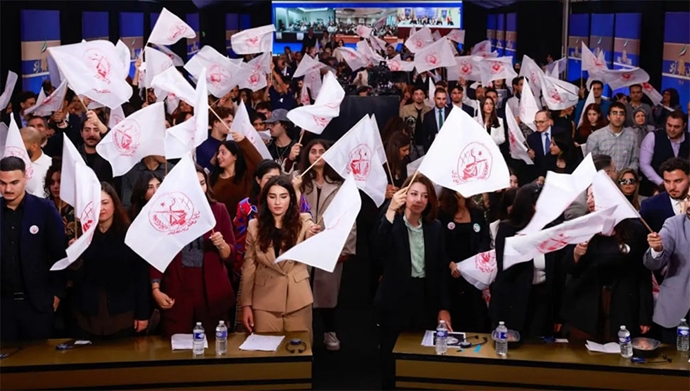

At the cusp of the anniversary of Iran’s November 2019 uprising, Iranian youth supporters of the People’s Mojahedin Organization of Iran (PMOI/MEK) and the National Council of Resistance of Iran(NCRI) convened for an eight-hour hybrid gathering with Maryam Rajavi, the President-elect of the NCRI, joined by delegations of students, professionals, and activists from across Europe, the United States, Canada, and Australia. Political figures from multiple countries attended online as observers. Youth groups from Bonn, London, and Zurich organized parallel programs that were woven into the day’s agenda.
The meeting featured statements from athletes, engineers, lawyers, medical professionals, students and academics, researchers and graduates, families of martyrs, and young Iranians who took part in the November 2019 and 2022 uprisings inside Iran. The program concluded with a multi-point youth resolution endorsing the Iranian Resistance’s platform and drawing a bright line of “no to the Shah, no to the mullahs.”
Maryam Rajavi’s message: a generational relay toward a democratic republic
As keynote speaker, Maryam Rajavi framed the moment as historic and urgent. “The people of Iran and the Iranian Resistance have reached an extraordinary moment in history. Now destiny is knocking at the door, calling upon us to fulfill our great historic duty and rise up for freedom,” she said.
#FreeIran2025: Youths’ Gathering
The Iranian people and Resistance have reached an extraordinary moment in history. Destiny is calling upon us to rise up for freedom. The decisive force in this struggle is the young, rebellious generation of Iran.pic.twitter.com/Ql56Goe3sx— Maryam Rajavi (@Maryam_Rajavi) October 28, 2025
Addressing young activists worldwide, Mrs. Rajavi stressed organizational discipline and the central role of youth in change: “The time has come for the most decisive battles and uprisings. The driving and decisive force behind this struggle and these uprisings is the young, rebellious generation of Iran… and will bring down the tyrannical rule of the mullahs.”
She underlined what she called the singular contest defining Iran’s future: “The primary war from the outset has been between the people of Iran, the Resistance and the people’s front on the one side and the religious dictatorship on the other. This battle will continue to the destination of freedom. Young warriors and rebels must get prepared for the final battle more and more every day.”
Tracing a lineage “of 60 years, or… 120 years, of unbroken struggle,” Mrs. Rajavi praised those who “mocked death and defeated torture and torturers,” and saluted Resistance Unit members who “tell Khamenei: ‘go ahead, arrest, detain, execute; in doing so you are digging your own grave.’”
She linked the present to specific milestones—the 1981 anti-dictatorship call, the National Liberation Army’s formation, and waves of protest culminating in 2022—and commemorated the approaching tenth anniversary of the Camp Liberty missile attack: “24 PMOI members gave their lives and raised high the blood-stained banner of Iran’s freedom.”
On strategy, Rajavi said Iran’s youth abroad have tangible roles: “You… have many ways to contribute to the revolution and fight for freedom. You can awaken every young Iranian to join the fight to overthrow the clerical regime, and to become a supporter and comrade of the Resistance Units.” She reiterated a vision for the day after: “We seek to build a free and flourishing Iran… where all citizens enjoy equal rights… [and] where no door is closed to women.”
Recalling November 2019 as “the volcano of the Iranian people’s fury,” she cited the breadth of unrest—“over 800 locations… more than 1,890 centers of repression, plunder, and propaganda were targeted”—and honored “the 1,500 proud martyrs,” reiterating that PMOI strategy “came alive in the streets.”
Panels and testimonies: from prisons of the 1980s to today’s Resistance Units
Zolal Habibi opened a segment dedicated to inter-generational commitment, saluting Ashraf-3 as a “heartbeat of resistance” and noting that 32 youth associations from Europe, the U.S., and Australia took part. She described the growing visibility of Resistance Units, the resilience of political prisoners, and the spread of youth support networks abroad, characterizing them as a living response to “demonization” campaigns.
#Breaking #Iran News Alert
A major Youth Convention for a Democratic Republic in Iran was held with the participation of Mrs. Maryam Rajavi, joined simultaneously by youth gatherings in the UK, Germany, and Switzerland, along with political figures from across the world.
Speakers… pic.twitter.com/hoYxbjzuw3— SIMAY AZADI TV (@en_simayazadi) October 27, 2025
From the Athletes’ Delegation, Neda Amani, a goalkeeping coach in Switzerland, traced her family’s history of imprisonment under both the Shah and the current regime. She argued that choosing struggle requires awareness, not just background: a conscious decision against state propaganda that portrays sacrifice as vice. She honored detained death-row political prisoner and boxing champion Mohammad Javad Vafaei Sani, comparing his courage to that of victims such as Habib Khabiri, Forouzandeh Abdi, and Navid Afkari, and pledged relentless advocacy “until the freedom of all Resistance Unit members under death sentences.”
Representing families of martyrs, Negar Safa, a 22-year-old medical student, recounted the life of her uncle Mehdi Azimzadeh, arrested in 1981 for PMOI affiliation, who completed a five-year sentence but was executed in the 1988 massacre and buried in Khavaran. She vowed to continue the justice campaign—“neither forgiving nor forgetting”—until accountability is achieved for the 1988 mass executions.
From the Engineers’ Delegation, Behrouz Maqsoudi, an oil-reservoir specialist from Norway, described a childhood marked by raids and the loss of three maternal uncles to executions. He said his personal research led him to the PMOI’s ethic of sacrifice. Addressing Mrs. Rajavi directly, he pledged that engineers and technical professionals would answer her call: “our generation is the generation of overthrow,” committed to rebuilding Iran with knowledge and skill.
Second part of the youth panel on the sidelines of the #FreeIran2025 Youth Convention on October 25. Who represents a democratic alternative to the mullahs’ regime? P1. pic.twitter.com/7j1yNAJvc6
— SIMAY AZADI TV (@en_simayazadi) November 1, 2025
Speaking for lawyers and legal experts, Mahan Taraj criticized the Iranian regime’s judiciary as an instrument of repression under clerical rule and a carrier of impunity from the previous monarchy. He spotlighted two articles of Mrs. Maryam Rajavi’s Ten-Point Plan:
Article 3—Commitment to individual and social freedoms and rights in accordance with the Universal Declaration of Humans Rights. Disbanding all agencies in charge of censorship and inquisition. Seeking justice for massacred political prisoners, prohibition of torture, and the abolishment of the death penalty.
Article 6—An independent judiciary and legal system consistent with international standards based on the presumption of innocence, the right to defense counsel, the right of appeal, and the right to be tried in a public court. Full independence of judges. Abolishment of the mullahs’ Sharia law and dissolution of Islamic Revolutionary Courts.
Taraj contrasted this with recent “transition” proposals from monarchist circles, which he said fail to secure judicial independence, warning that “democracy cannot be built with the tools of monarchy.”
From the Medical Delegation, Dr. Samira Ardalan condemned the health-care crisis—limited coverage, soaring costs—and referenced an admission by a former senior official that COVID-19 deaths reached 700,000 by the end of the Rouhani administration. She honored slain physicians such as Dr. Ayda Rostami, murdered by the Iranian regime’s security forces during nationwide uprisings, and pledged that no Iranian should be denied care.
In a panel on research and policy, Dr. Sahar Sanai, a youth psychotherapist, linked the heightened political agency of teenagers to lived trauma—killings of minors in 2019 and 2022, pervasive poverty, and gender oppression—arguing that this fuels the growth of Resistance Units and a culture of self-sacrifice. Hanifeh Kheiri, deputy head of a Swedish research institute, contrasted Europe’s investment in talent with Tehran’s imprisonment and execution of scientists and innovators, concluding that the regime’s strategy “destroys hope” and blocks nation-building. Dr. Ali Bagheri, a university researcher in Belgium, described Iran’s energy crisis as structural plunder: sub-40% power-plant efficiency, gas losses in transmission, and negligible solar integration despite ~300 sunny days per year—evidence, he argued, that resources serve repression and proxy wars rather than development.
Iran News Alert
Youth panel held on the sidelines of the #FreeIran2025 Youth Convention on October 25 discussed the role of the PMOI’s Resistance Units and the true alternative to the mullahs’ regime. Stay tuned — the full version with English subtitles will be released soon on… pic.twitter.com/y3l2tNyyGw— SIMAY AZADI TV (@en_simayazadi) October 30, 2025
Voices from 2019–2022 protesters and the diaspora
Hassan Amani, now in Germany and known as Farzad, said the 2022 protests reshaped his life; his teenage son established a local PMOI support circle in Kermanshah. He claimed those with monarchist images on their phones were often released, while suspected MEK supporters faced “prison, torture, and execution,” which, he argued, shows why Resistance Units are “Khamenei’s nightmare.”
From Shiraz, Abdollah Bazrafkan recalled the 2022 street tactics—diversion and dispersal to protect crowds—and the ubiquitous slogans “No to Shah, no to mullahs” and “Death to the dictator.” He framed regime change as an exclusively Iranian task led by organized resistance.
Elham Sajedian, a geology M.Sc. and daughter of Mohammad Sajedian, executed at 34 and a prisoner under both dictatorships, said families of PMOI martyrs face constant intimidation, particularly during uprisings. She called abolition of the death penalty—prominent in Rajavi’s plan—“one of the most valuable” provisions for a society scarred by executions.
Elaheh Mosaddegh, a pharmacy student in Uppsala, portrayed her generation as “rising from the ashes of repression,” citing the spread of the “thousand Ashrafs” strategy from classrooms to city streets. She highlighted Ehsan Faridi, a 22-year-old engineering student reportedly awaiting execution for PMOI sympathies, as emblematic of youth leadership.
From a transnational youth coalition, Sepideh Orafa praised young PMOI members in Albania—“they could have kept their personal freedoms, but chose responsibility”—and said diaspora youth stand as a “promise” that courage inside Iran “will not be in vain.” Ryan Salami called the movement “a living embodiment of hope and purpose,” and Kianoush Sadeghpour vowed that this generation would prevent any repeat of the 1979 revolution’s theft.
Saba Rezaei rejected any return to monarchy: “The crown does not free us; it serves itself,” insisting the struggle is for a democratic republic grounded in separation of religion and state—“a vision relentlessly set by Maryam Rajavi.”
First Part of Youth Panel held on the sidelines of the #FreeIran2025 Youth Convention on October 2025.
Role of the Resistance Units inside Iran. https://t.co/xYlAFj72X0 pic.twitter.com/L8JIwCcyHQ— SIMAY AZADI TV (@en_simayazadi) November 1, 2025
Final resolution: rejection of all dictatorship; backing the Ten-Point Plan and Resistance Units
The conference adopted a closing resolution read by Soroush Abutalebi and Arash Momeni, asserting:
- Iran faces one of the gravest periods after 105 years of Shah-and-mullahs rule; reform is a mirage.
- The only solution is the overthrow of the current regime and the establishment of popular sovereignty and democracy, now closer than ever because society is “explosive” and an organized alternative exists.
- The PMOI’s 60 years of struggle and the NCRI’s 44-year democratic coalition present a unique historic opportunity.
- Resistance Units have carried out thousands of activities against the regime, spreading a culture of resistance even among non-political prisoners; Ashraf-3, with 1,000 women leaders and 1,000 former political prisoners, is a model.
- The “Third Option”—neither foreign war nor appeasement, but regime change by the Iranian people and their organized Resistance—was reaffirmed, and monarchist projects were denounced as enabling clerical fascism.
- Youth pledged political and material support for Resistance Units, international recognition of their struggle, and contributions of professional expertise to rebuild Iran and realize Maryam Rajavi’s Ten-Point Plan—with vows to put national duty above personal interest.
Throughout the day, speakers returned to Mrs. Rajavi’s call that the “most vital measure of democracy in tomorrow’s free Iran will be the role that women and youth are empowered to play,” and to her insistence that history offers a stark choice: “Either the continuation of this regime, or a democratic revolution. The rule either of the mullahs’ Supreme Leader, or a republic founded on the vote of the people.”
Marking the November 2019 anniversary and the sacrifices of Camp Liberty, the gathering ended with a commitment—echoing Mrs. Rajavi’s words—that “the genuine solution is the overthrow of the regime by the people of Iran, their organized resistance, and this rebellious force thirsting for freedom.”