

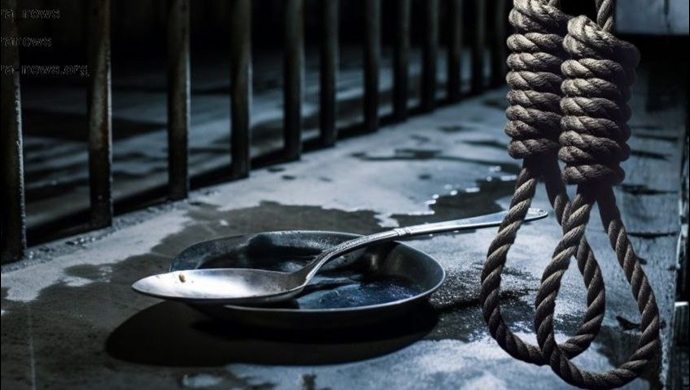

On Sunday, October 19, 2025, the Iranian regime was forced into an unprecedented public retreat. After six days of a mass hunger strike by over 1,500 prisoners in the notorious Ghezel Hesar Prison, many with their lips sewn shut, the clerical regime’s judiciary buckled. Authorities halted pending executions and returned six death-row inmates from solitary confinement. This was not an act of mercy; it was a panicked concession forced by a disciplined, organized protest that exposed the regime’s profound fear of the people’s collective power.
A concession born of pressure, not humanity
The regime’s initial response to the hunger strike, which began on October 13, was predictably brutal. Prison authorities cut off the water supply to the protesting ward, installed signal jammers to prevent news from leaking out, and deliberately withheld medical care from prisoners who were collapsing from weakness. According to sources inside the prison, a prisoner would lose consciousness every few hours due to low blood pressure, yet they were denied transfer to the infirmary. The message was clear: the regime intended to break the strike through cruelty and isolation.
October 18—Ghezel Hesar prison, Karaj, Iran
Sixth day of hunger strike by death-row prisoners, protesting the growing wave of executions in Iran. Despite deteriorating health conditions, prisoners continue their protest movement.#IranProtests pic.twitter.com/MEvWYYUwoi— People's Mojahedin Organization of Iran (PMOI/MEK) (@Mojahedineng) October 18, 2025
But the prisoners’ steadfastness pierced through the prison walls. On October 19, as the strike entered its seventh day, their families took the struggle to the streets of Tehran, gathering in front of the regime’s parliament. Chanting “No to execution” and “Do not execute,” they created a second front of pressure that the regime could not ignore. The repressive State Security Force (SSF) responded with violence, attacking the protesters with batons, but they could not silence them. Faced with an unbreakable protest inside the prison and a defiant one outside, the regime’s wall of oppression began to crack. A delegation of high-level officials, including the head of Tehran province’s prisons, Hayat-ol-Gheib, and a representative of the Judiciary named Asadi, was hastily dispatched to the prison to quell the uprising.
More footage of the protest rally by families of death-row prisoners in front of the Majlis in Tehran.#IranProtests #StopExecutionsInIran pic.twitter.com/DotubduZ2g
— People's Mojahedin Organization of Iran (PMOI/MEK) (@Mojahedineng) October 19, 2025
The regime’s paranoia unmasked
In a moment of telling desperation, the Judiciary’s representative, Asadi, revealed the regime’s deepest anxiety. Attempting to placate the prisoners, he promised a temporary halt to executions for “the next few months.” But he then immediately exposed the regime’s paranoia, stating, “Some believed your strike was organized by the PMOI, but we said that is not the case… But if you continue from now on, we will understand that you are in contact with them. They are liars!”
This clumsy threat is a confession. The clerical regime is so terrified of organized resistance, which it equates with the PMOI, that it sees its influence in every effective and unified protest. The prisoners’ courageous retort laid bare the failure of this intimidation tactic. They shot back: “Change the execution law. Does Iran belong only to you? This law has been wrong from the beginning. You are the liars!” Their defiance proved that the regime’s scaremongering no longer works.
October 18—Ghezel Hesar prison, Karaj, Iran
Death-row prisoners continue their hunger strike for the sixth day, hanging signs that read for an end to executions.#IranProtests #StopExecutionsInIran pic.twitter.com/rgjQdtHJnn— People's Mojahedin Organization of Iran (PMOI/MEK) (@Mojahedineng) October 19, 2025
The power of collective resistance
The prisoners of Ghezel Hesar did not simply end their protest; they made a strategic decision. In their statement, they announced they were ending the strike because their immediate demand—the return of their six comrades—had been met. They then declared their intention to join the ongoing “No to Execution Tuesdays” campaign, transforming their victory into sustained, long-term resistance. They concluded with a stern warning: “if the executions resume, we will restart our protest more intensely.” This demonstrates a level of strategic sophistication that terrifies the regime.
This episode is a powerful affirmation of the path articulated by the Iranian Resistance. As Mrs. Maryam Rajavi, the President-elect of the National Council of Resistance of Iran, stated, “Resistance is the only way forward against the regime of execution and massacre, a regime that will never willingly give up suppression and executions.” The victory at Ghezel Hesar was achieved not by appealing to the conscience of the executioners, but by imposing the will of the people through unity and perseverance.
Salute to the “no to execution” campaign and to the courage and protests of prisoners and their families.
Resistance is the only path forward against a regime built on executions and massacres, a regime that will never abandon repression willingly. Collective persistence and… pic.twitter.com/6Xxzx3VuIj— Maryam Rajavi (@Maryam_Rajavi) October 19, 2025
From Ghezel Hesar to a free Iran
The heroic stand at Ghezel Hesar has transformed a place of death into a national symbol of resistance. The prisoners’ sewn lips and starving bodies spoke louder than any of the regime’s threats. This event provides a clear lesson for the international community: the Iranian regime is not an invulnerable monolith but a hollowed-out dictatorship ruling by fear, and that fear is its greatest weakness. When confronted with organized and unwavering popular resistance, it will break.
This victory is not an end, but a vital milestone on the path to liberating Iran from the grip of tyranny. It is a powerful demonstration of the truth in Mrs. Rajavi’s words: “Collective persistence and protest forced the anti-human regime to take a step back, but the resistance must continue with even greater strength until the end of this regime.”