

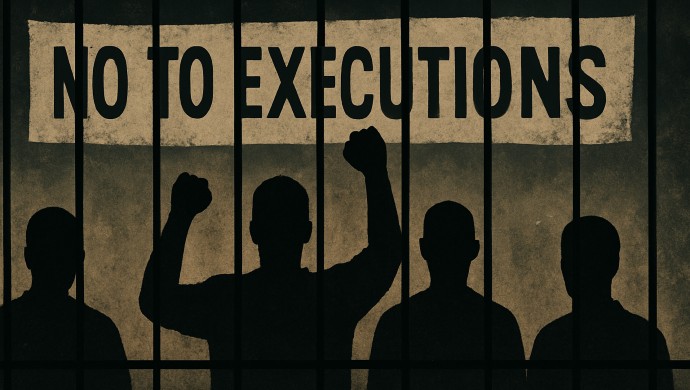

The “No to Executions Tuesdays” campaign, a powerful testament to the ongoing resistance against the Iranian regime’s brutality, has marked its 69th consecutive week with a significant expansion, now encompassing 44 prisons across Iran. This growth underscores the deepening resolve of prisoners and the Iranian people to challenge the theocratic dictatorship’s rampant use of the death penalty and its systemic oppression. The campaign, active since January 2024, has seen detainees courageously organize weekly acts of defiance, including hunger strikes, to protest the regime’s inhumane policies.
Expanding front of internal resistance
In a clear demonstration of its growing strength and reach, the “No to Executions Tuesdays” campaign announced this week that prisoners in Mahabad, Bukan, and Yasuj prisons have joined the coordinated hunger strikes. “With the joining of these three prisons to the strike, the number of prisons participating in the campaign has increased to forty-four,” the campaign’s 69th weekly statement declared.
This expansion is particularly noteworthy as it signifies that the prisoners’ organized protest is not only being sustained but is also inspiring others to join the struggle against the regime’s machinery of death, despite the immense risks involved.
Resistance amidst regime brutality and incompetence
The campaign’s statement powerfully articulates the conditions driving this resistance. “In a situation where the country is facing systematic corruption and the inefficiency of the ruling autocratic structure, and this situation has disrupted citizens’ lives and deprived them of basic needs such as water and electricity,” the statement reads, “the process of issuing and implementing inhumane execution sentences has not only not stopped but has also increased with a clear will from the ruling establishment.” This highlights the regime’s dual failure: its inability to govern effectively and provide for its people, and its reliance on brutal repression to maintain its grip on power.
The regime’s desperation is further evidenced by its refusal to provide accurate statistics on prisoners and executions. However, the campaign reports that “according to reports received by the campaign, since April 21, more than 129 people – including four women – have been executed.” It adds, “In the last week alone, the death sentences of 25 prisoners were carried out, among whom were two child offenders who were hanged in Malayer and Adelabad prisons in Shiraz; an act carried out without any fear of public opinion or international human rights institutions, depriving them of the ‘right to life’.”
Growing public support and a call to action
The “No to Executions Tuesdays” campaign is not an isolated effort confined within prison walls. It is a reflection of, and a catalyst for, broader societal discontent. This was vividly demonstrated during the 69th week, as families of political prisoners, protesting youth, and human rights activists took to the streets and public spaces in over 20 cities across Iran. These cities included Tehran, Arak, Saveh, Kermanshah, Sanandaj, Rasht, Isfahan, Tabriz, and many others.
Participants courageously held placards displaying photos of political prisoners on death row and voiced slogans such as, “Immediate abolition of the death penalty,” and “No to execution,” demanding an end to state-sanctioned killings of protesters, political activists, and oppressed minorities. In Tehran, families of political prisoners specifically held banners reading, “Do not execute our children, support the non-execution of our children. Support ‘No to Execution Tuesdays’,” directly linking their pleas to the ongoing prison campaign.
May 20—Tehran, Iran
In tandem with the 69th week of the "No to Executions Tuesdays" campaign, families of prisoners on death row rally in front of Evin prison to protest death sentences.pic.twitter.com/AgsMoAbvno— People's Mojahedin Organization of Iran (PMOI/MEK) (@Mojahedineng) May 20, 2025
The echoes of this resistance resonated powerfully even from within the regime’s notorious prisons. Simultaneously with the 69th week of “No to Execution Tuesdays” and the nationwide protests, women prisoners in Evin Prison defiantly voiced their support during their yard time. Their chants included, “This is the last message, if you execute, there will be an uprising!” “Neither suppression, nor execution, nor threat has any effect anymore. The execution government does not have a peaceful sleep,” and “The execution government must be destroyed, political prisoners must be freed! Death to the dictator!”
Furthermore, the campaign acknowledges the “widespread solidarity…formed with the ‘No to Executions Tuesdays’ campaign last week, through the initiative of struggling compatriots inside and outside the country.” This growing chorus of support, now visibly amplified by street protests and actions within prisons like Evin, demonstrates a unified front against the regime’s tyranny.
The brave organizers and participants of the campaign issue a direct call to the Iranian people, especially the youth: “We, the members of the campaign, while saluting all supporters of ‘No to Executions,’ call on all people, especially the youth, to raise their voices of protest against this anti-human punishment in every street and alley and to support this movement in every possible way. We invite all opponents of execution to stand by the justice-seeking families and not leave them alone in their protest gatherings.”
This expanding movement, fueled by the courage of prisoners and the unwavering support of the Iranian people demonstrated on the streets and online, sends a clear message: despite the regime’s escalating brutality, the spirit of resistance is alive and growing, demanding an end to executions and the dawn of freedom in Iran.
The prisoners participating in the 69th week of the “No to Executions Tuesdays” hunger strike on Tuesday, May 20, 2025, forming the backbone of this internal resistance, are from: Evin Prison (women’s ward, wards 4 and 8), Qezelhesar (units 3 and 4), Karaj Central Prison, Greater Tehran Prison, Khorin Prison in Varamin, Chobindar Prison in Qazvin, Arak, Khorramabad, Asadabad Prison in Isfahan, Dastgerd Prison in Isfahan, Sheiban Prison in Ahvaz, Sepidar Prison in Ahvaz (men’s and women’s), Nezam Prison in Shiraz, Adelabad Prison in Shiraz (men’s and women’s), Zahedan (women’s), Borazjan, Ramhormoz, Behbahan, Bam, Kahnuj, Tabas, Mashhad, Gonbad-e Kavus, Qaemshahr, Rasht (men’s and women’s), Rudsar, Haviq Prison in Talesh, Azbaram Prison in Lahijan, Dizelabad Prison in Kermanshah, Ardabil, Tabriz, Urmia, Salmas, Khoy, Naqadeh, Miandoab, Saqqez, Baneh, Marivan, Sanandaj, Kamyaran, Mahabad, Bukan, and Yasuj.