

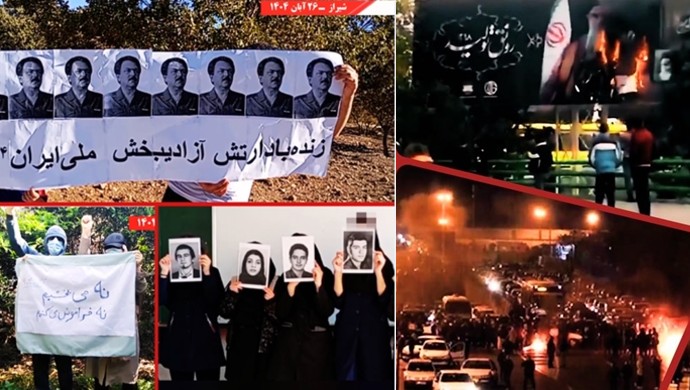

Six years ago this month, the Iranian regime unleashed a wave of brutal violence to crush a nationwide popular uprising, murdering at least 1,500 protesters in what became known as “Bloody Aban,” or the November 2019 uprising. The regime hoped that bullets and bloodshed would extinguish the Iranian people’s demand for freedom. Today, on the sixth anniversary of that massacre, a series of coordinated, nationwide campaigns by the PMOI’s Resistance Units proves that hope was a fatal miscalculation. The spirit of that uprising is not only alive but has grown more organized, strategic, and defiant, signaling an irrevocable confrontation between the Iranian people and the ruling theocracy.
The November 2019 uprising: a turning point of brutality and resistance
The uprising ignited on November 15, 2019, after the government announced a staggering 50–300% hike in gasoline prices. What began as protests over economic hardship quickly transformed into a revolutionary movement. Demonstrations spread across 28 provinces as citizens, fed up with years of corruption and repression, shifted their slogans from economic grievances to openly anti-regime chants targeting Supreme Leader Ali Khamenei.
The regime’s response was swift and merciless. Under a near-total internet blackout, security forces, including the IRGC and Basij, were unleashed on the population. Following Khamenei’s direct order to “do whatever it takes,” they used sniper fire, armored vehicles, and even helicopter-mounted machine guns against protesters, culminating in a horrific massacre in the city of Mahshahr. This brutal crackdown was a strategic inflection point, creating an irrevocable rift between the Iranian society and its rulers. Yet, even then, the leadership and organization of PMOI Resistance Units ensured the drive for change could not be extinguished.
Six campaigns in November prove the uprising’s fire is unquenchable
In November 2025, the Resistance Units have systematically demonstrated that the spirit of 2019 is the guiding force for today’s struggle. In a multi-stage commemorative campaign, they have carried out hundreds of audacious acts of defiance.
The campaign culminated on Monday, November 17, with 60 activities in cities from Tehran and Isfahan to Shiraz, Tabriz, and Zahedan. This followed five previous waves of activity throughout the month.
Shiraz
Flower wreath to commemorate the martyrs of the November 2019 uprising pic.twitter.com/yHTe3wzAcu— People's Mojahedin Organization of Iran (PMOI/MEK) (@Mojahedineng) November 15, 2025
These six waves of activity, carried out under the watchful eyes of the regime’s security apparatus, prove that the November 2019 uprising was an unquenchable fire that cannot be forgotten or extinguished.
A unified message: Iran’s streets articulate a clear strategy for change
More than just acts of defiance, the slogans and messages displayed by the Resistance Units articulate a clear and unified political strategy. Banners raised in Mashhad and Zahedan carried powerful messages: “The November uprising proved that the only way to liberation is ‘fire for fire'” and “The fiery November showed that the uprising and rebellion for overthrow are continuous.”
This is not random graffiti but a conscious political program being written on the walls of Iran’s cities. In Karaj, a slogan declared, “The lessons, experiences, and model of the November 2019 uprising are our guide to action.” These messages affirm that the strategy of Resistance Units, led by defiant youths and women which proved its effectiveness during the 2019 uprising, is now the accepted path forward.
Six years after the regime tried to terrorize a generation into silence, that same generation is now organized, motivated, and leading the charge for a democratic revolution. The fire ignited in November 2019 burns brighter today, fueled by the memory of its martyrs and guided by a clear strategy for liberation. The message from the streets of Iran is unmistakable: the final confrontation is underway, and the people will have the last word.