


Analysis by PMOI/MEK
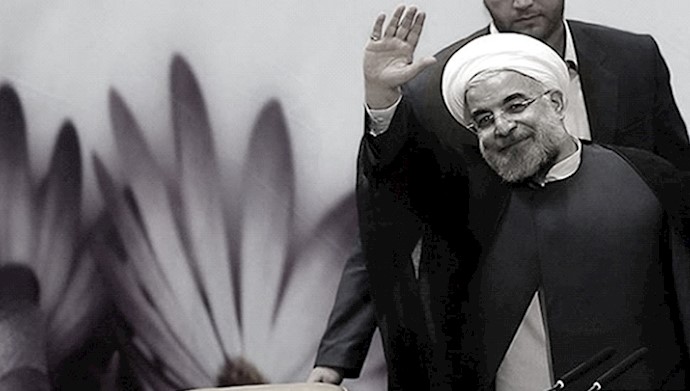
Feb. 2, 2019 – On January 31, Iranian regime president Hassan Rouhani visited the tomb of Islamic Republic founder Ruhollah Khomeini along with his cabinet members and made remarks regarding the upcoming 40th anniversary of the 1979 revolution.
As is his wont, to evade accountability for having achieved nothing in six years of presidency, Rouhani lay the blame for the country’s problems on “foreign enemies” and reiterated his decision to continue the nuclear deal and underlined the need for “unity.”
While stressing the importance of the Joint Comprehensive Plan of Action (JCPOA), as the nuclear deal forged between the Iranian regime and world powers is formally known, Rouhani pointed to the December 2017 protests as the source of the problems of the establishment, which he again linked to foreign enemies. “Some people must not make false interpretations. Presently, our problems are due to pressure from the U.S. We shouldn’t scold the servient government and the great Islamic establishment instead of condemning America. This is the greatest damage. This is the greatest injustice,” Rouhani said.
By shirking all responsibility for the problems of the country and laying the blame on others, Rouhani triggered reactions from officials and media affiliated with both his allies and rivals in the Iranian regime.
Reactions to Rouhani’s remarks
Assadollah Asgaroladi, the head of the Iran-China Chamber of Commerce, said, “[Rouhani’s claims] are completely false. More than 90 percent of the country’s problems are due to the wrong decisions made by economic ministers and government officials.”
Ahmad Zeidabadi, a journalist with ties to the so-called reformist camp, responded to Rouhani’s remarks by saying, “Finding the source of the problems is the job of experts. The president is in a position to solve those problems through practical planning. If he does not or cannot take the necessary measures, he has not fulfilled his duty. As a result, in the final examination, the problems will be the result of the incapacity of him and the people with whom he shares the power.”
In an interview with “Eqtesad 90” website economy analyst Bijan Abdi said, “I’m surprised by the president’s remarks. During the [Iran-Iraq] war, we didn’t have such high inflation rates. It’s evident that mismanagement has a greater role to play in economic grievances than external pressure. I’m surprised that the president is making such remarks. It’s clear that many of the present economic problems are stemming from domestic mismanagement. The problems our economy faces today hvae no precedent, not even during the [Iran-Iraq] war.”
While at the time the nuclear deal was forged, Rouhani claimed that all sanctions on the Iranian regime would be lifted, at Khomeini’s tomb he retraced his steps and claimed the JCPOA was a “moral, legal and political victory.”
During a parliamentary hearing session with Iranian foreign minister Javad Zarif, Ali Adyani, member of the Iranian regime’s parliament, compared the nuclear deal with the Treaty of Turkmenchay, which annexed large parts of Iranian soil to the Russian empire in 1828. Iranians consider Turkmenchay as the epitome of the government betraying the country. “This JCPOA donkey they delivered to us is skittish and kicks around. It doesn’t carry any load and doesn’t let anyone ride it,” Adyani said during the session.
The defeated regime
Iranian officials from both factions are rightly underlining that Rouhani has been defeated in his goals during his 6 years of presidency. But the truth is that defeat is not limited to Rouhani’s government. It is the mullahs’ regime in its entirety and its supreme leader Ali Khamenei that have been defeated and are entangled with a crisis of collapse and dismantlement.
Rouhani’s predecessor, Mahmoud Ahmadinejad, who had the full support of Khamenei, had raked in approximate $1,000 billion in oil sales during his 8 years in power. But he too failed to make any progress and handed over a crisis-riddled government to Rouhani in 2013.
It’s worth noting that all important matters of state, both domestic and foreign, are only decided upon with the approval of the supreme leader. This includes the nuclear deal, which has become a point of tension and a major subject of criticizing Rouhani’s government by officials with close ties to Khamenei.
The failure of Rouhani’s government, like that of his predecessors, is the direct result of two important factors: first, 40 years of repression of the Iranian people and the looting of the country’s wealth by the ruling mullahs, which has driven 96 percent of the Iranian population under the poverty line and has provoked unprecedented social and economic problems; and second, 40 years of resistance and persistence of the Iranian people and their organized opposition movement in not giving in to the tyrannical rule of the mullahs and exposing their regime’s crimes and corruption inside Iran and across the world.
The crises entangling the Iranian people
More than 40 million Iranians lack proper housing. 19 million are living in misery on the margins of urban areas. 3.4 million homes in rural area offer no protection against natural disasters and their owners don’t have the means to rebuild or renovate them. More than one third of schools don’t conform to safety standards and will collapse with the mildest earthquake or are prone to fire incidents due to lack of proper heating equipment. Addiction among youth is expanding. Poverty is expanding. Unemployment is expanding…
This is just a glimpse of the achievements of the mullahs who have been ruling in Iran for 40 years and have been imposing their corrupt practices and ideology on the Iranian people.
Uprisings have brought the Iranian regime to its knees
Undoubtedly, the defeat of Rouhani’s government and the Iranian regime’s deadlock at the cusp of the 40th anniversary of the 1979 revolution is the result of the resistance of the Iranian people and their long-standing opposition movement. Protests that have been expanding to every corner of Iran and comprising every segment of the population make it clear that the mullahs’ rule is coming to its end.
Unfazed by the show of power by the Iranian regime’s security forces and threats by its officials, Iranian resistance units have been paving the way for protests to continue and are preventing the regime from establishing fear and panic among the disenchanted and outraged Iranian population.
Of course, Rouhani did acknowledge that protests are the source of his regime’s problems. He’s just giving the wrong address as to what is causing those protests. At this point, not even his own peers in the mullahs’ regime can justify his ridiculous arguments.