

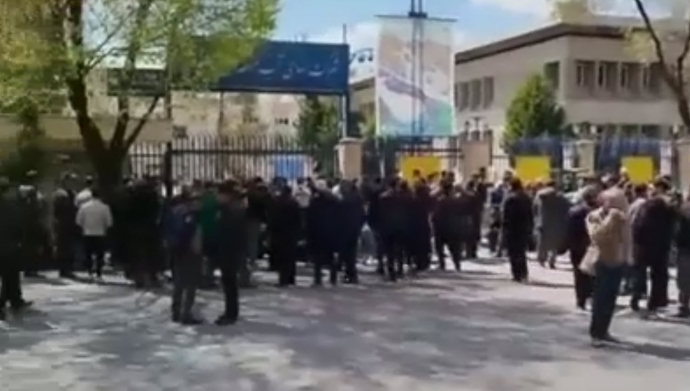

As the Iranian new year begins, cities across the country are witnessing a renewed wave of protests, driven by worsening living conditions, deepening poverty, and institutionalized corruption. On March 25 and 26, protests erupted in several provinces including Isfahan, Kerman, Tehran, and Khuzestan, reflecting widespread discontent with the regime’s oppressive and exploitative policies.
Isfahan farmers protest lack of access to water
In Isfahan, a group of farmers staged a protest in front of the regional water authority, demanding their rightful water shares. Protesters denounced unjust water policies and the mismanagement of resources by regime-affiliated entities. The protest took place as the Zayandeh Rud, the largest river in central Iran, has nearly dried up in large sections due to poor planning, excessive water diversion by state-backed entities, and years of drought.
March 25—Isfahan, central Iran
Protest rally by farmers in front of the water department, demanding access to water for irrigation.#IranProtestspic.twitter.com/FIQC8RsNv7— People's Mojahedin Organization of Iran (PMOI/MEK) (@Mojahedineng) March 25, 2025
One farmer voiced his outrage: “Nothing can stop us anymore. We are only asking for our rights — we just want water. It’s outrageous that our water has been stolen and diverted, and now they tell us not to protest! How can we remain silent in the face of this injustice? We are alive — not dead!”
Another added:
“They have stolen our rights and hidden them in pipelines, and now they want us to sit at home and die quietly! But we will not surrender. We will defend our rights, even if it costs us our lives.”
Farmers warned that continuing this situation would endanger both their livelihoods and the region’s food security.
Workers protest unpaid wages and protests against executions
In Khatunabad (Kerman Province), workers protested the non-payment of their salaries for the past two months. In Tehran, families of political prisoners sentenced to death gathered outside Evin Prison as part of the “No to Executions Tuesdays” campaign. In Haft-Tappeh, sugarcane workers took to the streets after being laid off without compensation due to the introduction of new machinery.
March 25—Tehran, Iran
Families of political prisoners rally in front of Evin prison in tandem with the 61st week of the "No to Executions Tuesdays" campaign, protesting death sentences for their loved ones.#IranProtestspic.twitter.com/6pCdMOqjUk— People's Mojahedin Organization of Iran (PMOI/MEK) (@Mojahedineng) March 25, 2025
Currency collapses while the regime funds repression and foreign interventions
These protests come amid a historic collapse of Iran’s national currency, as the US dollar surpassed 103,000 tomans in the free market. This has triggered an unprecedented rise in prices for basic goods and services, deepening the crisis for ordinary Iranians.
The economic catastrophe is not merely a result of sanctions, but rather a direct outcome of regime policies that prioritize financing proxy militias and regional interventions over citizens’ needs. While millions suffer from poverty, unemployment, and hunger, the regime continues to funnel billions into its terrorist apparatus and expansionist agenda in Lebanon, Syria, Iraq, and Yemen.
March 26—Shush, southwest Iran
Workers of Haft-Tappeh Sugarcane Company rally to protest lack of job security.#IranProtestspic.twitter.com/pLRCxAQ3DK— People's Mojahedin Organization of Iran (PMOI/MEK) (@Mojahedineng) March 26, 2025
Signs of a coming uprising
All indicators point to Iran standing on the edge of another popular uprising. The people are hungry. The economy is in freefall. The regime is corrupt and unaccountable. And repression grows by the day. Without meaningful and immediate change, the new year may usher in a national revolt, driven by a people who have nothing left to lose.