

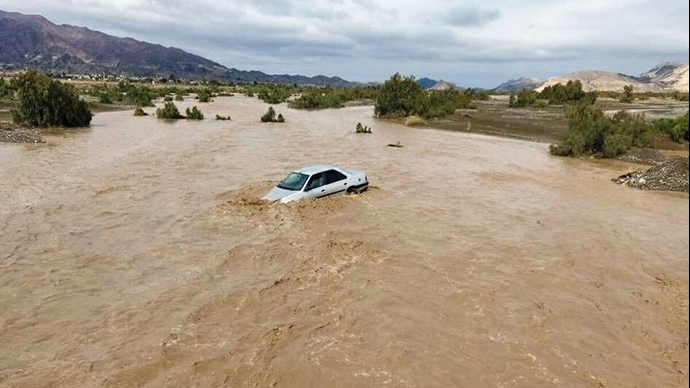

At the start of the new Persian calendar year, flooding in the provinces of Isfahan, Ilam, Bushehr, Chaharmahal and Bakhtiari, Khuzestan, Fars, Qazvin, Lorestan, Kermanshah, Gilan, and Kohgiluyeh and Boyer-Ahmad, along with landslides in various regions, caused significant damage to the people.
Flooding is a hydrologic event resulting from the complex interaction of climatic, geographic, and human factors. In spring, increased rainfall and snowmelt naturally raise the water volume entering river systems. When the soil’s absorption capacity, vegetation cover, and natural and artificial infrastructures are exceeded, the excess water turns into floodwaters that overflow from main channels into plains, riverbanks, and eventually residential and agricultural areas. This process is not only unsurprising but can be predicted and managed through climate data analysis.
In the past three days, the overflow of rivers and flooding in rivers such as Chol Hul in Mamulan (Lorestan), Polasjan (Isfahan), Sar Firouzabad (Kermanshah), Polrud (Gilan), and Helilan (Ilam) led to road blockages in multiple villages and disrupted drinking water pipelines. At the same time, the head of the Forests Organization of Iran’s regime stated that more than 45% of the country’s area—meaning 650 cities and 8,500 villages—are at risk of flooding.
The regime’s criminal negligence and inaction in preventing floods—despite prior warnings—led to landslides and the closure of 200 rural roads on Saturday in the cities of Siahkal and Rudsar in Gilan Province.
The scandal and disgrace of regime officials’ inaction in the face of floods, landslides, and the destruction of people’s homes became so apparent that on Monday, March 24, 2025, Tasnim News Agency, affiliated with the IRGC Quds Force, in an attempt to downplay the Revolutionary Guards’ role in the “environmental massacre,” wrote under the headline “An Old Wound Reopened”: “Six years have passed since the 2019 floods, yet every heavy rainfall takes Lorestan back to square one. Bridges collapse, roads are broken, villages become isolated, and promises are lost in the mud. The 2019 flood experience was supposed to be a starting point for resilience-building, but the first rainfall test in March 2025 has once again exposed the same old weaknesses. Every time it rains, the truth becomes clear: nothing has changed—only the same destruction repeats.”
The news agency entirely ignores the fact that what was exposed during the devastating 2019 floods was the criminal and plundering role of the IRGC, which, through reckless and profiteering construction in floodplains and the destruction of natural resources (forests, rangelands, etc.), directly contributed to the flood disaster.
In March 2019, in Shiraz, a 10-minute downpour turned people’s New Year celebrations into mourning because the IRGC had built a road in a natural floodpath near Qur’an Gate, carried out construction there, and sold the land at astronomical prices. As a result, dozens of our compatriots became flood victims in broad daylight and in full view of the public.
Although the plunderers and officials of the clerical regime attempt to portray flooding as a natural, unavoidable, and uncontrollable phenomenon, scientific and practical evidence shows that such events are not only predictable but that their destructive impacts can be greatly reduced through planning, investment in infrastructure, and natural resource management. Restoring forests, upgrading hydrological infrastructure, and strengthening forecasting and early-warning capacities can easily prevent widespread damage in the future.
In other words, while floods are natural disasters, the real force behind the destruction and devastation is not nature’s hand, but the wicked hands of the mullahs’ regime and the looting IRGC—whose only purpose is destruction, devastation, and suppression.