

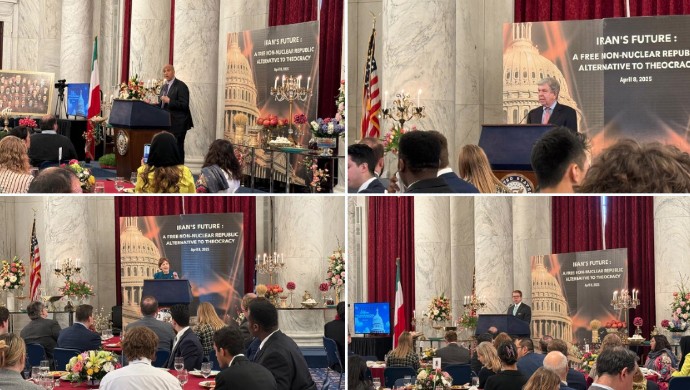

A formidable coalition of senior U.S. lawmakers, distinguished diplomats, military leaders, and national security experts convened in the U.S. Senate on April 8 for a policy luncheon focused on Iran. The event delivered a clear, bipartisan message of support for the Iranian people’s struggle against dictatorship and underscored the pivotal role of the organized Iranian Resistance movement, primarily the National Council of Resistance of Iran (NCRI).
The gathering marked the formal announcement of Senate Resolution 145. Introduced by Senator Thom Tillis (R-NC) and Senator Jeanne Shaheen (D-NH) with 14 original co-sponsors, the resolution calls for the protection of residents at Ashraf 3, the headquarters of the Iranian Resistance in Albania, and recognizes their right to political expression and activism against the Iranian regime.
Setting the tone for the discussion, Mrs. Maryam Rajavi, President-elect of the NCRI, addressed the conference via video message. She expressed gratitude to the resolution’s sponsors and sharply contrasted prevailing policy approaches towards Iran. Mrs. Rajavi dismissed appeasement and hopes for internal reform as “a failed policy,” advocating instead for a strategy centered on empowering the Iranian people and its organized Resistance. “There is a correct strategy that can bring an end to the threats and existence of this regime, by relying on the Iranian people and the Resistance,” she asserted. She highlighted the active role of Resistance Units affiliated with the People’s Mojahedin Organization of Iran (PMOI/MEK) within the country, stating, “This strategy is put into action by a resistance that has fighting forces on the ground—young people who are dedicated, organized, and led by the MEK.”
Message to the Conference at the U.S. Senate to announce resolution 145
A Decisive Political Strategy Relying on the People of Iran and the Iranian Resistance#FreeIran10PointPlan pic.twitter.com/9MFl8lssJF— Maryam Rajavi (@Maryam_Rajavi) April 8, 2025
Mrs. Rajavi also directly addressed disinformation campaigns aimed at delegitimizing the opposition, stating, “The regime spreads the false notion that there is no alternative… But it is this very force that has confronted the IRGC on the ground for 46 years.”
Crucially, she emphasized the Resistance’s self-reliance: “We do not seek money, weapons, or foreign troops. What the people of Iran expect from the international community is recognition of their right to resist.” She concluded with a direct appeal for U.S. legislative action recognizing the Resistance Units’ right to confront the Islamic Revolutionary Guard Corps (IRGC).
The event, moderated by Ambassador Marc Ginsberg, former U.S. Ambassador to Morocco, emphasized the urgency of the situation. “Behind the facade of this Iranian theo-military dictatorship lies a decaying Potemkin village, teetering on a threshold of free fall,” Amb. Ginsberg stated, calling for a new strategy “led by democratic forces from within, championed by the Iranian democratic forces of resistance led by the NCRI.” He also reminded attendees of the regime’s reach, referencing its foiled terrorist plot targeting the NCRI’s large international gathering in Paris in 2018.
Bipartisan leaders came together at today’s Senate Event “IRAN POLICY: Countering Tehran’s War and Terror”
Speakers included @Maryam_Rajavi @CoryBooker @RoyBlunt @SenatorShaheen @LBJunior and General James Jones ⬇️ pic.twitter.com/fK7rVOmJOJ
— OIAC: Organization of Iranian American Communities (@OrgIAC) April 8, 2025
Bipartisan legislative support was a central theme. Senator Jeanne Shaheen, Chair of the Senate Foreign Relations Democratic Caucus, reaffirmed commitment to the cause. “We are introducing a bipartisan resolution again this year, recognizing the people of Ashraf 3 Camp in Albania,” she said, praising their resilience: “Your bravery and courage in the face of all of these challenges has never faltered.”
Senator Cory Booker (D-NJ) delivered a powerful moral appeal: “This is one of those issues that’s not right or left—it’s right or wrong. The bravery of Iranian people who stand for justice, who’ve suffered torture and imprisonment, should be inspiring all of us.” He expressed confidence in a future democratic Iran.
Senator Roy Blunt (R-MO) stressed the importance of internal dynamics. “What’s even more important is what we can do to encourage protests in Iran,” he remarked, noting the country’s young demographic. He endorsed Mrs. Rajavi’s platform for a future Iran: “The Ten-Point Plan by Mrs. Rajavi is exactly the kind of future [Iran’s people] deserve.”
Support from the military and national security community was equally robust. General James Jones, former U.S. National Security Advisor and NATO Supreme Allied Commander, unequivocally endorsed the NCRI. “The NCRI represents the most organized, long-standing, and principled opposition to the clerical regime,” he stated, praising their four-decade struggle and their internal networks. “They have built extensive networks within Iran through Resistance Units that coordinate protests and actions against the regime and act as an engine for change… They have repeatedly provided accurate intelligence on Iran’s nuclear program and terrorist activities.” General Jones described Mrs. Rajavi’s Ten-Point Plan as “a concrete roadmap for transitioning from theocracy to democracy,” concluding, “Supporting the Iranian people and their organized Resistance… aligns perfectly with America’s strategic interest.”
Ambassador Lincoln Bloomfield, former Assistant Secretary of State, countered decades of misinformation targeting the Resistance. “Every malignant narrative and allegation against the resistance has been fully investigated and researched, and all are false,” he said, calling for formal U.S. recognition of the movement’s legitimacy. “Anyone in 2025 who says the NCRI has no relevance to the future of Iran is either entirely ignorant… or is willfully aiding and abetting the clerical dictatorship.”
Throughout the luncheon, speakers consistently condemned the Iranian regime’s oppressive actions against its citizens and its destructive role in regional instability and global terrorism. The consensus emerging from the event was a strong, bipartisan call for a fundamental shift in U.S. policy – one that actively supports the Iranian people’s aspirations for freedom and recognizes their organized Resistance, embodied by the NCRI and its Ten-Point Plan, as the viable democratic alternative to the current theocracy.