

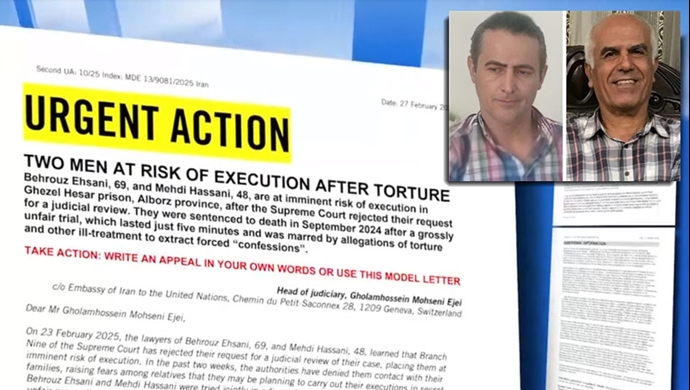

Amnesty International has sounded the alarm over the imminent execution of two Iranian political prisoners, Behrouz Ehsani, 69, and Mehdi Hassani, 48, who were sentenced to death after a grossly unfair trial. The Supreme Court of Iran’s regime recently rejected their request for a judicial review, paving the way for their execution at Ghezel Hesar Prison in Alborz province. Their case has drawn widespread condemnation due to allegations of torture, forced confessions, and violations of due process.
A Sham Trial and Systematic Abuse
Ehsani and Hassani were convicted in September 2024 after a trial that lasted only five minutes, Amnesty International warns in its latest statement. They were found guilty of “armed rebellion against the state” (baghi), “enmity against God” (moharebeh), and “corruption on earth” (efsad-e fel-arz) due to their alleged ties to the People’s Mojahedin Organization of Iran (PMOI/MEK).
“According to an informed source, for six months following arrest, agents held Mehdi Hassani in solitary confinement and forced him to write self-incriminating statements under torture and other ill-treatment, including beatings and threats to harm his family,” Amnesty International wrote in the statement.
According to Amnesty International, Mehdi Hassani, was forced to write false confessions while enduring torture. Ehsani faced similar conditions. He was held in solitary confinement for 50 days and subjected to severe pressure to confess. Authorities reportedly threatened him with flogging, execution, and harm to his family. His refusal to comply led to further mistreatment and prolonged detention under dire conditions.
Secret Executions and Denial of Contact with Families
Family members of both men have been kept in the dark regarding their fate. Authorities have denied them visits and phone calls in recent weeks, raising fears that their executions may be carried out in secret. The sudden transfer of Ehsani and Hassani from Evin Prison to Ghezel Hesar—where executions take place—has further heightened concerns.
“I urge you to immediately halt any plans to execute Behrouz Ehsani and Mehdi Hassani, quash their convictions and sentences, and release them as their detention is arbitrary due to severely grave violations of their fair trial rights,” the organization stated in an appeal to the Iranian regime’s judiciary.
The statement also called for urgent reforms: “I further urge you to grant them immediate access to their families, independently chosen lawyers, and to any adequate medical care they may need; and protect them from further torture and other ill-treatment.”
Growing Resistance Against Executions
Despite the severe repression, political prisoners and human rights activists in Iran continue to resist the government’s execution policies. Ehsani and Hassani have participated in the “No to Execution Tuesdays” hunger strike movement, which began in early 2024. Every Tuesday, prisoners across Iran refuse food in protest against the country’s increasing use of capital punishment.
In a letter smuggled out of prison and published online, Ehsani condemned the systematic executions in Iran and called for international intervention:
“After 22 months of uncertainty, they [the authorities] have now issued a death sentence against me without any evidence. We expect nothing else from this execution-driven system… In addition to political prisoners, ordinary prisoners are executed every day… who are the defenseless victims of this system and its conditions.”
His letter continues: “We will continue these hunger strikes every Tuesday as long as executions continue to take place. I call on my dear compatriots, international organizations, and human rights institutions to take action against executions in Iran today because tomorrow will be too late.”
A Widening Crackdown and Surge in Executions
Iran’s regime has faced growing international scrutiny for its increasing use of the death penalty, particularly in the wake of the 2022 nationwide protests. According to Amnesty International, Iran executed at least 853 people in 2023, marking a 48% increase from the previous year. Many of these executions were carried out after unfair trials before Revolutionary Courts, which are notorious for their lack of independence and due process violations.
“In 2024, the authorities continued their execution spree, including against protesters, dissidents, and ethnic minorities, again executing hundreds of people, many arbitrarily after grossly unfair trials,” Amnesty International reported.
According to the information sources of the Iranian Resistance, the regime carried out more than 1,000 executions in 2024, even exceeding the previous year.
With the execution of Ehsani and Hassani imminent, activists are urging the international community to act before it is too late.
Ehsani’s plea in his letter serves as a stark reminder of the stakes: “People who seek freedom and democracy do not deserve execution. The silence of the international community emboldens this regime to carry out its executions.”
Human rights defenders are urging governments, international bodies, and civil society organizations to take a stand. The coming days will be critical in determining whether global pressure can prevent another act of state-sanctioned injustice in Iran.