

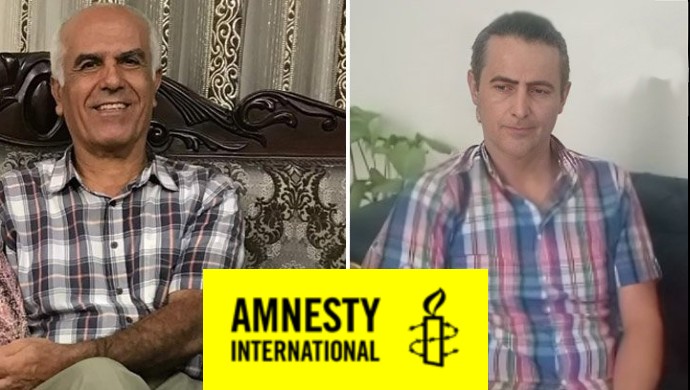

Two Iranian political prisoners, Behrouz Ehsani (69) and Mehdi Hassani (48), face imminent execution following the upholding of their death sentences by the Iranian regime’s Supreme Court. Their forced transfer on January 26, 2025, from Evin to Ghezel Hesar prison—commonly used for executions—has heightened concerns about their fate. Amnesty International has urgently called on the Iranian regime to halt the executions and address allegations of torture and grossly unfair trials.
The death sentences for Ehsani and Hassani were initially issued on September 16, 2024, by the criminal judge Iman Afshari, head of Branch 26 of the regime’s so-called “Revolutionary Court” in Tehran. The charges included “rebellion against the state, enmity against God, spreading corruption on earth, membership in the People’s Mojahedin Organization of Iran (PMOI/MEK), collecting classified information, conspiracy against national security, and illegal possession of firearms and ammunition.” These sentences were later upheld on January 7, 2025, by the mullahs’ regime’s Supreme Court.
The trial was plagued by due process violations, including denial of legal representation during the investigation phase, prolonged solitary confinement, and the use of forced confessions extracted under torture. Amnesty International reported, “They were tried jointly in a five-minute trial session on 10 August 2024 in grossly unfair proceedings before Branch 26 of the Revolutionary Court in Tehran. Their torture allegations were not investigated.”
Amnesty International also quoted a letter by Behrouz Ehsani from prison: “After 22 months of uncertainty, they [the authorities] have now issued a death sentence against me without any evidence. We expect nothing else from this execution-driven system… People who seek freedom and democracy do not deserve execution. The silence of the international community emboldens this regime to carry out its executions.”
Amnesty International has called on global citizens and human rights defenders to pressure Iranian regime authorities to halt the executions, quash the prisoners’ sentences, and implement a moratorium on the death penalty. Both men have joined a broader resistance movement in Iran, including hunger strikes under the “No to Executions Tuesday” campaign, underscoring the growing desperation to combat state-sanctioned killings.
The use of the death penalty in Iran has escalated significantly in the past year. Amnesty International reports, “In 2023, Amnesty International recorded the executions of at least 853 people by the Iranian authorities, marking a 48% increase from 2022.” Revolutionary Courts, which are criticized for their lack of independence, continue to hand down arbitrary death sentences, primarily targeting dissidents, protesters, and ethnic minorities.
The international community must act now to protect the lives of Behrouz Ehsani and Mehdi Hassani, ensuring justice and accountability prevail over the cycle of repression and executions in Iran.