

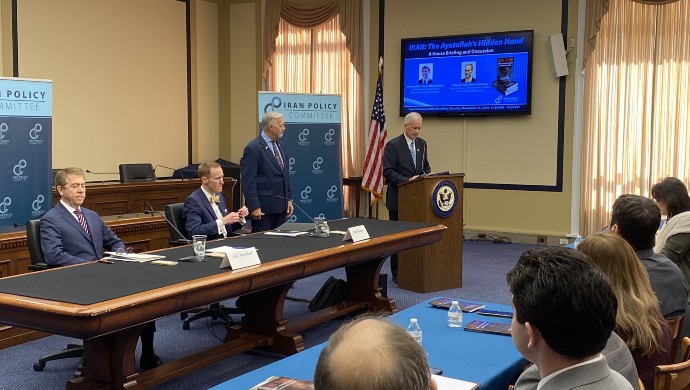

On Tuesday, November 14, a briefing session was held by a group of members of the House of Representatives in the United States Congress. The subject of this session was the demonization campaign against the Iranian Resistance, including its history, dimensions, and objectives. During this session, the book Iran: The Ayatollah’s Hidden Hand, written by Professor Ivan Sascha Sheehan, was introduced. This book explores the regime’s covert activities aimed at striking at its main opposition.
At the beginning of the session, Tom McClintock, a member of the House Judiciary Committee, in response to the reason behind such a volume of demonization against the Iranian Resistance, stated: “It’s important that we understand how the Iranian dictatorship has been able to manipulate the media, how it has insinuated itself into academia, and how it has ingratiated itself with governments that frankly ought to know better.
“We know the effectiveness of the National Council of Resistance because of the Iranian disinformation campaign that’s been turned against it. In order to counter efforts to undermine the Iranian freedom movement, we must first understand their tactics, and that’s the purpose of today’s panel.”
Regarding the dimensions of demonization and the appeasement policy’s efforts to provide assistance to religious fascism Professor Sasha Sheehan, Deputy Dean of the School of Public Relations at the University of Baltimore and author of the book Iran: The Ayatollah’s Hidden Hand, said: ” In a prior study, actually one carried out by Professor Raymond Tanter, the late Professor Raymond Tanter, of state-run media sources determined that the PMOI and the NCRI are discussed by regime officials four times as often as all other dissident organizations combined.”
Professor Sheehan, referring to the four-decade massive deception campaign, considered the appeasement policy as one of the factors for the advancement and infiltration of the Iranian regime’s agents into official organs of the United States. He said, ” The regime’s use of assets and agents, some of whom have infiltrated the U.S. government, has been given comparatively less attention. As a scholar, I’ve tried to do what the legislative and executive branches of government have failed to do. And the media has not done so. And that is to connect the dots. I suspect that what we are revealing today in this book is just the tip of the iceberg. ”
Ambassador Lincoln Bloomfield, former Assistant Secretary of State for Political-Military Affairs, attributed the root of demonization and propaganda by the regime against the PMOI to the historical resilience of the PMOI in standing against the regime and not yielding to the demands and pressures of the mullahs and their attempts to compromise their principles.
Regarding the goals of the demonization efforts against the PMOI, Ambassador Bloomfield added: “Not only has the regime in Tehran maintained a wall of falsehoods and propaganda for over 40 years, backed by harsh repression to keep their own people in check, they’ve invested heavily in resources, in foreign capitals, to try to shape the message in other places, not least of which is Washington, D.C. So, they’ve done this.”
US House Representative Randy Weber also emphasized the urgency of addressing the threat posed by the Iranian regime and its influence in Europe and the US. Representative Weber criticizes the State Department for being too soft on the regime, advocating for a shift in focus toward opposition parties like the PMOI. He argued against remaining stuck in a time warp of 1979, emphasizing the need to recognize the evolving geopolitical landscape. Weber contended that Tehran manipulates tensions with opposition parties to maintain power.