

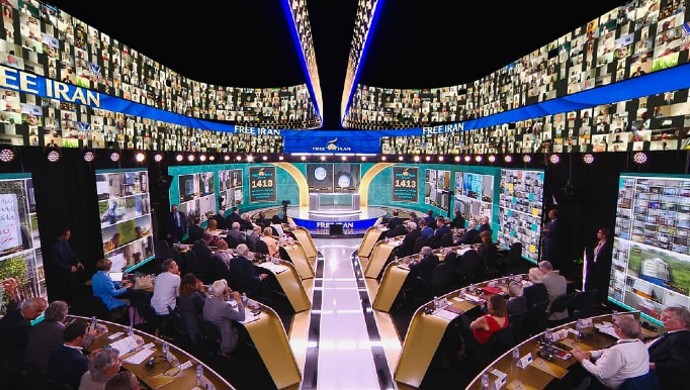

At a conference held in the European Parliament in Brussels on November 20, Mrs. Maryam Rajavi, the President-elect of the National Council of Resistance of Iran (NCRI), outlined the process of power transfer following the regime’s collapse.
She stated: “Regarding the future of Iran, I have consistently emphasized that our goal is not to seize power but to restore it to its rightful owners—the people of Iran and their vote. According to the NCRI platform, the process for transferring power after the regime’s overthrow consists of the following steps:
“a) The establishment of a provisional government, which will be in power for a maximum of six months. The primary responsibility of this government will be to organize elections for a Constituent Assembly.
“b) Once the Constituent Assembly is formed, the provisional government will step down, marking the completion of the NCRI’s mission.
“c) Sovereignty will then be transferred to the people’s representatives in the Constituent Assembly, who will form a new government for a two-year term, tasked with drafting, approving, and conducting a referendum on the constitution of the new republic.”
Maryam Rajavi has frequently addressed the topics of alternatives and regime overthrow, which are pivotal political challenges for any revolution. Notably, at the grand Resistance gathering on June 30, 2018, in Villepinte, Paris, she emphasized fundamental points.
Recalling some parts of that speech from five years ago can be enlightening. She said:
“These days, an industry of concocting phony alternatives has become prevalent in the political arena, of course copying and pasting aspects from others. And this in itself is another sign of the phase of the regime’s overthrow. But the crux of the matter is how they are going to actually bring down this regime in practice. This question is especially relevant as the blood of the martyrs has permanently and historically blocked the path to reform within the clerical regime and the return of the monarchy.
“Now, if one can topple this regime without an organization and leadership, without overcoming thorny trials, and without paying the price and making sacrifices, we say: Please, go ahead, don’t delay.
“If one can restore the people’s sovereignty without a history of fighting against two regimes, without drawing boundaries against dictatorship, subordination and dependency, without waging a nationwide resistance and offering a galaxy of martyrs, without challenging the principle of the velayat-e faqih and phony regime ‘moderates,’ we say: Please, go ahead, don’t delay.
“If one can topple the mullahs without challenging Khomeini over the unpatriotic Iran-Iraq war, forcing an end to the inferno of that war, and discrediting the regime’s slogan of ‘liberating Qods via Karbala’; without compelling Khomeini to accept the ceasefire by launching 100 military operations by the National Liberation Army of Iran, which captured the city of Mehran and marched to the gates of Kermanshah; and without exposing the regime’s nuclear weapons, missile, chemical and microbiological programs and facilities, yes, go ahead and don’t delay.
“If one can leap frog a fifty-year history overnight and create real change in Iran while dreaming about foreign support, and without having to expose the regime’s human rights abuses and crimes in 64 UN resolutions, without the campaign for justice for the massacre of political prisoners in 1988, without campaigns by supporters of the resistance worldwide and insisting on the rights of the Iranian nation for four decades, without having a specific platform and programs of the NCRI and the Provisional Government for the transition of sovereignty to the Iranian people, and finally without a tested leader, who has guided this ferocious struggle for five decades, if all this could instead be done overnight, we say: go ahead, the ball is in your court.
“Nevertheless, as Massoud Rajavi said in the context of evaluating the January uprising: ‘We are not in competition with anyone seeking to assume power. On the other hand and most certainly, no one can compete with the PMOI when it comes to practicing honesty, sacrifice and paying the price.’”
Mrs. Rajavi elaborated on the plans and proposals of the democratic alternative, stating: “We call for the establishment of a society based on freedom, democracy, and equality, which has clear demarcation lines against despotism and dependence as well as gender, ethnic and class discrimination. We have defended and will continue to defend gender equality, the right to freely choose one’s attire, separation of religion and state, autonomy of nationalities, equal political and social rights for all citizens of Iran, abolition of the death penalty, freedom of expression, parties, the media, assembly, unions, associations, councils and syndicates.”
This is the image of the democratic alternative, which rejects the mullahs’ rule or any form of dictatorship.