

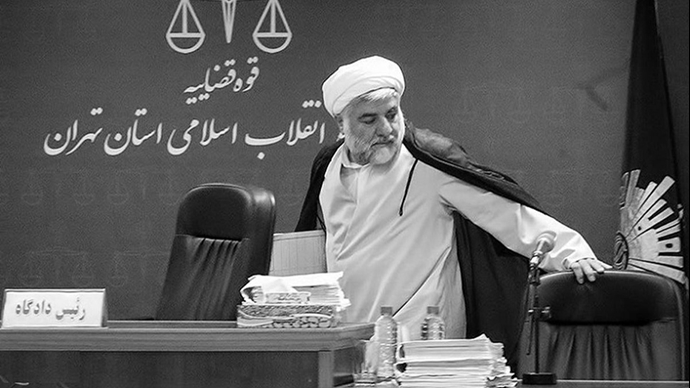

Mohammad Moghiseh, a notorious judge of the mullahs’ regime in Iran, was killed in his office on Saturday, January 18 2025. Moghiseh, known by the alias “Naserian,” was one of the key perpetrators of the 1988 massacre of more than 30,000 political prisoners—a personification of state-organized crime representing the mullahs’ regime and its founder Ruhollah Khomeini.
From a Rural Seminary Student to Interrogator in Evin Prison
Mohammad Moghiseh was born in a village near Sabzevar. Before the establishment of the clerical regime, he had no political background. Following the overthrow of the shah dictatorship, he quickly integrated into the new power structure. In the early 1980s, he began his career as an interrogator and torturer in Ward 3 of Evin Prison, soon becoming a key figure in suppressing regime opponents.
During the 1980s, Moghiseh served as a supervising deputy prosecutor in various prisons, including Ghezel Hesar and Gohardasht. During this period, he oversaw the torture and repression of prisoners, actively participating in the physical and psychological torture of political detainees.
The 1988 Massacre: The Darkest Chapter of Moghiseh’s Record
Mohammad Moghiseh was a primary executioner during the summer of 1988 mass executions. These atrocities were carried out based on Khomeini’s fatwa against political prisoners, particularly members and supporters of the People’s Mojahedin Organization of Iran (PMOI/MEK). With unparalleled cruelty, he issued execution orders for hundreds of prisoners.
During his temporary tenure as the head of Gohardasht Prison, he insisted that not a single PMOI supporter should survive. Throughout this period, he relentlessly expedited the hanging of prisoners.
He even sent ill prisoners to the gallows. Among them were Nasser Mansouri, a paraplegic inmate, and Mohsen Mohammad Bagher, who was born paralyzed in both legs.
Promotion at the Cost of Bloodshed
Mohammad Moghiseh, despite having no legal background or expertise, was rewarded for his loyalty to the regime’s repressive apparatus with the presidency of Branch 28 of Tehran’s Revolutionary Court. In this position, he continued issuing harsh and unjust death sentences and exerting pressure on political prisoners. In November 2020, he was transferred to the Supreme Court of Iran.
Moghiseh’s role in widespread human rights violations made him one of the most reviled judicial figures on the international stage. In 2011, the European Union sanctioned him along with 31 other Iranian officials for widespread human rights violations, banning him from entering EU member states.
A Historical Testimony
The late poet and writer Hamid Asadian wrote in one of his notes about Mohammad Moghiseh:
“From the very first days of the dark 1988 massacre, I became acquainted with two categories of new names that were unfamiliar to me. On one hand, there were the heroic martyrs who bravely stood, kissed the gallows, and made us proud. On the other hand, there were the murderers who stained their hands with the blood of this land’s finest children, exhibiting boundless cruelty and unmatched savagery. Identifying these killers was as significant to me—and to anyone aware of the clerical regime’s dark genocide—as discovering the name or grave of an unknown martyr.
“Some, like Nayyeri, Raisi, and Ejei, were already known and became more infamous over time. Yet, there are executioners whose names we have only heard, whose crimes we know of to some extent, but who, with utter treachery, have hidden their faces. These individuals, like Nazi war criminals, must be tried in an open international court.”
He adds:
“One of these criminals, particularly notorious among all political prisoners from the 1980s to 1988 and beyond, is Mohammad Moghiseh (alias Naserian), a criminal cleric whose crimes and savagery warrant an extensive book that must surely be written. In the early 1980s, under the name Haj Naser, he served as the head of Ward 3 at Evin Prison and was highly active in torturing and killing PMOI members and other dissidents. Specifically, during the 1988 massacre at Gohardasht Prison in Karaj, he clearly displayed his vile nature and that of Khomeini.
“He is known to have played a very active role in sending prisoners to the gallows, as attested by survivors. It has been reported that even when prisoners were hanging from the noose, he would grab their legs and pull them downward to hasten their suffocation. Only God knows what the prisoners endured in such moments. In subsequent years, as a judge in the regime’s so-called courts, he issued numerous death sentences against PMOI members and even non-PMOI individuals—and he continues to do so to this day.”