


December 8, 2024 marked the overthrow of Syrian dictator Bashar al-Assad and the end of half a century of rule by him and his father, Hafez al-Assad. This is arguably one of the most significant days in the modern history of the Middle East.
Bashar al-Assad, with the support of the Iranian regime, suppressed the Syrian people’s protests and demands for freedom through brutal repression, leading to the death of half a million people and the displacement of millions. Ultimately, it was the Syrian fighters and the widespread protests of the people that toppled Bashar al-Assad’s authoritarian regime.
The world knows that Assad’s regime was effectively finished eight years ago. However, it was the Iranian regime who kept the Syrian dictator in power by deploying the terrorist Qassem Soleimani and IRGC Quds Force troops to Syria and spending at least $50 billion stolen from the Iranian people’s resources and their livelihoods.
Thus, the fall of Assad’s regime represents the collapse of the main pillar of the Iranian regime’s strategic depth and lays the groundwork for the inevitable overthrow of the Iranian regime. This reality is so evident that even state media and analysts acknowledge it, writing, “What Iran had woven in Syria over the past years unraveled with the victory of Bashar al-Assad’s opposition” (Setareh Sobh – December 8). A week earlier, they anxiously predicted, “The chain of surprising events in the Middle East, which has now reached Syria, will not stop here. Its scope will soon extend to Iraq (and Iran)” (Rouydad 24 – November 30).
The fall of Bashar al-Assad is strategically part of the process leading to the overthrow of the religious fascism ruling Iran. This strategic reality was evident on the ground in the actions of Syrian fighters and the widespread protests of the people. During the capture of Aleppo, the Iranian regime’s consulate was among the first targets of public anger and was destroyed. In Damascus, Syria’s capital, before the rebel fighters even entered the city, people had already stormed and destroyed Assad’s palace—symbolizing five decades of the Assad family’s rule—and the Iranian regime’s embassy, a symbol of the clerical regime that had occupied and devastated their country for the past two decades.
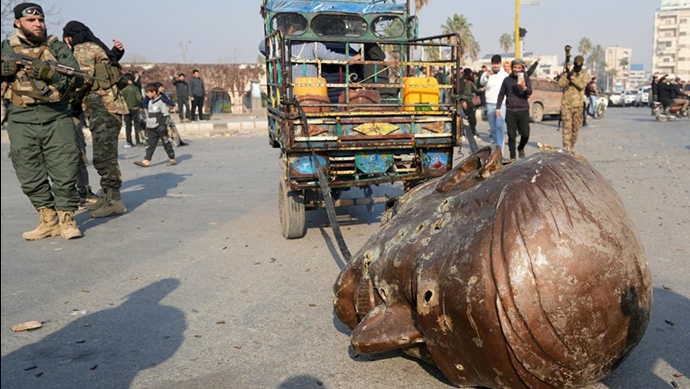
Alongside the destruction of the Iranian regime’s embassy, people tore down and destroyed large portraits of Qassem Soleimani and Hassan Nasrallah that had been displayed on the embassy’s facade. Similarly, they toppled statues of Hafez al-Assad, the former Syrian dictator responsible for atrocities including the massacre of 50,000 people in Hama in 1982. These statues were dragged through the streets and ultimately destroyed, demonstrating that dictators inevitably meet the fate of being tossed into the trash bin of history.
Syrian fighters and protesters smashed the dictator’s prisons in every city they captured, liberating the prisoners. This suggests that the day is not far when the prisons of the Iranian regime, such as Evin in Tehran, Adelabad in Shiraz, Dizelabad in Kermanshah, Vakilabad in Mashhad, and Sepidar in Ahvaz, will be opened one by one by the heroic people and freedom fighters of Iran.
Thus, in addition of the Syrian people, the fall of Bashar al-Assad and the liberation is a cause to celebrate for the Iranian people, freedom fighters, and the bereaved families of over 120,000 martyrs of Iran’s struggle for freedom. Just as the Shah’s powerful military and feared SAVAK police could not save him, and as the heavily armed military and ruthless enforcers of the Syrian dictator failed to preserve his regime, Iran’s security and military forces will also be unable to prevent the downfall of the mullahs’ regime. Its fate will mirror that of other overthrown dictators.