

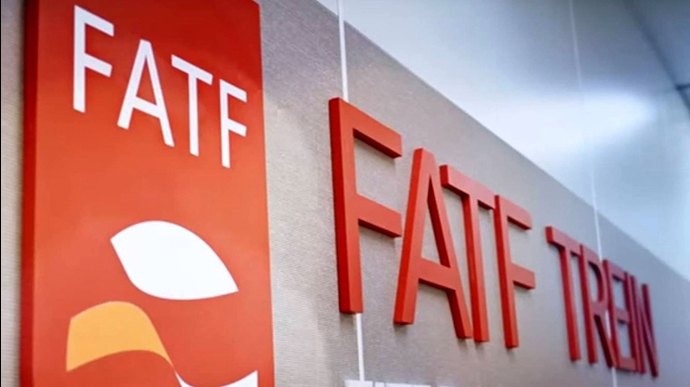

In a stunning political humiliation for Supreme Leader Ali Khamenei and the administration of Masoud Pezeshkian, the Iranian regime’s calculated gamble to gain international legitimacy has spectacularly backfired. On October 24, 2025, the Financial Action Task Force (FATF) announced that Iran would remain on its blacklist of high-risk countries, delivering a damning verdict on the regime’s unchangeable nature just days after Tehran thought it had been able to maneuver its way out of its international conundrum.
After a bitter seven-year internal war, the regime reluctantly ratified the Palermo and CFT conventions, hoping this concession would open the door to sanctions relief. Instead, the move has only deepened its international isolation while simultaneously igniting a firestorm of internal division, proving that a system built on terror financing and illicit finance can never truly reform.
Internal division and international rejection
The regime now finds itself in an impossible position, having achieved the worst of both worlds. On October 18, 2025, the government formally implemented the conventions. Less than a week later, the FATF rejected the move. The fallout was immediate. Inside the regime’s rubber-stamp Majlis, parliamentarian Kamran Ghanzanfari attacked the Expediency Council on October 29 for approving the conventions, sarcastically noting that they had “complied with the demand of the US government,” only to have their “heads hit a stone wall.”
This sentiment was echoed by the Supreme Leader’s mouthpiece, the Kayhan newspaper, which on October 26 fumed, “Those who promised that banking problems would be solved with FATF must now answer why, after the conditional approval of the Palermo and CFT conventions, not only was there no breakthrough, but FATF took a more insolent position against Iran?” The regime’s attempt at deception gained it nothing abroad while costing it dearly at home.
The unacceptable truth: why the regime can never comply
The core reason for the FATF’s rejection lies not in legal technicalities, but in the fundamental nature of the regime itself. The FATF statement highlighted Tehran’s extensive cover-ups and the continued threat of terrorism financing. But the most damning evidence came from the negotiations themselves. Hadi Khani, the head of Iran’s Financial Intelligence Unit, revealed that the FATF posed a crucial question: What would Tehran do if one of the groups it recognizes as a “liberation movement” commits organized crimes like arms or drug trafficking?
The regime’s delegation offered a response, but it “was not accepted.” This single point exposes the unbridgeable gap between Tehran and international norms. The regime’s foreign policy and regional influence are built upon its network of terrorist proxies, which are funded through precisely the kind of organized crime the Palermo convention is designed to combat. To comply with the FATF would be to dismantle its own terror apparatus.
A system built on illicit “shadow banking”
This refusal to abandon its criminal network is further evidenced by the regime’s reliance on a massive global money laundering machine. Just one day before the FATF decision, the U.S. Treasury’s Financial Crimes Enforcement Network (FinCEN) announced it had identified approximately $9 billion in the regime’s “shadow banking” activities conducted in 2024. FinCEN Director Andrea Gacki stated that identifying these networks is an essential part of cutting off the financial resources used for the regime’s military, weapons programs, and affiliated terrorist groups.
Regime insiders have long known this. During the internal debates, MP Mojtaba Zonnouri openly admitted that joining the CFT would mean “putting a noose around the neck of the system,” as it would expose “all the routes for circumventing sanctions and its secret economic cooperation.”
No path to moderation, only more deceit
The FATF episode is more than a diplomatic failure; it is a definitive judgment on the criminal nature of the Iranian regime. It proves that no matter who occupies the office of presidency, the core policies of terror financing and nuclear defiance remain unchanged. The international community must abandon the fantasy that this regime can be moderated through engagement. The only viable path forward is to increase pressure on Tehran and stand in solidarity with the Iranian people and their organized opposition, who are striving to establish a democratic, secular, and non-nuclear republic that is genuinely committed to global peace and security.