

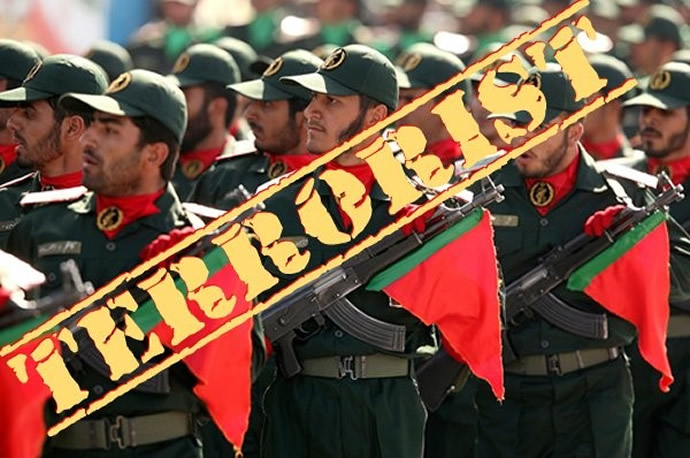

On Monday, July 13, 2026, the British government officially banned support for the Islamic Revolutionary Guard Corps (IRGC) and its linked groups.
The UK’s proscription is a highly welcomed and long-overdue step that validates the decades-long warnings of the Iranian Resistance. However, designating the IRGC must not be the end of the road. As this development proves that the regime relies entirely on state-sponsored terrorism to survive, the sole logical next step for the international community is to completely isolate the religious fascism ruling Iran and officially recognize the Iranian people’s right to confront this terror apparatus and overthrow the regime.
For years, Western capitals were paralyzed by a policy of willful blindness, desperate to preserve bilateral ties with Tehran. But the UK’s legal pivot demonstrates that the IRGC’s terrorism is an active, borderless threat that can no longer be ignored. The UK implemented new powers under the fast-tracked National Security (State Threats) Act 2026. The government and intelligence agencies acted upon deep concerns regarding foreign powers paying organized crime groups for sabotage and surveillance on British soil.
The new powers close a critical gap in existing laws around state-linked actors, making it entirely illegal to show support for the IRGC. The penalties are severe: under the new regulations, support for the IRGC carries penalties of up to 14 years in prison, while anyone involved in acts of sabotage on behalf of the designated group could face life imprisonment. This legislative milestone definitively proves that engaging diplomatically with Tehran only invites the regime’s terrorist proxies directly onto European streets.
Mrs. Maryam Rajavi, the President-elect of the National Council of Resistance of Iran (NCRI), welcomed the UK government’s decision, however long overdue, to proscribe the Islamic Revolutionary Guard Corps (IRGC), describing it as essential for regional and global peace, stability, and security.
.@BobBlackman, UK MP and Chairman of the British Committee for Iran Freedom
It has long been the goal of the UK—both in our cross-party efforts—that the Iranian Revolutionary Guard Corps should be classified as a terrorist entity and their assets sequestrated.
I’m pleased to say… pic.twitter.com/w6S03MDshZ— Maryam Rajavi (@Maryam_Rajavi) July 13, 2026
Mrs. Rajavi also expressed her appreciation for more than four decades of perseverance and efforts by members of the British Houses of Commons and Lords, particularly the members of the British Committee for Iran Freedom, in advocating the proscription of the IRGC and exposing its actions against the people of Iran.
The regime’s desperation and furious backlash
The UK’s designation sent immediate shockwaves through Tehran, prompting a hysterical and furious reaction across state-run media and from top regime officials. The sheer panic emanating from the highest echelons of the regime exposes a fundamental truth: the IRGC is the sole pillar keeping the ruling elite in power, and stripping it of its international legitimacy terrifies a regime that is highly vulnerable at home.
IRGC commander and Parliament National Security Commission member Esmail Kowsari furiously demanded that the Iranian Foreign Ministry summon the UK ambassador, declaring that if the British government could not provide “strong and logical reasons,” the ambassador must be expelled. Kowsari labeled the UK’s move as “impudent and illogical.”
State media outlets immediately launched into a panicked frenzy. The official news agency IRNA, alongside outlets like Jamaran, Ettelaat Online, and KhabarOnline, obsessively warned their domestic audience about the legal consequences in the UK. They reported that under the new rules, showing support, raising funds, or even displaying the IRGC logo in public in the UK is now a criminal offense carrying up to 14 years in prison. The Judiciary’s news agency, Mizan, complained about London’s “hostile actions,” while Defa Press, utilizing the regime’s classic propaganda vocabulary, described the designation as “the old fox’s venting of frustration against the IRGC.” This frantic reaction reveals how heavily the regime relied on Western appeasement to maintain the IRGC’s aura of invincibility.
The Resistance’s decades-long intelligence pipeline
The UK’s legislative milestone was not generated spontaneously; it was the direct result of a highly organized, transnational intelligence and diplomatic campaign led for years by Mrs. Maryam Rajavi, the President-elect of the National Council of Resistance of Iran (NCRI). In countless speeches, parliamentary meetings, and international conferences, Mrs. Rajavi repeatedly called on Western governments to blacklist the IRGC in its entirety and hold its commanders accountable for their crimes.
The Iranian Resistance systematically demolished the West’s primary excuse for inaction by providing an irrefutable evidentiary pipeline. By leveraging the extensive PMOI/MEK network inside Iran, the NCRI published dozens of comprehensive dossiers since 2014 that moved the conversation from abstract theory to actionable data. For example, the 2017 book “Terrorist Training Camps in Iran” exposed 15 Quds Force facilities dedicated to training foreign mercenaries. “The Rise of Iran’s Revolutionary Guards’ Financial Empire” mapped the 14 economic powerhouses the Supreme Leader uses to siphon national wealth to fund international terror. Later reports like “IRGC’s Rising Drone Threat” detailed the 15 front companies driving UAV proliferation, and “Iran’s Emissaries of Terror” proved how Tehran’s embassies function directly as assassination hubs.
Crucially, this open-source intelligence mapped exactly how the IRGC maintains an absolute monopoly over Iran’s banking, economy, and clandestine nuclear weaponization efforts. By pairing this sweeping evidentiary base with massive diplomatic mobilization, the movement secured the endorsement of more than 3,000 parliamentarians across 55 countries, and the backing of over 550 cross-party UK MPs and Peers, leaving the Home Office with no defensible alternative but to enact the ban.
The sole complement: Recognizing the right to overthrow
In her statement welcoming the UK government’s decision, Mrs. Maryam Rajavi emphasized a critical point: designating the IRGC is essential for global peace, but it is only part of the solution. For years, the PMOI/MEK and NCRI have warned that appeasing this regime only leads to the expansion of terrorism and human rights violations. Now, Mrs. Rajavi states, the time has come to translate this designation into concrete action without political or economic considerations.
Mrs. Rajavi consistently argued that the regime’s internal repression and its foreign terrorism are not separate policy issues; they are two dimensions of the exact same system. The very same IRGC forces directing proxy attacks in London and the Middle East are the ones who operated the machinery of repression inside Iran during the January 2026 protests—deploying rooftop snipers, enacting total internet blackouts, and massacring thousands of innocent citizens. The IRGC cannot be divided into “acceptable” and “unacceptable” factions because its entirety serves one objective: preserving the clerical dictatorship.
Therefore, the only logical complement to the UK’s terrorist designation is acknowledging the realities on the ground in Iran. As Mrs. Rajavi noted, “Recognizing the right of the Iranian people and the Iranian Resistance to confront the IRGC is one of the practical imperatives of the IRGC’s proscription.” The regime in its entirety is run by terrorists, and it cannot be reformed. The international community must stand alongside the people of Iran and support their fundamental right to fight against the regime, dismantle the IRGC, and overthrow the theocracy to establish freedom and democracy.
The time for constructive engagement with this terrorist regime is over. The international community must comprehensively blacklist the IRGC, shut down the regime’s embassies that act as terror hubs, and boldly recognize the legitimate right of the Iranian people to overthrow their oppressors.