

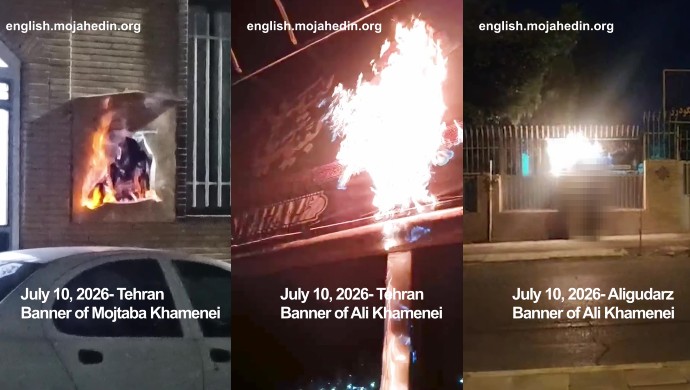

On July 10, 2026, following the Iranian regime’s lavish and highly militarized state funeral ceremonies for the eliminated supreme leader Ali Khamenei, PMOI Resistance Units launched a nationwide campaign of defiance. While the regime desperately sought to manufacture a hollow display of unity and social backing for the newly installed supreme leader, Mojtaba Khamenei, the Resistance Units targeted centers of and symbols repression and corruption. Their daring operations echo the true desire of the Iranian people: the total overthrow of the mullahs’ rule and the establishment of a democratic republic.
July 10—Iran
Following the regime's lavish state funeral ceremonies for eliminated supreme leader Ali Khamenei, PMOI/MEK Resistance Units carried out 25 daring operations, targeting regime centers of repression and corruption, and echoing the real desire of the Iranian people,… pic.twitter.com/VNNEr2xUb4— People's Mojahedin Organization of Iran (PMOI/MEK) (@Mojahedineng) July 14, 2026
Across the country, Resistance Units shattered the regime’s propaganda efforts by destroying billboards and banners of eliminated supreme leader Ali Khamenei, newly installed leader Mojtaba Khamenei, regime founder Ruhollah Khomeini, and eliminated IRGC Quds Force commander Qasem Soleimani. Operations spanned major cities including Tehran, Isfahan, Babol, Yazd, and Arak.
Furthermore, the Resistance Units directly targeted the regime’s apparatus of suppression and espionage. In Karaj, they set fire to the entrance of an IRGC Basij base, and in Zahedan, they torched the signpost of a Basij base explicitly tasked with spying on and suppressing students. In Dorud, a billboard belonging to the Ministry of Intelligence was targeted, a propaganda billboard promoting espionage for the IRGC was set ablaze in Khorramabad, and a regime building in Aligudarz was set on fire.
Babol
Resistance Units set fire to poster of Ali Khamenei pic.twitter.com/ZgxazyoEU1— People's Mojahedin Organization of Iran (PMOI/MEK) (@Mojahedineng) July 14, 2026
The regime’s attempt to project power was a totalitarian illusion. In reality, more than 70 percent of funeral attendees were coerced into participating through severe threats, such as university expulsions, job terminations, and salary cuts.
On July 6, 2026, it was reported that in Kurdistan, government employees were forced onto buses under threat of firing. The regime even weaponized poverty, threatening to cut off financial aid to destitute families reliant on the Khomeini Relief Committee and the State Welfare Organization if they did not attend the ceremonies in Tehran and Qom.
Exposing the regime’s profound weakness, Mojtaba Khamenei was entirely absent from the public ceremonies, reportedly hiding in a secret location due to injuries and a deep fear of being eliminated.
Aligudarz
Resistance Units set fire to regime building pic.twitter.com/3YmGxkEw3R— People's Mojahedin Organization of Iran (PMOI/MEK) (@Mojahedineng) July 14, 2026
Terrified of a restive and explosive public following recent massive uprisings, the IRGC turned the funeral into a week-long military scenario, heavily saturating the streets with Basij and intelligence forces. Yet, the regime’s panic was glaringly obvious.
On the fourth day of ceremonies in Tehran, authorities abruptly canceled the pre-planned coffin procession route on live television. Unable to secure the streets, the IRGC was forced to fly the coffins out by helicopter.
Instead of showcasing structural cohesion, the ceremonies exposed violent internal divisions. The bitter factional divide was further laid bare by the exclusion of key figures, with former presidents Mohammad Khatami, Mahmoud Ahmadinejad, and Hassan Rouhani uninvited to official VIP rows, while Hassan Khomeini was denied a front-row seat.
The courageous nationwide operations by the Resistance Units, juxtaposed with the regime’s fractured and panic-stricken display, send a clear message to the world: the Iranian people are not fooled by state-sponsored charades and remain resolute in their struggle for freedom.