

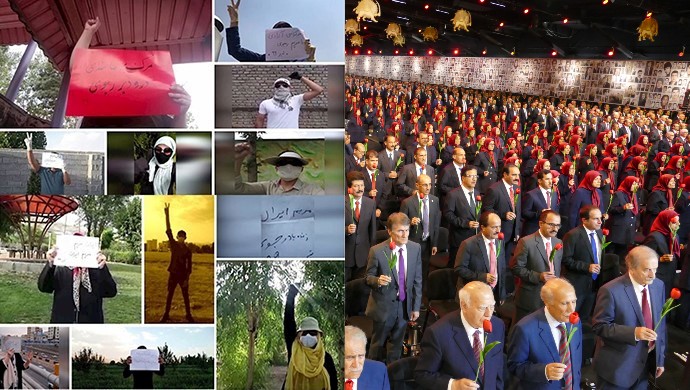

Iran currently stands at one of the most critical junctures in its history. As the ruling religious dictatorship grapples with profound political, economic, and social crises, the international community is once again confronted with a defining question: What is the solution to the crisis in Iran?
For decades, Western policymakers have been trapped in a false dichotomy, operating under the assumption that the only available options are endless appeasement or devastating foreign military intervention. However, the Free Iran 2026 Summit clearly articulated that both of these paths are fundamentally flawed. The true answer lies in the “third option”: democratic regime change brought about exclusively by the Iranian people and their organized Resistance.
As Mrs. Maryam Rajavi, the president-elect of the National Council of Resistance of Iran (NCRI), emphasized, the only viable path forward is relying on the power of the Iranian people. “The only solution to Iran’s present crisis is regime change. And that change can only be achieved through the uprising of the Iranian people and their organized Resistance,” she stated.
The dangerous illusion of appeasement
For years, Western governments have attempted to negotiate with the clerical regime, hoping to find moderation or induce a change in behavior. This policy of conciliation has consistently failed, only serving to prolong the life of the ruling clerics and embolden their domestic repression and regional terrorism.
The Iranian Resistance has long cautioned the global community about the futility of this approach. “For years, when the Iranian Resistance warned that a viper does not give birth to a dove—when we said that no one should look for moderation, reform, or a change of behavior inside the dark tunnel of Velayat-e Faqih, or religious fascism, and that appeasement was a dangerous illusion—many governments refused to accept it,” Mrs. Rajavi noted.
As I have repeatedly said:
The overthrow of the religious dictatorship, and the achievement of freedom and a democratic republic, are the responsibility of ourselves, our people, and the National Liberation Army.
Peace and freedom will prevail in Iran.https://t.co/852TFGeelx— Maryam Rajavi (@Maryam_Rajavi) June 21, 2026
The reality is that a regime built on terror, which lacks any shred of popular legitimacy, cannot be reformed. As former UK Defense Secretary Sir Liam Fox pointed out, “The West must learn that they can be no more reasoned with today or trusted today than at any time in the past 47 years. The wolf may lose its teeth, but it never loses its appetite.” Making concessions to religious fascism is a failed strategy. “Self-delusion is not the road to peace,” Fox added.
The futility of foreign military intervention
While the international community increasingly recognizes the existential threat posed by Tehran, the Iranian Resistance has always maintained that foreign military intervention is neither desired nor capable of delivering genuine freedom. Democracy cannot be imported or imposed from the outside; it must be won from within.
Mrs. Rajavi has made the Resistance’s stance unequivocally clear, rejecting any reliance on foreign powers. “The overthrow of the ruling religious dictatorship, and the achievement of freedom and a democratic republic, are the responsibility of ourselves, our people, and the National Liberation Army of Iran,” she affirmed.
.@LiamFox: Factors driving internal change remain: a failing economy, violent repression, and a lack of legitimacy. Only the Iranian people have the authority to determine who governs—not foreign govts, tyrants, or monarchs. It is only the Iranian people themselves, and it's our…
— NCRI-FAC (@iran_policy) June 21, 2026
International allies have echoed this fundamental truth. General James L. Jones noted that Mrs. Rajavi “has never asked for foreign military intervention to create regime change, and she’s always maintained that the Iranian people will achieve that goal themselves.” External force alone is insufficient. As Linda Chavez observed, “you cannot impose freedom by dropping bombs… What has to happen is the Iranian people have to stand up and fight.”
Rejecting the false alternative of the past
In its desperation to survive, the regime benefits from the promotion of a false alternative centered around the remnants of the Shah’s deposed monarchy. This media-driven mirage relies on foreign intervention rather than popular support and serves only to divide the opposition.
The Iranian people categorically reject a return to the monarchial dictatorship. Mrs. Rajavi described the prospect of returning to the Shah’s rule as “like pounding water in a mortar—a completely futile exercise.” She noted that the Shah’s heir openly calls for change utilizing the regime’s Revolutionary Guards (IRGC) and intelligence apparatus.
David Jones, MP: For too long, Western govts pursued appeasement. The correct policy is the third option: neither war nor appeasement, but democratic change brought about by the Iranian people themselves. #NCRIAlternative https://t.co/ta0xXodcXh
— NCRI-FAC (@iran_policy) June 21, 2026
British MP Bob Blackman highlighted this stark reality: “Democracy in Iran will not be delivered by those who seek to inherit power as a family entitlement or depend on foreign powers to restore yet another dictatorship.” Blackman noted that Reza Pahlavi has never condemned his father’s dictatorship, repeatedly praised the notorious SAVAK secret police, and publicly claimed support from the IRGC—the very force responsible for suppressing protesters.
The true force for change: The organized resistance
Meaningful democratic change in Iran requires a dedicated, organized force capable of surviving the harshest repression and standing shoulder-to-shoulder with the uprisings of the Iranian people.
That force is the network of Resistance Units inside the country. Made up of courageous and committed young men and women, they “ignited the engines of resistance across Iran” and “constitute the most important organized force within the uprisings,” Mrs. Rajavi explained.
Now look at the generation that has joined the ranks of the Resistance Units in Iran.
Look at the young rebels who stand tall before the regime's sham courts and proudly declare that they have risen to overthrow the dictatorship.Look at Vahid Bani-Amerian and his heroic unit,… pic.twitter.com/etDBC0YVes
— Maryam Rajavi (@Maryam_Rajavi) June 21, 2026
These activists proudly declare their intention to overthrow the dictatorship, even before the regime’s sham courts. Mrs. Rajavi highlighted the bravery of activists like Vahid Bani-Amerian, executed in April 2026. Refusing to surrender, Bani-Amerian and his heroic unit told their executioners: “We do not bargain with you over our ideals, our beliefs, or our lives.” This tested, organized movement is the singular entity the regime truly fears.
Transferring sovereignty to the people
The equation of Iran has found its answer. The international community must abandon the failed policies of appeasement and intervention, and instead recognize the Iranian people’s legitimate right to overthrow the religious fascism ruling their country.
The NCRI offers a clear blueprint for this transition through Mrs. Rajavi’s Ten-Point Plan, which guarantees free elections, gender equality, the separation of religion and state, and a non-nuclear republic. Crucially, the Resistance does not seek to monopolize power. “We are not seeking to seize power,” Mrs. Rajavi pledged. “We are prepared to transfer power from the tyrannies of the Shah and the Sheikh to its rightful owners—the people of Iran.”
By officially recognizing the NCRI’s democratic alternative and acknowledging the right of the Iranian people and the Resistance Units to determine their own destiny, the world can finally help open the door to a free and democratic Iran.