

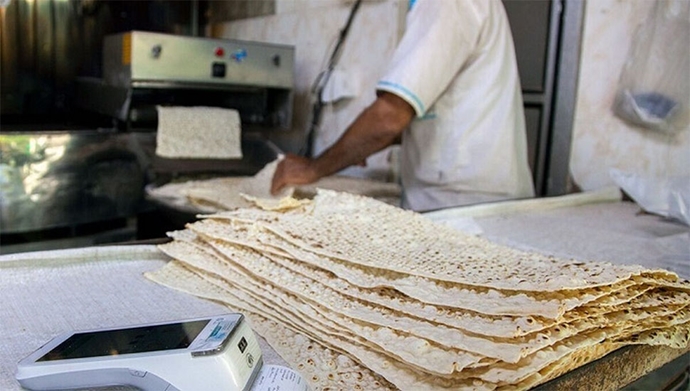

While the ruling clerics in Iran spend billions on domestic suppression and regional conflicts, ordinary Iranians are now being stripped of their last remaining staple food: bread. After months of denial and empty promises by regime officials regarding price stability, bread prices have officially skyrocketed by up to 100% across the country.
According to state media reports, staggering new rates were officially implemented and entered into the national bakery system on June 23, 2026. Mohammad Javad Karami, a member of the flour and bread working group of the regime’s Chamber of Guilds, confirmed that the price of subsidized bread in Tehran changed drastically starting June 22, 2026.
The cost of Lavash bread in the capital has seen a near 100% increase, jumping from 14,000 to 27,000 rials. Barbari bread surged from 53,000 to 100,000 rials, Taftoon from 23,000 to 45,000 rials, and Sangak more than doubled from 74,000 to 155,000 rials.
The crisis is not limited to Tehran; it spans nationwide. In Mazandaran province, prices for some types of bread have almost doubled, while Razavi Khorasan experienced a 49% increase. Higher price mandates have also been issued to bakeries in Hamedan.
The devastating impact on ordinary Iranians
The clerical regime’s disastrous economic policies have decimated the purchasing power of the Iranian people. With hyperinflation removing essential items like meat, dairy, and fruit from the shopping carts of many families, bread had become the most important—and sometimes the only—constant food item for low-income households to meet their minimum nutritional needs.
In Semnan province, Hamid Dehrouyeh, the Deputy Governor for Economic Affairs, announced price hikes between 70% and 100% across eight counties. The cost of a traditional Sangak in Semnan increased from 60,000 to 90,000 rials. The inflation has spared nothing; even the cost of plastic bags at bakeries doubled from 20,000 to 40,000 rials, and the price of adding a mere 10 grams of sesame seeds to Sangak bread jumped from 28,000 to 60,000 rials.
The root causes: Regime corruption vs. public starvation
While regime officials attempt to frame the price hikes as necessary adjustments, the reality points to systemic macroeconomic failures. Karami admitted that government-subsidized wheat and flour only account for 5% to 6% of the final cost of bread. The real factors making bread unaffordable are unchecked inflation, soaring energy costs, and skyrocketing rent—all direct results of the regime’s destructive economic mismanagement and corruption.
The impoverishment of the Iranian people is a deliberate consequence of the regime’s malign priorities. The national wealth that should be used to subsidize the lives of everyday Iranians is instead being plundered by those in power.
State media reports that bread prices have doubled in Tehran and many provinces across Iran.
Under this religious fascism, the masses are losing access to even basic bread, while the nation's wealth is poured into domestic oppression, regional warmongering, and projects designed…— Maryam Rajavi (@Maryam_Rajavi) June 23, 2026
Maryam Rajavi, the President-elect of the National Council of Resistance of Iran (NCRI), highlighted this stark reality. Responding to the crisis, she noted that under this religious fascism, the masses are losing access to basic bread, while the nation’s wealth is poured into domestic oppression, regional warmongering, and projects designed solely to keep the despised clerical regime in power.
“While everyday Iranians suffer from hunger, the regime’s elites, their children, and cronies enjoy lives of ultimate luxury both at home and abroad,” Rajavi wrote. She emphasized that the systematic starvation of the public leaves the people with only one viable option: “The only path forward is revolt and uprising against the tyrants ruling Iran.”