

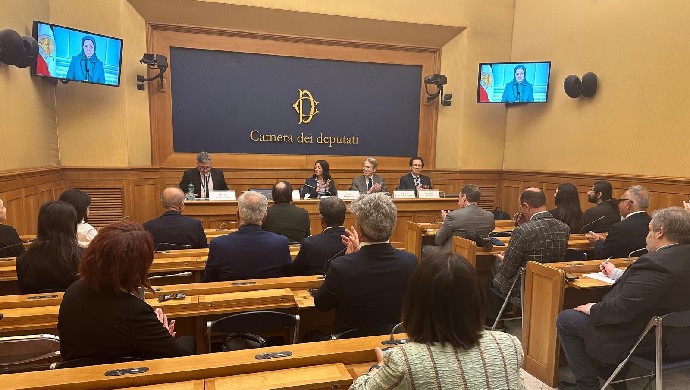

On May 21, 2026, the Italian Parliament in Rome hosted a strategic conference bringing together prominent lawmakers, human rights defenders, and Mrs. Maryam Rajavi, President-elect of the National Council of Resistance of Iran (NCRI). The gathering occurred at a highly volatile juncture in Iranian history. Following the massive nationwide uprisings of December 2025 to January 2026, which began in the Tehran bazaar and quickly morphed into sweeping demands for regime change, the ruling theocracy responded with a brutal execution spree.
Amidst the upheaval caused by the recent war, the conference in Rome sought to ground the international narrative in a crucial reality: foreign military interventions and aerial bombardments will not bring democracy to Iran.
Instead, lawmakers and analysts underscored that genuine regime change can only be achieved by the Iranian people and their organized resistance. The parliamentary panel focused on the necessity of ending Western appeasement, rejecting the dictatorships of both the deposed Shah and the ruling clerics, and formally endorsing Mrs. Rajavi’s Ten-Point Plan for a democratic republic.
The Real War: The People vs. The Regime
Addressing the Italian Parliament, Mrs. Maryam Rajavi outlined the unprecedented domestic crisis crippling the theocracy. She established that the true battle for Iran’s future is being waged on its streets, not in foreign capitals. She cautioned that recent international tensions have obscured this internal struggle, stating, “The regime is currently exploiting foreign war to camouflage its own desperate domestic crisis, particularly as the precarious standing of the new Supreme Leader has triggered widening fractures at the very summit of power.”
Conference at the Italian Parliament: Support human rights and condemn executions in Iran
The Iranian people are moving toward establishing a society free from all forms of tyranny.#StopExecutionsInIranhttps://t.co/OeYM4c6hnk pic.twitter.com/O6a1sGaQuB— Maryam Rajavi (@Maryam_Rajavi) May 21, 2026
Condemning the recent hangings of eight PMOI members and numerous protesters from the recent uprising, Mrs. Rajavi argued these executions are driven by the regime’s “sheer fear of the Iranian people and their uprisings.” Emphasizing that external forces cannot bestow liberty upon the nation, she declared, “The overthrow of this regime can only be achieved through one path: popular uprisings and the organized resistance of the Iranian people, spearheaded by the Resistance Units.” She called on European nations to break their diplomatic silence, pointing out that the defiant youth standing courageously before the regime’s kangaroo courts prove the undeniable legitimacy and vitality of this internal, grassroots struggle for freedom.
An Unprecedented Execution Spree
The parliamentary briefing was convened against the backdrop of a staggering wave of state-sanctioned killings. Over the past month, the ruling regime hanged eight PMOI members and numerous political dissidents arrested during the nationwide winter protests.
MP Naike Gruppioni, the primary organizer of the event, delivered an impassioned critique of Western complacency regarding fundamental human rights. Highlighting the tragic execution of Vahid Bani Amerian, a young engineer and PMOI Resistance Units commander, she echoed his defiant final words to his executioners: “Even if you kill us, we multiply.” Gruppioni warned that Western democracies have a dangerous tendency to take human liberty for granted, noting that “its importance is truly understood only when it is denied, repressed, and suffocated.” She called on Italy and the broader international community to stand on the right side of history by recognizing the Iranian people’s legitimate right to resist oppression.
The Fallacy of Appeasement and International Complicity
Throughout the briefing, panelists systematically deconstructed the long-standing Western policy of appeasing Tehran, arguing that maintaining diplomatic normalcy with a murderous state actively destabilizes global security.
Professor Antonio Stango, President of the Italian Federation for Human Rights, offered a strict linguistic and political critique of contemporary diplomacy. He argued that the English term “appeasement” should not be translated into Italian as pacification, but rather as “condescension—an action of condescension, in that case, with the bloody regime of the ayatollahs.” He corrected political commentators who attempt to position Iran as a victim of geopolitical dynamics, stating unequivocally, “The regime of the Iranian ayatollahs is an aggressor regime.” Noting that the theocracy heavily finances, coordinates, and arms regional terror networks, Stango concluded that true regional stability dictates a policy of “ayatollah regime zero.”
Italian MP @naike_gruppioni: “The Iranian people have rejected both dictatorships and want a democratic republic.”
During a conference at Italy’s Chamber of Deputies, MP Gruppioni stressed: “We cannot limit ourselves to routine declarations. The Iranian issue does not only… https://t.co/tf1qefrR0z pic.twitter.com/VXLcamDyAh
— SIMAY AZADI TV (@en_simayazadi) May 23, 2026
In a written statement transmitted from state business in Belgrade, Senator Marco Scurria echoed this demand for an uncompromising defense of human dignity. Addressing the killings of protesters and dissidents, Senator Scurria wrote, “One cannot witness in silence the repressions and killings that strike men and women, and even children. It is a reality that challenges the conscience of the international community.” He emphasized that Western governments must not allow economic or geopolitical factors to dictate their policies, asserting that “no political or strategic interest can ever justify the systematic repression of a people.”
Rejecting the Dictatorships of the Shah and the Mullahs
A recurring theme throughout the parliamentary briefing was the Iranian public’s definitive rejection of all forms of totalitarianism. Lawmakers firmly dismissed the remnants of the deposed Pahlavi monarchy as a false alternative attempting to hijack the immense sacrifices made by the Iranian people.
Senator Giulio Terzi, President of the European Affairs Committee and former Minister of Foreign Affairs, drew upon decades of diplomatic experience to expose the dangers of these “pseudo-alternatives.” Senator Terzi lambasted international actors who historically engaged with a regime he described as a “nazi-fundamentalist horror that wanted to have the atomic bomb to dominate more and more, torment its people, but torment humanity.”
Terzi sharply contrasted the sacrifices of the internal Resistance Units with figures operating safely abroad. Referencing the Shah’s son, Reza Pahlavi, Senator Terzi criticized those who “pretend to be wanted by the Iranian people and live in comfortable, luxurious residences.” He explicitly condemned Pahlavi’s expressed willingness to compromise with the current state-terror apparatus, noting that Pahlavi bases his transition plans on “a solution that also includes a part of a terrorist organization that forms the backbone of the terrorist state of Iran, which are the Islamic Revolutionary Guard Corps, the MOIS, the Basiji, and other criminals of this type.”
MP Gruppioni reinforced this reality, pointing out that the street protests of late 2025 and early 2026 proved the public’s demands are entirely forward-looking. “The Iranian people have already rejected every form of authoritarianism,” she said. “They have rejected the religious dictatorship of the ayatollahs, just as they have rejected the return to monarchical models belonging to the past.”
The Efficacy of Internal Resistance
To dispel any notion that the regime’s eventual collapse relies on external military pressure, Mrs. Rajavi highlighted the concrete, ongoing achievements of the PMOI Resistance Units inside Iran. She reminded the assembly that the validity of the resistance is proven by its “tangible success on the battlefield of struggle.”
During the massive uprising of December 2025 to January 2026, these deeply entrenched networks carried out 630 targeted operations against regime centers. Furthermore, she revealed that on February 23, 2026—just days before the outbreak of foreign war—multiple units comprising 250 resistance fighters launched coordinated strikes targeting the regime’s most sensitive government centers in its most heavily fortified security zones. These highly organized actions prove that a structured, active alternative exists at the heart of the nation, and that the daily operations of these units are the true engine driving the regime toward collapse.
The Only Viable Solution for a Democratic Future
Stressing the conference’s core message, lawmakers and human rights defenders reached a unified conclusion: foreign wars will not overthrow the Iranian regime. While external strikes earlier this year disrupted the state’s upper echelons, the fundamental task of dismantling the theocracy and replacing it with a democratic apparatus rests exclusively with the Iranian people.
To secure this future, the Italian lawmakers explicitly endorsed Mrs. Rajavi’s platform. MP Gruppioni described the NCRI’s vision not as mere political rhetoric, but as “a concrete political project for a future of a free Iran, a democratic, non-nuclear Republic.” The panelists jointly called on the European Union to formally recognize the Iranian people’s right to resist, to legally proscribe the IRGC, and to stand alongside the internal resistance forces who face the gallows daily to win their freedom.