

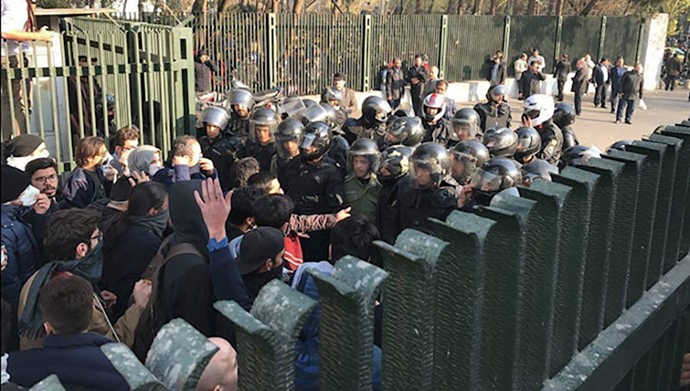

The socio-economic and political situation in Iran has reached a hyper-critical stage. While the regime attempts to project strength and hide behind the noise of regional conflicts and negotiations, its true and overriding fear is an inevitable internal explosion. To prevent this, authorities have launched a hasty, brutal crackdown on universities, dispatching “disciplinary committees” to purge dissident students and strip universities of their core identity: freedom of thought.
Students currently find themselves trapped between two blades of the regime’s suppression machine: university disciplinary committees and the Revolutionary Courts. Despite the widespread suspension of in-person classes, a massive wave of suspensions and expulsions has been unleashed.
According to a June 1, 2026, report by the state-run Shargh newspaper, at least 352 students across four major universities in Tehran have been summoned or disciplined in just a few weeks. At Sharif University, five to seven students have been expelled, and over 20 suspended for up to three terms. At Beheshti (Melli) University, 25 students have been blocked from accessing educational systems. Iran University of Science and Technology has opened cases for over 100 students, while nearly 200 students at Tehran University have been summoned.
This crackdown is nationwide, extending to universities in Mashhad, Shiraz, Isfahan, Guilan, Birjand, and Babol, heavily targeting students for their participation in the massive December 2025–January 2026 uprisings.
Complicity at the highest levels
The government of Masoud Pezeshkian is fully complicit in this crackdown. Hossein Simaei Sarraf, the Minister of Science, publicly acknowledged the campaign against protesting students. Speaking to state media, he confirmed that student cases are being processed simultaneously by judicial authorities for alleged “crimes” and by university committees for “infractions,” proving this is a coordinated, state-sponsored purge.
These disciplinary committees bypass all legal frameworks to turn universities into interrogation centers. A June 8, 2026, report by the Tose’e Irani newspaper revealed that committee members operate like “mafia gangs,” refusing to identify themselves and ignoring their own rulebooks.
To crush the youth’s progressive spirit, the regime employs medieval inquisition tactics. In Sharif and Tehran universities, interrogators subjected students to severe psychological abuse, asking them, “How much are you complicit in the blood of the martyrs?” and absurdly blaming them for casualties during the regime’s recent conflict with the US and Israel.
Revealing the regime’s deep-seated fear of young women—who were at the forefront of the recent uprisings—a Tehran University student reported that 90 percent of the targeted individuals are undergraduates, and approximately 80 percent of them are young women.
Furthermore, with campuses repeatedly closed and the internet heavily restricted, authorities have intensified their digital witch hunts. Students are being disciplined simply for their profile pictures, messages in private chat groups, or for retweeting anti-regime content.
Heavy prison sentences from Revolutionary Courts
Paralleling the campus purges, the regime’s Revolutionary Courts have handed down draconian sentences against students for participating in street protests. Judge Abolqasem Salavati, notoriously known for his brutal rulings, is sentencing students to prison on fabricated charges of “collusion to disrupt national security.”
Despite these heavy-handed tactics, the regime has failed to silence the universities. Student organizations have strongly protested the multi-layered crackdown. Students continue to hold protest rallies against the regime and its policies.
Meanwhile, Iran’s rebellious youth, many of whom are students, continue to confront the regime’s apparatus of repression.