

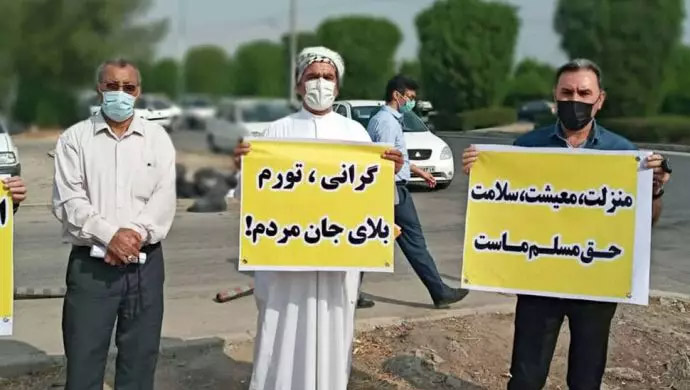

Forty-five years after the mullahs’ usurped the revolution of the Iranian people, economic-social crises on one hand and political and cultural crises on the other have brought Iranian society to the brink of a dreadful precipice. Today, with mega economic challenges, economists warn that we have reverted not just to the pre-Constitutional Revolution era, but even to the pre-Qajar dynasty period.
On July 29, economist Farshad Momeni said, “In this situation, we are falling into the pre-Qajar era, and this is very dangerous. This indicates that the immediate and most profound change affecting our welfare and social security is the restructuring of the institutional framework in favor of production and against profiteers, usurers, brokers, and importers. With the current path, we still witness shocking debates and astonishing neglects in this area.”
How did profiteers and usurers, behind the scenes of corrupt clerics and the Revolutionary Guards (IRGC) tear apart the fabric of the nation’s existence? Why have millions of impoverished households, hundreds of thousands of unemployed educated individuals, child laborers, retirees with meager pensions, extremely poor female heads of households, and workers who haven’t been paid for months ended up living in poverty and misery, shuttling between strike venues and the prisons of the ruthless regime?
Five Mega Challenges of Iran’s Economy
Economist Hossein Raghfar says Iran has five mega challenges that are strategic because they affect each other. Without political will to address these mega challenges, the political system will undoubtedly face very deep and serious threats.
On August 2, Tejarat News website quoted him as saying: “The governance mega challenge creates four other major challenges. The population and employment mega challenge encompasses youth unemployment and pension funds. The environmental and water mega challenge affects the life of the Iranian society. The technology and innovation mega challenge and the foreign diplomacy mega challenge.”
Each of these is enough to cause a society to regress, but the clerical regime embodies all of them simultaneously. The same economist illustrates the regime’s bankruptcy: “What remains in the treasury is about 110 trillion rials. This is while Raisi’s government has left a huge debt for the next administration. No government’s economic performance in the past 45 years has been as poor as the thirteenth governments.”
The Root Cause of Crises: Rent-Seeking Relationships
Alluding to the main characteristic of the regime’s plundering, Momeni says: “The root cause of all current crises in Iran is rent-seeking relationships. If you want to trace the roots of Iran’s troubles, you must make the rulers understand that with the continuation of rent-seeking relationships, poverty, corruption, misery, moral decay, and civilizational decline are inevitable. You must realize that this trend cannot continue.”
He compares the clerical regime’s era with the pre-Qajar period: “The total responsibilities of the government during the Qajar period were limited to establishing levels of order and security. Now, I warn that while the highest responsibilities for poverty alleviation and support are assigned to the government in the Constitution of the Islamic Republic, we are approaching a financial capacity less than that of the Qajar period for allocating resources to those areas” (Source: Jamaran website, July 29).
Constitutional Revolutionaries in the Era of Religious Fascism
The 1905 Constitutional Revolution in Iran was one of the most important events in Iran and the world in the past century. Among its causes and reasons was the Iranian people’s struggle for freedom and equality.
“What caused the monarchy’s disrepute, the government’s loss of legitimacy, and the weakening of the Qajar’s power was the spread of corruption, betrayal, factionalism, plotting, carelessness and irreligiosity, extravagance, luxury, and other decadent traits among the ruling class, in a word, the decline of the Iranian government…” (Source: IBNA News website, August 7, 2018).
The widespread and deep crises of Iran under the rule of religious fascism reflect the same situation and the starting point for the establishment of a democratic revolution for the liberation of the Iranian people.