

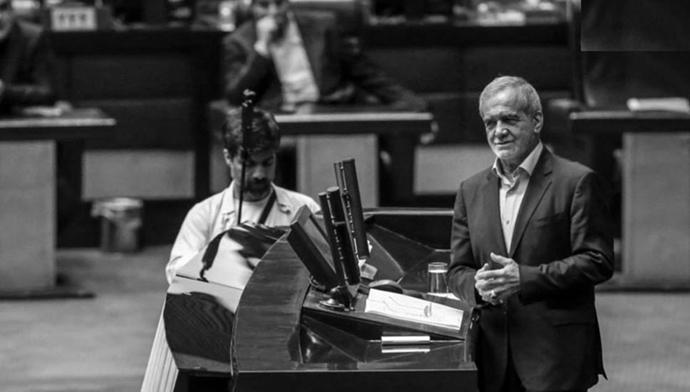

On Tuesday, October 29, 2024, the Iranian parliament discussed the 2025 budget bill. Experts and state-affiliated media have described it with terms such as “a buildup of imbalances,” “a debt-dependent budget,” “an opaque budget,” “a budget with a 40% deficit,” and “the most challenging budget in Iran’s economic history.”
Regime president Massoud Pezeshkian attended parliament to defend the bill, revealing aspects of this alarming budget and depicting the regime’s fear of explosive social tensions and potential uprisings. He stated: “We obtained permission from the Supreme Leader to include foreign currency in the budget in advance. Previously, we had to request it mid-year after social protests erupted, but this time, we secured it beforehand.” Pezeshkian also pointed out the insolvency issue in this budget, often referred to as “imbalance,” stating, “We face imbalances in electricity, water, and gas—all requiring scientific interventions, and we must take necessary action.”
Pezeshkian’s mention of “interventions” and “necessary action” hints at potential price hikes. Coinciding with the budget proposal, the Minister of Energy announced that “electricity prices will increase, and the government is no longer obligated to cover electricity costs in rials.”
Statements from other parliament members on Tuesday further reflected fears of public protests. MP Jafar Qaderi warned that this “could create issues, and God forbid, lead to tensions in society, making the country more unstable than before.”
Nasrollah Pejmanfar remarked, “This is a debt-financed budget,” and added, “For the first time, a government is turning to the (Development) Fund at the beginning of the year, which is a risk.”
Another parliament member, Hossein Samsami, commented, “If you want to increase public dissatisfaction, vote for the 2025 budget bill… They are trying to incite unrest and drag people into the streets. This budget itself sets the stage for social unrest.”
State-affiliated newspapers have published numerous articles about this hastily constructed, contradictory budget, whose result is further devastation to the national economy and worsening public suffering, particularly for the deprived. On October 28, Jahan-e Sanat described the 2025 budget as “the most challenging budget in Iran’s economic history,” explaining further, “A buildup of imbalances… all have now reached a crisis point. Continuing this path without reforms is impossible, yet any economic reforms will bring social and political challenges to the country.”
It concludes by saying that the regime “faces a painful paradox, with neither a path forward nor back. Economic reforms cannot be postponed, yet the country lacks the political and social capacity for these reforms… Continuing on this path will undoubtedly push Iran’s economy into even more critical conditions than in previous years.”
Naturally, this state-affiliated newspaper cannot discuss the root cause of the “critical conditions,” which is the rule of the mullahs. However, anyone can easily understand that as long as the cause remains, the effects will persist. The root of the current economic and social deadlock lies in the mullahs’ kleptocratic regime, and thus, the only solution is to overturn this ruling system.