

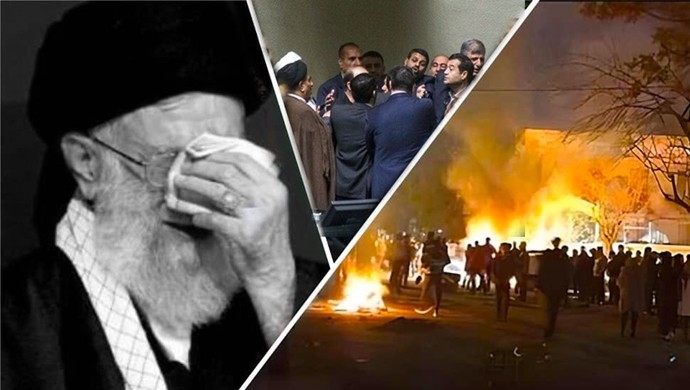

While the Iranian regime’s upcoming presidential election has intensified internal tensions within the regime, the intelligence and judiciary apparatuses are warning the candidates and state media to avoid infighting. Many regime officials see tensions as extending beyond the election issue. They implicitly and even explicitly analyze the regime’s tensions following Ebrahim Raisi’s death as a systemic crisis.
On June 5, Mohammad Hossein Saei, a member of the regime’s Cultural Revolution Council, said in an interview with state television, “The loss of [Raisi] cannot be easily compensated. We currently do not have a personality capable of creating political balance within the country to the extent he did.” He continued, referencing the precise and “important historical juncture” and “the critical pass that everyone knows about,” addressing those disqualified in a frightened and pleading tone, saying, “If we pass this stage correctly, the benefit of those who are complaining will certainly be better met than in a situation where we, with this type of approach which is neither critical nor subversive, create an atmosphere where we all suffer together. This understanding that we are all in the same boat is crucial.”
At this “critical pass,” even the regime’s experts, who are sitting in the damaged and sinking ship of the regime, have unveiled the curtains about the “reduction of social capital” and are warning about the danger of an eruption of social anger against the regime.
In an interview with a state-run website, economist Hossein Raghfar said, “Our society is prone to very widespread protests, even more extensive than those we witnessed in 2022. The reason for this is the inequalities that our young generation rightfully demands…” He went on to set aside pleasantries with the regime and its rulers, bluntly stating, “The rulers must decide whether they want to stay or must be overthrown. They need to make a decision, and unfortunately, I think we are approaching those stages.”
Even regime supreme leader Ali Khamenei, who in the initial hours of Raisi’s fall tried to make it seem bearable and under control, when he went to console Raisi’s family, said, “I feel that it is irreparable. It is a heavy loss, a great sorrow.”
The turmoil and anxiety in the mullah’s regime after Raisi’s death can be seen in the way the leaders and the regime’s propaganda apparatus are trying to boost the spirits of their demoralized forces, especially when they compare the current situation of the regime with the state of the regime and the threat of overthrow in 1981.
In this regard, on May 24, Hossein Shariatmadari, Khamenei’s representative in the Kayhan newspaper, said in an interview with state television, “In 1981, within approximately two months, give or take a few days, the President, Prime Minister, Chief Justice of the Supreme Court, several ministers, several members of parliament, and several high-ranking officials of the regime were martyred. Any one of them alone was enough to overthrow a regime.”
A day later, on May 25, Khamenei’s website, under the title “The God of 1981 is the same God of this year”, wrote: “If the country grew and flourished in the midst of those crises and wounds while its official and legal structures were not yet fully formed, it will also emerge proudly from the bitter and tragic events like the loss of former IRGC Quds Force commander Qasem Soleimani and Raisi.”
These statements only highlight the depth of the regime’s crisis and the concern of regime factions about the threat of uprising and overthrow.