

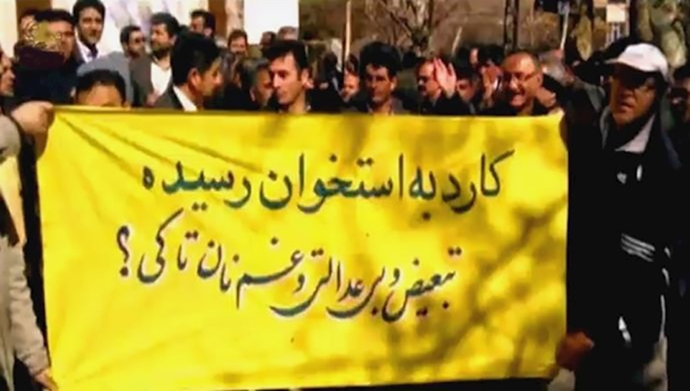

“The 400% Drop in Wages Over a Decade”—this is the shocking front-page headline of Iran’s state-run Mardomsalari newspaper on January 29, 2025. This headline alone paints a grim picture of the catastrophic living conditions of workers and wage earners in Iran. It means that the standard of living for workers and laborers has declined fourfold over the past 10 years. Other economic data confirm this conclusion. A decade ago, the minimum wage for workers was around 6 million rials, which was equivalent to approximately $235 at the time. Today, the minimum wage, adjusted for the current exchange rate, amounts to just $94. This decline in wages is accelerating rapidly. At the beginning of this year, the minimum wage was equivalent to $133, meaning that in just 10 months, workers’ purchasing power has dropped by 30%.
Statistics alone cannot fully capture the bleak reality of workers’ and laborers’ lives. According to state-run newspapers, 60% of the population is unable to meet the minimum daily requirement of 2,500 calories for survival. At this stage, it is no longer just about shrinking dinner tables; people’s tables have become void of meat, dairy, cooking oil, and other basic necessities, leaving the majority exhausted. Even the regime’s own statistics confirm this. According to Etemad newspaper on December 12, 2024, since 2011, per capita consumption of fruit has dropped by 50-60%, dairy by 80%, and meat by 60%.
The meaning of these statistics, in one word, is hunger—a vast population of the hungry, many of whom are forced to scavenge for food in trash bins. Workers, in an effort to survive, often work second and third jobs, clocking in more than 12 hours a day.
Research shows that 75-80% of Iran’s population now lives below the poverty line. On April 6, 2024, the state-run ILNA news agency quoted a regime-affiliated expert as saying, “The population below the poverty line has doubled, and the number of employed individuals living under the poverty line has increased fivefold.”
This growing poverty and deprivation are manifesting in all aspects of social life, including housing. In 2020, the Iranian regime’s Ministry of Housing and Urban Development reported that 26 million people were living in slums. Given the rapid expansion of poverty over the past four years, estimates suggest that at least 30% has been added to this figure, leading to conditions beyond slum-dwelling, such as homelessness, rooftop sleeping, and even grave sleeping. Significantly, during this same period, official sources report that at least 2.5 million housing units remain unoccupied. These units are said to be primarily owned by banks, which hoard housing and play a major role in driving up property prices and rent. It is clear that these banks are controlled by regime-affiliated plunderers, rent-seekers, and embezzlers, with Supreme Leader Ali Khamenei at the top, effectively holding the livelihoods of over 80 million Iranians hostage.
Regime officials try to blame the unprecedented levels of poverty and destitution on foreign conspiracies and economic sanctions. However, this is a lie that deceives no one, as everyone knows that the real problem lies within the corrupt and kleptocratic system of the mullahs’ regime and its predatory economy. Over the past four years, during a period when sanctions had been somewhat loosened, the regime exported an average of over 2 million barrels of oil per day. Yet, during this same period, poverty has deepened and expanded further. The real cause is the multi-headed dragon of government corruption and the Islamic Revolutionary Guard Corps (IRGC), which has sunk its claws into Iran’s economy and the livelihoods of its people, continuously devouring the hard-earned income of the working class.
Iran’s oppressed and working-class population, trapped under this predatory economy, has now turned into a volcano of fury against the regime of executioners and looters. The rumbling of this volcano can even be heard in state-run media. A regime-affiliated newspaper recently issued a stark warning, as quoted by the Jomhouri newspaper on November 25, 2024: “These suppressed grievances will one day erupt like a volcano, unleashing an army of the deprived and the hungry against those responsible for this injustice—an uprising that can only be called the Revolution of the Hungry Army. Are you not afraid of such a revolution?”