

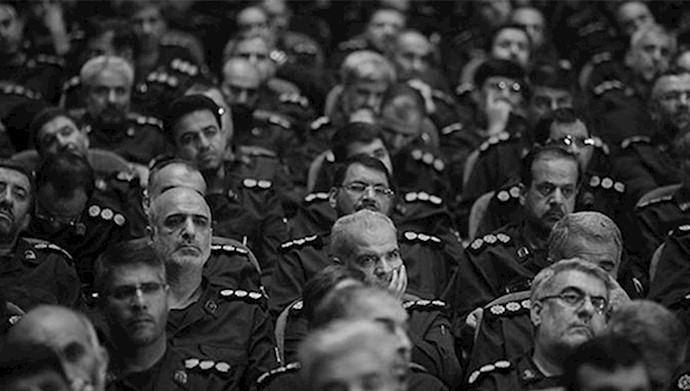

The common practice among Iranian regime officials when addressing political, economic, and social crises is to make misleading statements, which they deceptively label as “interpretation jihad.” The closer these officials are to regime supreme leader Ali Khamenei or in cases where they are directly appointed by him, they try to be more deceiving in their statements regarding the roots of the regime’s problems. Examples of such officials include heads of the judiciary, Majlis (parliament), and government.
The regime resorts to the strategy of “interpretation jihad” to evade acknowledging the root causes of the successive political, economic, and social crises of the regime.
Over the past year, Khamenei, the leaders of the three branches of regime, and others within the regime have made every effort to avoid acknowledging the horrifying principle at the root of the crisis. One important part of this strategy is to replace the word “people” with “enemy.” Whenever regime officials use the term “enemy,” they are effectively referring to the people. On the other hand, whenever they use the term “people,” they refer to the regime and its interests.
If the word “enemy,” which is used in the literature and propaganda of the regime, is placed in its rightful position, it becomes evident that it is this regime and its leaders who are the enemies of the Iranian people. And from the regime’s perspective, it might make sense, because in reality, the regime is the main enemy of the people, and the people of Iran want nothing more than to overthrow this regime.
How is it possible that a regime, with all the available media and publishing resources at its disposal over the past 45 years, keeps emphasizing the “necessity of interpretation jihad to introduce the values of the regime”? What is the reason behind all this hype surrounding “interpretation jihad” and its supposed necessity?
But no matter how much they resort to their deceitful rhetoric under the umbrella of “interpretation jihad,” the regime’s officials can’t hide the truth, which is the fact that they are the real culprit of the crises that have riddled Iran. On January 10, Gholamhossein Mohseni Ejei, the head of the judiciary, made remarks in Mashhad, which were later reported by the IRGC-run Tasnim News Agency:
“Today, the sword of justice must move forward alongside the issue of interpretation. Cultural work must be done, but judicial and security measures must also be taken, and in some cases, there is simply no other way.”
In other words, Mohseni Ejei acknowledged that deceitful rhetoric cannot replace suppression, torture, and executions, which have been fundamental pillars of the regime’s rule.
In the same remarks, Mohseni Ejei also revealed his true fears, which in recent weeks have been echoed by other regime officials. As the sham parliamentary elections near, he is afraid of a widespread boycott by the people, which will shed the last veneer of legitimacy that the regime has tried to maintain. “Let’s participate by voting, and then continue with our demands,” he said, trying vainly to implore the people to participate in the sham elections while implying that no matter what the outcome will be, their demands will not be met.
In short, the regime has accepted that its deceitful rhetoric will not fool the people, and it is trying futilely to push the can down the road, hoping against hope that it can delay its inevitable downfall by a few more months.