

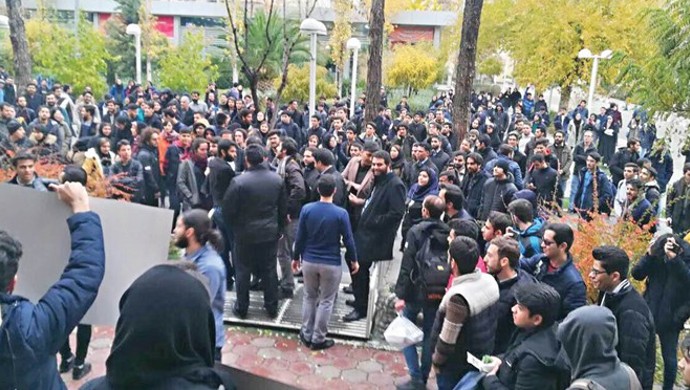

The university holds a special and prominent place in the history of Iran’s pro-democracy movements. Particularly over the past 70 years, universities have played a leading role in the country’s socio-political developments. The “first signs of public anger” against the coup of August 19, 1953, appeared at the university. On December 7, 1953, when the Shah intended to show his foreign patrons that he had regained control following the coup against Mohammad Mossadegh and that “the bloodshed was over and the gallows dismantled,” it was the students of the University of Tehran who raised their voices in protest amidst the dark atmosphere of post-coup oppression, bringing renewed hope for the nation’s future. During the protests, the Shah’s security forces murdered three student activists, who later became the symbols of Iran’s “Student Day.”
It was the blood of students that flowed through the veins of universities thereafter, making them bastions for freedom struggles. From these bastions emerged the vanguard of resistance against the Shah regime, founding groups like the Fadaiyan and PMOI. Their sacrifices culminated in the mass protests that overthrew the Shah regime in 1979.
After Ruhollah Khomeini seized power in the 1979 revolution, he shut down universities from 1980 to 1983 in a repressive move. Expressing his disdain for universities, he declared, “All the misfortunes that have befallen humanity have their roots in universities… Universities have led the world to corruption!” (December 18, 1980).
Khomeini’s successor, Ali Khamenei, spared no cruelty against students and academics. He filled universities with Basij militia members under the guise of students, institutionalized the dominance of his representatives and repressive forces on campuses, and expelled and imprisoned thousands of conscious and activist students while purging and dismissing numerous professors and academic staff.
Despite the regime’s repressive measures against universities, rebellious students have repeatedly risen up. Through powerful demonstrations and chants like “Students will die but will never accept disgrace,” they have dealt significant blows to the oppressive government.
In the nationwide uprisings of December 2017, November 2019, January 2020, and Fall 2022, universities played their rightful roles. The slogan “Reformist, conservative, the game is over” ignited at universities and spread nationwide, sending the message that the people of Iran reject the regime in its entirety and with all its factions. During the November 2019 protests, students directed their sharp slogans at the regime’s leader and initiated a movement for freedom. In the Fall 2022 uprising, students from over 250 universities across Iran staged more than 1,000 protests, shaking the foundations of the regime.
In recent years, Khamenei has attempted to co-opt Student Day by organizing appearances of regime officials at universities to further his agenda. Each year, several of his appointed cronies and functionaries are dispatched to deliver speeches at various universities. However, students have not tolerated this disgrace. On numerous occasions, they have disrupted these staged events, humiliating the officials and forcing them to leave the campus under the echo of resounding protest slogans.
This year, too, a number of regime officials are scheduled to visit various universities to give speeches for Student Day. This occurs amidst a backdrop of devastating crises engulfing the regime both internally and externally, and the mounting fury and resentment of a populace weary of skyrocketing prices, inflation, oppression, and repression—especially the reactionary measures imposed on the free women of the nation.
In such circumstances, students will reflect the anger of the population by protesting the presence of government officials in universities and to reclaim the bastion of freedom from the regime’s agents.