

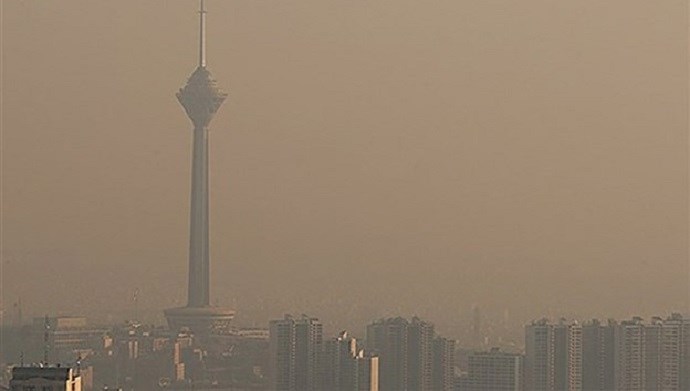

Deprivation in Iran has reached a point where the people have been denied of the right to breathable air. They must take to the streets and cry out to obtain their vital and natural right. This symbolizes a regime that does not hesitate to commit atrocities against the people of Iran.
Under the rule of mullahs, who do not recognize any international standards for citizen health, Iran’s people have been suffering from air pollution caused by polluting industries for decades. Even media and environmental experts of the regime raise warnings and publish articles about this critical issue, but public health has no place on the mullahs’ agenda.
The annual damage of nearly $8 billion attributed solely to particulate matter smaller than 2.5 microns (according to the statistics of the Ministry of Health in 2021) includes the costs associated with mortality. This includes increased respiratory diseases such as respiratory infections and lung cancer, as well as strokes and heart attacks, and the prevalence of autoimmune diseases, cancers, and emerging diseases such as multiple sclerosis (MS) in industrial cities.
One of the devastating effects of environmental pollution is the impact it has on pregnant women and newborns who face the consequences of the regime’s policies. The inflicted damages include premature births, brain injuries to infants, developmental disorders, autism, decreased intelligence quotient (IQ), and fetal abortion. These are just a fraction of the tragedies that the clerical regime imposes on future generations.
An incomplete list of air pollution sources
During winter season, concerns about air pollution are multiplied.
On January 20, the state-run Shargh newspaper quoted Dr. Youssef Hojjat, a university professor and the head of the Air Pollution Task Force at the Academy of Sciences, as saying, “The main problem of air pollution is fine particulate matter smaller than 2.5 microns, which is caused by private vehicle transportation. Following that is non-standard public vehicles. The issue is the quantity of gasoline consumption.” In fact, the problem lies in excessive traffic. According to statistics published in 2019, daily gasoline consumption in Iran is 90 million liters, while in Turkey, it is only 9 million liters. Daily diesel consumption in Iran is 85 million liters, compared to 47 million liters in Turkey.
Under the mullahs’ rule, there has been a continuous reduction in urban development plans and fundamental investments in urban services, including public transportation services, which are part of citizens’ rights. Instead, emphasis has been placed on personal transportation, which has added numerous detrimental effects to environmental health.
The Law on Public Transportation Development and Fuel Consumption Management, passed in 2007, states that the share of suburban public transportation should be 60%. However, in 2021, it has reached only 7%. The share of urban public transportation should be 50%, but in 2021, it has reached only 13%.
Where is the water?
Nowadays, finding drinking and irrigation water in the land of Iran is like discovering treasure in ruins. For 40 years, the mullahs’ have deprived Iran’s people of the most basic needs.
Gholamali Shah-Hosseini, one of the managers of the country’s water resources, says, “Our country has been facing water stress for 20 years. In all six main river basins of the country, the extraction of renewable water resources exceeds the standard, and naturally, this extraction is done from groundwater. 63% of the country’s area is prohibited in terms of groundwater extraction. 80% of the country’s aquifers are located in these prohibited areas. Groundwater resources have a direct relationship with land subsidence, and 60% of agricultural lands are experiencing subsidence.”
The Director-General of the Geological Survey Organization presents even more alarming figures: “Between the years 2016 and 2021, the area of subsided lands in the country has increased by 10 times. This is happening while approximately 55% of surface water resources and 75% of groundwater resources are facing increasing salinity.”
The immense crisis of land subsidence and soil erosion
Inappropriate agricultural practices, deforestation, and reckless grazing have resulted in soil erosion throughout the country. Unsustainable land use eliminates protective vegetation cover and disrupts soil structure, making it vulnerable to erosion.
On December 20, the state-run Fars News Agency wrote, “Soil erosion in Iran is six times higher than the global average. Land subsidence is a critical crisis that has intensified in recent years due to excessive water extraction in Iran. The issues of land subsidence and soil erosion can lead to a major crisis in the future of the country.”
Approximate estimates and expert statistics indicate that soil erosion in Iran, outside of government and administrative structures, causes annual damages of around $50 billion.
On February 19, the official IRNA news agency wrote, “Iran has an erosion rate equivalent to 2 billion tons per year, making it one of the countries with the highest soil erosion rates in the world. This rate is three times higher than the national average in Lorestan province and ranges from five to ten tons per hectare annually in Borujerd city. ”
Soil is either non-renewable or has a process that spans thousands of years. It takes approximately 500 years to produce one centimeter of soil on land, but it only takes one year to destroy 2 billion tons of fertile soil in the country! What makes soil destruction alarming is its relationship with food security. It takes around a thousand years to form one centimeter of fertile soil. The formation of 25 centimeters of agricultural soil takes place over a period of 20,000 years.
In Iran, air, water, and soil have also become the victim of the mullahs’ tyrannical rule. And they can also be restored once this regime is overthrown and replaced with a state that cares for the people and the land.