

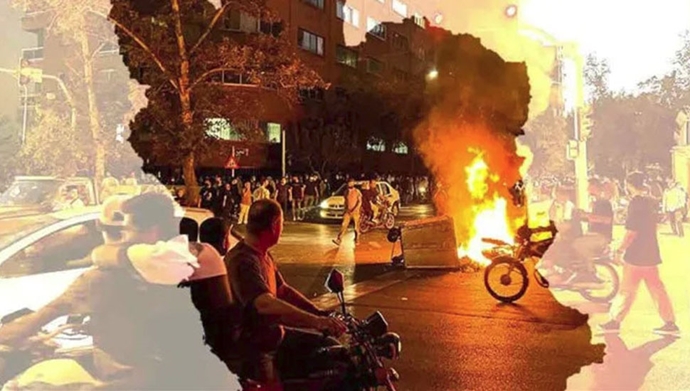

After more than four decades, religious fascism ruling Iran has reached its most critical state. Deep social, economic, and political rifts, rampant systemic corruption, and the decline of its regional and international standing have created new dynamics. The regime’s desperate efforts to increase executions indicate that the religious dictatorship has reached a dead end and is on the verge of collapse.
The critical state of the governance can be analyzed along the following four main axes:
- A Society on the Brink of Explosion
The regime faces widespread dissatisfaction among the population, stemming from systemic corruption, ruthless repression, and economic incompetence, bringing the situation to a boiling point. Nationwide uprisings in recent years, from December 2017 to the 2022 protests, have demonstrated that Iranian society no longer trusts the regime, and the escalation of uprisings in the future is inevitable. This constitutes the objective condition for revolution and overthrow.
- Organized Resistance and the Role of Rebellion Hubs
Despite the regime’s repressive measures, Iran’s Resistance has become an effective and inspiring force. The Resistance Units inside the country are becoming the cornerstone of organizing protests and countering the regime’s repression.
The invaluable experience of the Syrian revolution, as one of the many successful movements, proved that it is impossible to overcome a ruthless dictator without having a dedicated force and organized resistance. The Iranian Resistance currently possesses such an asset, which can play an pivotal role as the subjective condition in the democratic revolution of the Iranian people.
- The Decline of the Regional Standing of the Regime
Regionally, the expansionist and terrorist policies of Iran’s regime have failed. The regime’s proxies in Iraq, Syria, Lebanon, and Yemen have been weakened due to internal and external pressures, and they can no longer serve as levers of regime influence. The decisive defeat and marginalization of Hezbollah in Lebanon and the overthrow of Bashar al-Assad in Syria have inflicted irreparable damage on the regime’s “strategic depth.” What is now referred to as the “Axis of Resistance” is nothing but empty rhetoric.
- Economic Stalemate and Inability to Reform
The regime is neither able to extricate itself from its economic crisis nor implement even minimal reforms in its flawed structure. Economic bankruptcy, rampant inflation, and the collapse of the national currency have made life extremely difficult for people. This economic deadlock, coupled with structural corruption, fuels public protests.
The increase in the military budget compared to budgets for infrastructure, education, healthcare, industry, communication, energy, and transportation in the 2025 budget bill reflects a wartime scenario. Its effects are evident in reduced investment in the power industry and the forty-fold rise in food prices since the early 2010s.
The Three Pillars of the Regime’s Failed Strategy
The regime relies on three elements for survival: domestic suppression, regional warfare, and efforts to acquire nuclear weapons. However, this strategy is also crumbling.
Domestic suppression: Widespread and persistent protests have shown that repression can no longer control society.
Regional warfare: The failure of the regime’s policies in the region and the weakening of its proxies have proven that foreign expansionism is no longer effective.
Nuclear ambitions: Efforts to obtain nuclear weapons have not only increased the regime’s isolation but also mobilized the free world against it.
Fearmongering with the Illusion of Syriafication of Iran
Certain policy circles, advocates of appeasement policies, and regime lobbyists abroad tried to scare Iranian society and the global community with the notion of “Iran turning into Syria.” Or better said, they used to do so. It has now become clear that this regime-engineered phobia has no basis.
In a recent conference, Maryam Rajavi, the President-elect of the National Council of resistance of Iran (NCRI(, challenged this big lie:
“Some in the West are attached to commercial deals with the regime. However, the benefits of such trade pale in comparison to the damage this regime inflicts on global peace and security.
“Others believe that the overthrow of this regime will lead to instability. Yet, the events of the past 14 months have once again shown that the primary source of instability and destruction in the region is this very regime.
Some, influenced by the regime’s propaganda and its lobbyists, spread the great lie that the alternative to this regime is chaos and terrorism.
“For this criminal and belligerent regime, there is an Iranian solution.
“This solution is the overthrow of the regime by the Iranian people and their organized resistance.”
In her speech, Mrs. Rajavi stressed that the key elements of this solution include:
The deeply discontented and incensed people, along with the Resistance Units—components of the Liberation Army—that, through the preparation of an organized uprising, are the driving force for change in Iran and will bring it to fruition.
The democratic alternative represented by the National Council of Resistance of Iran (NCRI), which, with its international recognition and credibility, and a clear program, is leading this struggle.
The People’s Mojahedin Organization of Iran (PMOI/MEK), with thousands of experienced cadres, and Ashraf 3, one of its centers, which serves as a source of inspiration for the struggle of women and youth in Iran for freedom.
A Program for the Future: The Iranian Resistance emphasizes freedom, equality, and the separation of religion from state. Its future program includes the abolition of the death penalty, the establishment of social justice, and the creation of a non-nuclear Iran.
The Need to Recognize the Resistance
Rather than relying on foreign powers, the Iranian resistance relies on the will of the people and its supporters inside Iran. In the same conference, Mrs. Rajavi emphasized:
“As I have repeatedly said: We have never asked any government or power to take action for change in Iran.
“However, we call on the entire world to: Firstly, recognize the Iranian people’s struggle to overthrow the regime. Secondly, as emphasized in the statement of 510 German lawmakers last July: ‘The Iranian regime has closed all political avenues for change. Therefore, the free world must recognize the right of the Iranian people to revolt and the right of the Resistance Units to confront the Revolutionary Guards (IRGC).’”
What is certain is that the regime ruling Iran is on the brink of collapse and cannot overcome its multi-layered crises. This situation has created a historic opportunity for the Iranian people and the organized resistance to put an end to decades of oppression and tyranny.
With the unity of the people and the resistance, a free, democratic, and bright future awaits Iran and its people.