

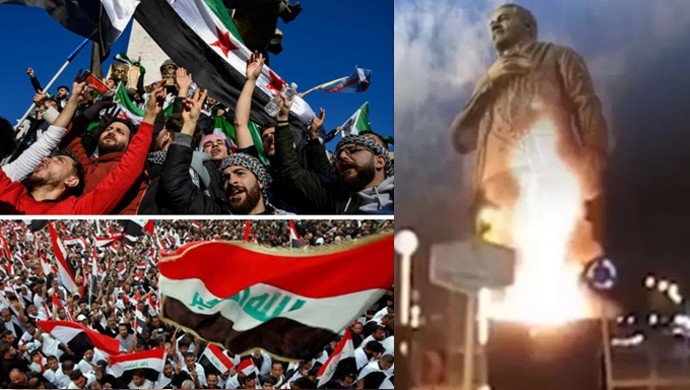

On the anniversary of the killing of Qassem Soleimani, the former chief terrorist of Iran’s regime, both his crimes in Syria and Iraq and the toppling of images of this criminal amid chants of “Curse on Soleimani” in these two countries have been highlighted. This occurs under conditions where the recent fall of the Assad regime in Syria has triggered a chain of extraordinary transformations with visible effects in the region, particularly in Iraq.
The overthrow of the Syrian dictatorship, as a severe and strategic defeat for the Iranian regime, has disrupted the balance of power in Iraq to the Iranian regime’s detriment. The Popular Mobilization Forces (Hashd al-Shaabi), the paramilitary wing of the Quds Force in Iraq, is now facing potential dissolution. Ibrahim Sumaidaie, political advisor to Iraq’s Prime Minister, stated in a televised interview: “Iraq cannot remain the sword of the resistance axis after the fall of the Assad regime and the weakening of Hezbollah in Lebanon. Now, from the perspective of our responsibilities, we must work with armed groups to consider their dissolution and integration into the country’s political structure” (Asharq Al-Awsat, December 18, 2024).
These remarks may serve as a rebuttal to claims by Iran’s regime and its proxies, who strive to save face and pretend that nothing significant has occurred, claiming that the “resistance” (which in reality is the regime’s policy of warmongering and exporting terrorism in the region) remains unscathed.
During a meeting with regime eulogists on December 23, 2024, regime supreme leader Ali Khamenei referred to “faithful men present and who will be present in Yemen, Iraq, Lebanon, Palestine, and soon in Syria” as being capable of turning the situation around. One of his loyalists, Ahmad Khatami, stated: “The resistance remains and will continue until America is driven out of the region” (Fararu, December 17, 2024).
However, the reality is entirely different. A spokesperson for one of the PMF factions, Kata’ib Hezbollah, admitted: “The conditions are decisive and shape the stances of the groups. This matter is no longer about courage or recklessness” (Asharq Al-Awsat, December 23, 2023).
What Asharq Al-Awsat quoted from the spokesperson of Kata’ib and the advisor to the Iraqi Prime Minister reflects the precarious state of forces aligned with the Iranian regime, which are no longer able to maintain their previous role even within Iraq. Especially since the regime’s proxy forces in Iraq, responsible for corruption, repression, and killings, are hated by the Iraqi people. Now that the regime has been severely weakened, their existence is in jeopardy.
According to the leader of the Harakat Hezbollah al-Nujaba group, one of the factions under the regime’s command in Iraq, an agreement has been reached between the militias and the Iraqi Prime Minister. Under this agreement, these groups will halt military operations against Israel and remain silent regarding changes in Syria. He added, “Iran has given us the freedom to decide on issues related to Syria” (Entekhab, December 23, 2024).
Statements by Esmaeil Baghaei, spokesperson for the regime’s foreign ministry, on December 23, 2024, that “relentless pressure is being exerted on the Iraqi government to dissolve Hashd al-Shaabi” and that “decisions about Hashd al-Shaabi are up to the Iraqis,” reveal the regime’s weakened position in Iraq. The regime is unable to support its proxies and can only offer asylum to some of them who have fled Iraq, such as Qais Khazali, the leader of the Asa’ib group. According to a spokesperson for this group, Khazali has been in Iran for some time and has gone to Qom “to continue his religious studies” (Asharq Al-Awsat, December 22, 2024).
The loss of the regime’s influence in Iraq represents an irreparable disaster for Khamenei, as he has repeatedly emphasized the vital importance of the regime’s “strategic depth,” stating: “Strategic depth is sometimes more essential than the most essential necessities of the country” (Khamenei’s official website, October 2, 2019).
This “most essential necessity” has collapsed in Syria, and with the arrival of this transformative earthquake’s wave in Iraq, Khamenei faces a grim fate.