

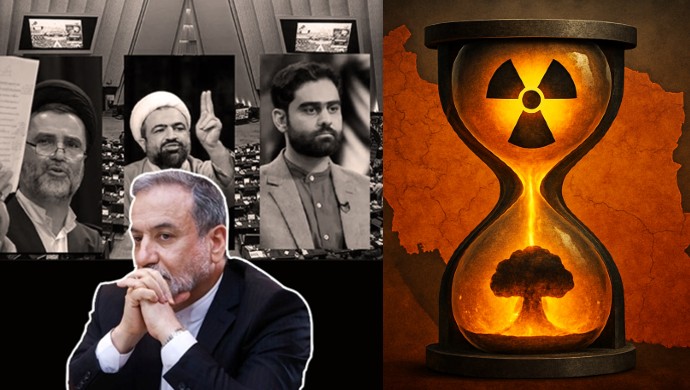

The Iranian regime’s recent nuclear agreement with the International Atomic Energy Agency (IAEA) in Cairo, presented as a diplomatic breakthrough, has instead ignited a firestorm of infighting within the ruling theocracy. Supreme Leader Ali Khamenei’s desperate calls for “unity” have been utterly ignored, as the deal has exposed the deep, irreconcilable fractures between the regime’s factions. This internal war is not a sign of healthy political debate; it is the death rattle of a corrupt and crumbling dictatorship whose singular, unwavering goal is to buy time to build a nuclear bomb. The chaos in Tehran is yet another clear signal that the regime is incapable of being a reliable partner and that the time for international complacency is over.
A desperate ploy to avert sanctions
The agreement, struck on September 9 between Foreign Minister Abbas Araghchi and IAEA Director-General Rafael Grossi, was designed to resume inspections of the regime’s nuclear sites. However, its true motive was not a newfound commitment to transparency but a desperate maneuver to stave off the reimposition of crippling UN “snapback” sanctions threatened by European powers. The E3—France, Britain, and Germany—had made renewed IAEA access a condition for pausing the process.
The regime’s duplicity was on full display immediately. Araghchi issued a blunt threat, stating that the agreement would be considered “null and void” in the event of any hostile action, including the reinstatement of sanctions. This proves the deal was never a good-faith effort at diplomacy but a cynical, tactical ploy to delay accountability while continuing its clandestine nuclear activities.
A firestorm of infighting erupts
The backlash from within the regime was immediate and vicious, revealing a government at war with itself. Hardliners launched a coordinated assault against Araghchi and the agreement. Hossein Shariatmadari, Khamenei’s representative at the Kayhan newspaper, publicly questioned Araghchi’s legal authority and denounced any deal with Grossi, calling an agreement with a “traitorous party” legally invalid.
This sentiment was echoed in the parliament. Mahmoud Nabavian, a prominent MP, branded the Cairo accord a “cursed agreement,” accusing Grossi of being a spy whose work led to the killing of the regime’s commanders and scientists. Other MPs went even further, with Javad Hosseini-Kia calling the IAEA chief a “Mossad agent” and demanding that he be arrested if he ever enters Iran. The conflict became so intense that the parliament, which had been suspiciously sent on an 18-day recess until September 27 to avoid oversight, was forced to convene an emergency session after more than 70 enraged MPs demanded answers from Araghchi and Ali Larijani, a close advisor to Khamenei and the Secretary of the Supreme National Security Council (SNSC).
The time for delay is over
The chaos consuming Tehran is irrefutable proof that the regime is too fractured, too duplicitous, and too obsessed with its nuclear ambitions to be trusted. This recurring pattern of deceit and delay is a deliberate strategy to advance its illicit weapons program. This is further proof that the era of stalling and buying time is over for this regime. The international community must abandon any illusion of reaching a viable agreement with this crumbling theocracy. The time has come for a firm and decisive policy that holds the regime accountable for the grave threat it poses to global peace and security. There is no possible scenario that the regime will endorse peace, security and stability in the region. The ultimate solution to the impasse lies within the Iranian people and their organized resistance, who are poised to overthrow the regime and establish a democratic republic.