

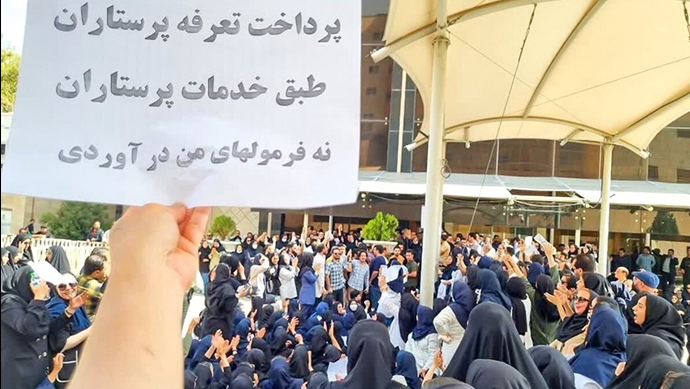

While Iranian regime factions continue to fight over the cabinet of new regime president Massoud Pezeshkian, various social groups and segments of the population, indifferent to this dirty power-sharing environment, continue to expand their protests daily in the streets.
In recent days and weeks, almost no day has passed without protests in the streets of cities, with a general “no” rising against the entire regime and its handpicked government. This stands in stark contrast to the empty slogans and even the speech given in parliament last Saturday, where it was blatantly admitted that the new administration intends to continue Ebrahim Raisi’s path and the seventh plan, which has been rejected by economists. This path includes the same suppression of freedom, misogyny, and the theft of the remaining crumbs of bread from the poverty-stricken. This was evident in the immediate 25-percent hike in bread prices percent and the withdrawal of 40 trillion rials from the bankrupt pension fund to perform government theatrics during the Arbaeen (the 40th day of the martyrdom of Imam Hussein, the grandson of the prophet Mohammed) pilgrimage.
According to Jamaran website on July 19, regime economic analysts continuously warn that “special economic decisions made without considering social issues and realities may lead to increased inequality, deepening social divides, and the emergence of social discontent and protests. The economy should not be viewed separately from society, as every economic decision has its own social and political consequences”. However, the regime’s newly appointed president, despite all the fanfare and rhetoric, is incapable of making these “special” and broad economic decisions, as these matters are reserved for the regime supreme leader Ali Khamenei and his inner circle.
Protests of Social Groups and Classes
All protesting segments of society have reached the conviction that regime officials will do nothing for them and they can only reclaim their rights in the streets. Among these groups, some find opportunities for solidarity and can exploit gaps within the regime’s security apparatus to voice their demands with protest cries heard by their fellow citizens.
A quick look at the headlines of a few protest reports in the past week reflects the explosive situation in the country, fueled by exploited social groups and classes:
For more than two weeks, nurses and healthcare staff in various cities across Iran held protest rallies, chanting slogans such as “We won’t stop until we get our rights” and “The rallies, sit-ins, and strikes will continue.” As one of the hardest working segment of the society, nurses are being neglected by the government, facing extremely low wages, poor working conditions, harsh overtime work rules, and other harsh conditions.
At the same time, employees and workers of the oil and gas sector have held protests in cities such as Aghajari, Lavan, and Siri. Working in extremely difficult conditions, these protesters are demanding changes to their contract and wage status and better working conditions.
Meanwhile, retirees of different sectors, including telecommunications, steel, and the public sector continue to hold protests in dozens of cities on various days of the week. After spending a life of serving their country, the retirees are facing very low pensions that can’t cover their most basic needs.
Additionally, creditors of the state-run Maskan-e Melli housing company in Shahrekord staged a protest in front of the city’s Department of Roads and Urban Development. These applicants have made down payments for their homes several years ago but the company has yet to deliver their homes.
The Incompetence of the “Anxious Government”
Pezeshkian’s speech on August 17 in the Parliament demonstrated the deadlock and lack of solutions for this appointee of the Supreme Leader.
He repeatedly begged and pleaded with the parliamentarians to accept ministers who have long demonstrated their loyalty to the Khamenei’s line and have participated in all the regime’s crimes. He said, “I beg the representatives of the parliament to help… By God, we consulted in selecting the proposed ministers.” However, even regime experts indirectly admit that this fledgling government will not take any steps toward “improving social and economic quality” and is entirely focused on suppressing protests.
On August 1, Farhikhtegan newspaper wrote: “Because in recent years social protests in Iran have widened the social gap and increased social pressure, governments are now working under difficult conditions. I call this situation the ‘anxious government.’ In this situation, the government fears that any action might cause public discontent and anger, and as a result, it refrains from taking any action for improving social and political quality, becoming more of a neutral government.”
In this turmoil, the first people to receive the message of the new government’s weakness and anxiety are the very segments of society and hardworking individuals who bear the heavy burden of economic crises. For this reason, they seize every opportunity to take to the streets.
They know that none of the economic and social crises are being resolved, so they are on the lookout for moments to act, which will undoubtedly come with the escalation of economic and social crises at the grassroots level and the growing political anxieties within the ruling elite.