

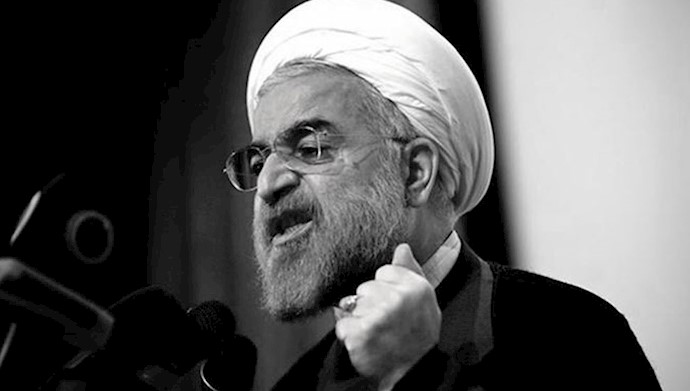

After the letter from the U.S. president to the Iranian regime and Ali Khamenei’s remarks on March 12, Hassan Rouhani, the former president of the regime, once again raised the internal debate within the crisis-ridden regime over whether to negotiate or not.
Khamenei himself addressed this debate on March 12, saying: “Some people inside the country keep amplifying the issue of negotiations, asking why we don’t respond, why we don’t negotiate, why we don’t sit down with America. Let me tell you, if the goal of negotiations is to lift sanctions, negotiations with this U.S. administration will not lift sanctions. In fact, they will make the sanctions more complicated, increase pressure, and negotiating with this administration will only intensify the pressure.”
Thus, the Supreme Leader once again crushed the hopes of those advocating for negotiations. However, 48 hours later, Hassan Rouhani, the former president—who has been sidelined following his disqualification from the Assembly of Experts elections and a series of attacks and threats of prosecution and imprisonment—stepped into the debate, alarmed by the regime’s “critical” and “difficult” situation. Emphasizing the economic crisis and growing public dissatisfaction, he once again called for negotiations.
Rouhani stated: “The situation is very critical, and the further we go, the harder and worse it becomes.” While praising Khamenei, he lamented his lost political position and, in a gathering of his former administration members, said: “We argue over whether we should negotiate or not—what kind of discussion is this? What does it even mean to say we should or should not negotiate? Then we link it to the idea that the Supreme Leader is against negotiations. The Supreme Leader is not against negotiations in principle—he might oppose them under current circumstances, but in a few months, with new conditions, he could be in favor.”
Rouhani knows that after Khamenei’s decisive stance, his words won’t lead to anything. However, the regime’s deepening crisis and especially the fear of an eruption of public anger are so intense that, like other worried regime insiders, he desperately pleads for negotiations. In reality, Rouhani’s appeals and concerns reflect the looming threat of social unrest, like a ticking time bomb under the regime’s foundation—a bomb whose likelihood of detonation increases daily. This crisis manifests in various imbalances, water, fuel, and electricity shortages, inflation, and crushing price hikes that have paralyzed people’s daily lives.
Ironically, Khamenei is even more aware of this danger than Rouhani. However, he understands that if he pulls the thread of negotiations, first his own hegemonic authority will unravel, and then the decayed fabric of the entire regime will be torn apart, leaving no room for maneuver.
Amid the internal power struggle over the nuclear deadlock, on the very same day that Rouhani made his anxious remarks, Khamenei’s Friday prayer leaders across different cities launched attacks on those advocating negotiations.
Ahmad Alamolhoda, Khamenei’s representative and Friday prayer leader in Mashhad, said: “Certain elements have infiltrated our system in such a way that they want to force us into negotiating with America. One fears that such plots might be in motion.”
Reza Nouri, Khamenei’s Friday prayer leader in Bojnurd, also stated: “Trump wanted to trap our officials in a dilemma of war or negotiations. But you saw how beautifully the Supreme Leader saved us from this trap!” Echoing Khamenei’s position, he stressed: “No rational, intelligent, or wise politician would ever enter negotiations with such a person.”