

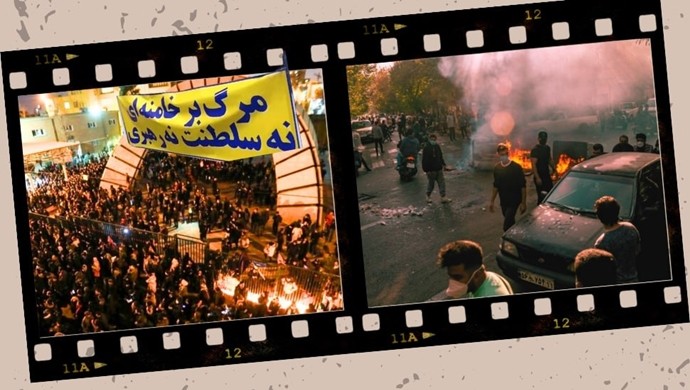

For decades, the West’s approach to Iran has centered on appeasement, sanctions relief, and periodic engagement in the hopes of curbing Tehran’s nuclear ambitions and fostering regional stability. However, the results have been disappointing at best and destructive at worst. The effects are being seen more than ever in the prolonged war that has engulfed the Middle East in the past year.
The Iranian regime’s role in destabilizing the Middle East cannot be overstated. Iran has not only instigated but also fueled conflicts in Iraq, Syria, Yemen, and Lebanon by supporting proxy groups and militias that advance its agenda through violence and fear. Its terrorist interventions in the region have earned Iran’s regime the title “the head of the snake.”
But behind this posturing, the regime is trying to hide its main weakness and fear: the people of Iran and their organized resistance movement who want to overthrow the despotic rule of the mullahs and establish freedom and democracy in their country. As Maryam Rajavi, the president-elect of the National Council of Resistance of Iran (NCRI), said in a recent speech, “Last October, on the day the Middle East war began, the Iranian Resistance declared that the head of the snake of warmongering in the region is the Iranian regime. This regime, which was on the verge of collapse after the 2022 uprising, turned to this foreign war to prevent another uprising and being overthrown by the Iranian people and the Iranian Resistance.”
Berlin Conference:
Ways out of the deadlock: Perspectives for a new #Iran policy democratic change within reach#Time4FirmIranPolicyhttps://t.co/52NcUopqlt— Maryam Rajavi (@Maryam_Rajavi) October 26, 2024
Unfortunately, a series of misguided policies have effectively emboldened Tehran’s ambitions rather than containing them. While the West has prioritized engagement with the Iranian regime, often to secure fleeting nuclear compromises, it has neglected to address the root of the crisis: the regime’s relentless suppression of democratic voices within its borders and its habitual exportation of violence abroad. Diplomatic overtures have been met with a regime that represses its people more brutally with each passing year, as evident in a high number of executions, especially of political prisoners and dissidents.
In her speech, Mrs. Rajavi stressed that “the ruling regime has never been as weak, lacking a solution, and without a future as it is today.” This weakness, however, has only driven the regime to intensify domestic repression and foreign terrorism to survive. Iran’s regional activities—sponsoring terrorist attacks, meddling in Middle Eastern affairs, and even plotting assassinations on European soil—make the regime a direct threat to global security. Between 2018 and 2024 alone, Iran’s regime attempted at least eleven terrorist attacks in Europe.
This unsustainable situation demands a reimagined Western stance. This change would start by cutting off ties with the regime and designating its Revolutionary Guards (IRGC) as a terrorist entity for its destructive role inside Iran and across the globe. This would send a clear message that the regime’s behavior, both at home and abroad, will no longer be tolerated.
But more importantly, it is time for the West to stop propping up the mullahs and stand with the people by recognizing their right to resist the regime and fight against the IRGC. Fortunately, the people of Iran have an independent and organized Resistance movement with a decades-long history of fighting against the regime and with Resistance Units across the country who are organizing protests and anti-regime activities. Together they are fully capable of overthrowing the regime. And the Iranian Resistance already has a platform for a free Iran, enshrined in the Ten-Point Plan of Mrs. Rajavi, a vision for a free, secular, non-nuclear Iran, based on the separation of religion and state, gender equality, and a policy of peaceful coexistence with neighboring countries.
Per Mrs. Rajavi, “Recognize the struggle of the Iranian people for overthrowing religious fascism. This is the solution for Iran’s freedom and peace in the region.”