

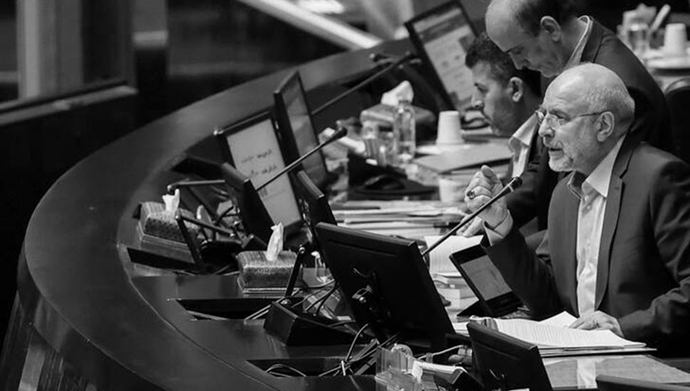

In recent days, the Iranian regime’s parliament (Majlis) has shown fear and concern over the intense dissatisfaction among workers and deprived segments of society, and the potential for livelihood crises, along with water and electricity shortages, to turn into security threats for the clerical regime.
On April 23, 2025, Mohammad Jamalian, a member of the regime’s parliament, stated: “Another important issue is water stress. We are talking about a matter that, more than ever, requires national understanding, managerial consensus, and practical action. Water, this vital element, if we delay action, will turn into a social, economic, and security crisis…”
On April 21, the state-run Mashregh News website, in an article titled “Tehran on the Brink of Severe Drought,” referred to the water crisis and land subsidence as security challenges, writing: “Tehran province, with a population of over 20 million, is facing one of its most serious water resource crises. Consecutive droughts have weakened underground resources, turning land subsidence into a security challenge.”
The challenge and “security crisis” are not limited to water stress and land subsidence. On Wednesday, April 23, Ezzatollah Habibzadeh, another member of the regime’s parliament, pointed to rampant inflation and said: “Today, we face great challenges. Inflation and high prices have exhausted the people. Prices rise daily, but incomes remain stagnant. Unfair taxes are bringing many shopkeepers and producers to their knees. Youth unemployment, especially among the educated, has become a national problem. Housing has become a dream for many young people. Heavy rents have made life difficult for families… People can no longer tolerate hearing repetitive promises…”
Regime officials and state-affiliated media also express fear about the danger of protests, popular uprisings, and “security crises” for the regime, citing statistics on poverty and inflation. On April 19, the state-run Ebtekar newspaper wrote: “The poverty line is increasing at an exponential rate, as food items constitute 35% of household expenditure baskets, and any price increase pushes millions below this line. Rampant food inflation continues while wage growth does not even reach half the inflation rate; this inequality deepens the cycle of poverty.”
On April 24, the Bahar News website also provided a shocking report on the inflation rate under the headline “A Narrative of Difficult Times for Lower Deciles,” writing: “The inflation rate reached its highest level in 1.5 years… Iran’s economy once again witnessed an unprecedented jump in the point-to-point inflation index in Farvardin 1404 (March-April 2025); the wave of price increases, this time not only in daily consumer goods but also in transportation, healthcare, and even fruits and nuts, has affected the lives of millions of Iranians.”
Another member of the regime’s parliament, Mojtaba Zolnouri, while expressing concern about the eruption of public anger and the security crisis for the regime, listed the people’s impatience and frustration: “One: People’s frustration with frequent power outages… Two: When the currency exchange rate rises, everyone raises prices citing the exchange rate, but now that the exchange rate has come down, no one is willing to lower prices…” (April 22).
These examples, which are only a fraction of the crises gripping the regime, are clear signs that these crises have shaken the regime’s foundations and turned into a “security” problem for it. The infighting that occasionally erupts in the regime’s parliament regarding the severity of livelihood and economic crises reflects their concern about the security consequences of these crises and the danger of looming protest uprisings that threaten the regime’s “security” and existence.