

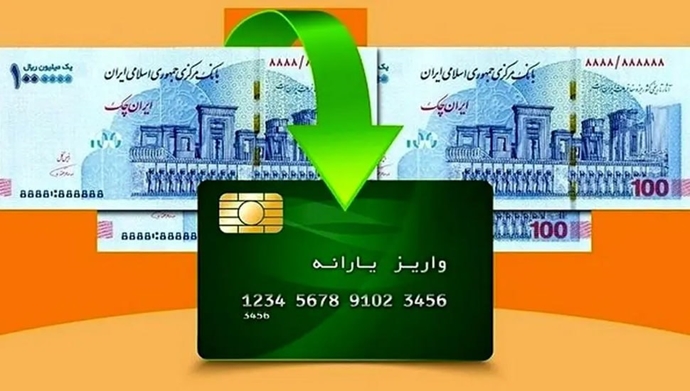

While Iran’s economy struggles with an unprecedented inflation crisis, the mullahs’ regime has once again turned to the policy of distributing ration cards. This move, promoted under the guise of supporting low-income groups, is a clear indication of the failure of the regime’s economic policies. Experience has shown that such measures do not solve people’s livelihood problems and, in the long run, only deepen economic and social crises.
What Is a Ration Card?
A ration card is a digital version of the traditional coupon or support basket system, where instead of distributing physical goods or paper coupons, electronic credit is used. This transformation represents a shift from a traditional model to a technology-driven approach to welfare policies.
According to the claims of the clerical regime, under this plan, specific credit is allocated to some household heads, which can be used without the need for physical documents or paper coupons—just through their national ID number and bank card. These individuals can visit designated stores to purchase essential goods such as meat and poultry.
However, this credit is restricted to specific items, and it cannot be used for purchasing desired goods. Additionally, for promotional purposes and in line with the regime’s propaganda, a special type of ration card called “Fajraneh” has been introduced, which only adds to the existing burdens.
A Superficial and Symbolic Measure
The Iranian Parliament’s Research Center, citing statistical data, reported that “the total cost of implementing the electronic ration card plan until May 2024 was approximately 423 trillion rials, with 76% of it allocated to the Fajraneh phase.”
Allocating 76% of it to Fajraneh is merely a symbolic move to promote the regime’s so-called “Ten Days of Dawn” ceremonies, commemorating the 1979 revolution. Moreover, it only covers the bottom three economic deciles, and its funding comes from temporary and unstable revenues.
The report further states: “The financial resources for this plan mainly came from temporary revenues (such as income from the National Gas Company), which lacked sustainability. Expanding its coverage from three to seven economic deciles without securing sufficient resources imposed significant financial pressure on the budget and ultimately led to the plan’s suspension in May 2024.” (Source: the state-run Donya-ye Eghtesad newspaper, February 18)
Ration Cards: Cover-Up for Inflationary Policies
As the national currency continues to lose value daily and inflation reaches record levels, the government of Masoud Pezeshkian resorts to symbolic actions like distributing ration cards to create the illusion that it is supporting the lowest-income groups.
Economist Farshad Momeni says: “The government’s distribution of ration cards is a short-lived and ineffective painkiller, aimed at easing the guilt of their wrongdoings.”
He further adds: “When the government adopts shock therapy policies that are inherently inflationary and job-destructive, it imposes misery on the people. None of its monetary, financial, trade, industrial, or exchange rate policies align with this compensatory gesture.”
Why Is the Ration Card Policy Doomed to Fail?
- Experience has shown that Iran’s government-controlled distribution system lacks transparency and efficiency, creating opportunities for widespread corruption and profiteering.
- The government has admitted that it withdrew funds from the National Development Fund to finance this plan. As a result, this policy is financially unsustainable and merely depletes the country’s future resources to temporarily ease social pressure.
- Increasing the money supply without boosting production is a major cause of inflation. While the government claims to support the poor through ration cards, this policy artificially raises demand, exacerbating inflation instead.
According to what has been stated, the ration card system is merely a digital version of the traditional coupon system. However, instead of effectively assisting lower-income groups by ensuring access to essential goods, it has turned into a superficial and symbolic measure. As reported by the Iranian Parliament’s Research Center, this program was implemented in three phases but ultimately faced serious financial and operational challenges, leading to its suspension.
It is evident that if this policy continues for any reason, it will only exacerbate poverty, inequality, and class divisions within Iranian society.