

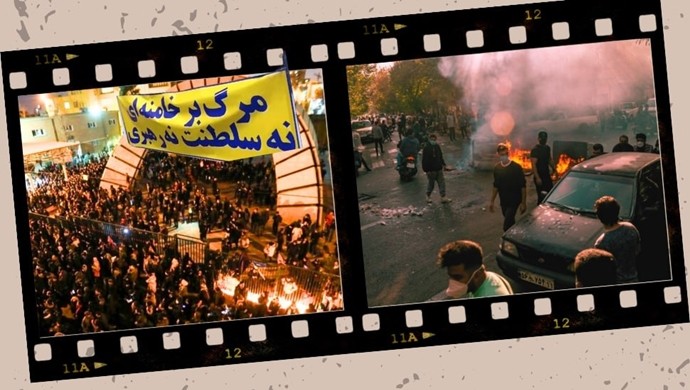

On March 29, Gholamhossein Mohseni Eje’I, the head of the Iranian regime’s judiciary, who was visiting the tomb of regime founder Ruhollah Khomeini, made remarks that are indicative of the regime’s desperation in the face of crises that surround it from within and outside, as well as the rulers’ fear of explosive societal conditions.
While attributing the regime’s crisis to external forces, Eje’I, said, “Today, enemies and demons are striving to create division, pessimism, hopelessness, and despair among the people.” He also said, “demons are busy creating divisions and gradually imposing negative mindsets.”
In the continuation of his statement, he addressed the incurable internal crisis and the self-destruction of factions, and turned towards the regime’s factions, saying: “Let us refrain from canceling and spreading rumors, from accusations and conspiracies!”, and added, “We have not come to attain a position or power to weaken others… We must preserve and strengthen our unity and cohesion, and not allow demons and spies to infiltrate our ranks.”
Eje’I disregard his own comments about restraint and highlighted the fear of uprising and the regime being overthrow. It blamed the “governing” leadership for the explosive conditions and the danger of people being provoked.
On March 30, the Mizan News Agency, owned by the judiciary, quoted him as saying, “Today, we must provide good governance for these people and strive to ensure their dignity in this world and the hereafter. We are obligated to provide the means of comfort, tranquility, and security for the people. We are responsible for the livelihood of the people. Today, some people are under pressure and in distress. These people rightfully expect no oppression, corruption, or discrimination.”
Expressing fear of the danger of a popular uprising and attributing it to the consequences of the failure of the government is not limited to these statements. In recent weeks and days, regime officials and media outlets have increasingly openly voiced such sentiments.
On March 28, the state-run Etemad newspaper quoted Iranian politician Mansour Haghighatpour, as saying, “[Regime president Ebrahim] Raisi should apologize to the people; this government is not in the interest of the Iranian nation… This government cannot solve the problems… The government should be free from any faction and govern based on independence and rationality, but the Raisi government is not like this.”
On March 25, Rouydad 24 news website quoted journalist Fayyaz Zahed, referring to potential social anger that can ignite, as saying, “We must quickly address this anger. The Raisi government has the least competence and cannot prevent this anger.”
On March 25, The state-run Khabar Online news website quoted Gholam Ali Jafarzadeh Imenabadi, a former member of Majlis (Parliament), who criticized the weakness and incompetence of Raisi and said, “Illiterate and delusional individuals who cannot cope with reality and are not inclined towards the truth have taken positions of power and make decisions… Someone who has never managed a classroom suddenly becomes a minister.” He further adds, “We are not happy that the government has not succeeded, is a failure, and has no positive track record. I wish Raisi had never become president.”
In a March 24 with Khabar Online, Hossein Kanani Moghadam, a politician from the regime’s “principlist” faction, criticized the false and deceitful promises of Raisi and said, “The government should be accountable for its actions. If it only makes slogans and none of the elements are realized, we are essentially deceiving the people.”
Regardless of the figures and media outlets of the so-called moderate faction who have been issuing warnings for a long time, stating “If we continue with this government’s leadership, it will undoubtedly lead to a downfall,” now protests and expressions of fear within Khamenei’s own faction are also expanding regarding the trajectory and path of Raisi’s government.
The expansion of these warnings within the regime’s camp, along with an emphasis on Raisi’s failure, signifies the implications of the significant defeat of the regime in the sham elections and the devastating effects of the popular boycott by the people. Raisi, who was the last card of the regime to consolidate power and confront the uprising, has been unsuccessful in his endeavors.