


Iranian regime founder Ruhollah Khomeini sowed the initial seeds of the kinds of policies and rhetoric that is known today as “lie treatment” and “promise treatment,” where regime officials make a bunch of commitments and promises that they never uphold. A few weeks before the 1979 revolution, Khomeini promised everyone, “Don’t be content with us just building houses; we will provide free water and electricity for the poor. We will make bus rides free… We will elevate your spirituality and morale,” and so on.
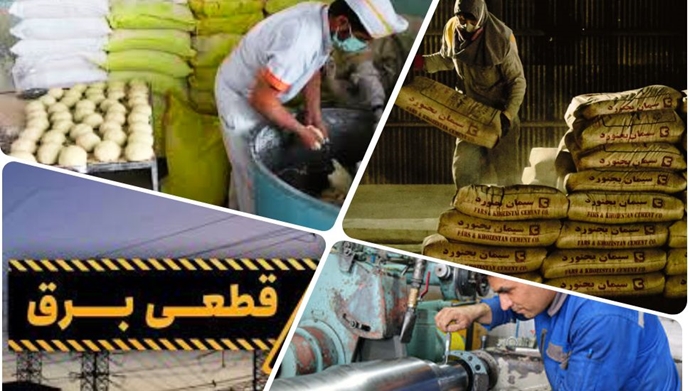
One of the crises that has surfaced in society is the electricity shortage crisis. A flood of protests from various groups, including workers, bakers, farmers, orchard owners, poultry farmers, and others, is being posted on social media every day. Some of these protests manage to bypass the regime’s censorship and reach state-controlled media:
“In many cases, the dough in bakeries, used to bake bread—the staple food of Iranians—has spoiled due to power outages.”
“Power outages in the cement industry have caused numerous problems, including the closure of workshops and the unavailability of cement in the market”.
“Due to prolonged power cuts, chickens and chicks in some poultry farms in Lorestan have died.”
“Repeated and unscheduled power outages of agricultural wells in Isfahan have caused damage to agricultural products.”
On August 24, Asr-e-Iran news website reported, “Power outages have caused 40% of pistachios in Kerman to become hollow.”
Is it the people’s fault or the regime’s?
Regime officials responsible for electricity distribution, as usual, point the finger of blame at the people, accusing them of ignoring the excessive consumption of electricity and energy in the country.
A regime official in Kurdistan, while blaming the people and stating that “increased consumption leads to power outages,” also proposes a solution at the expense of the already suffering people, suggesting that “some areas of the city should be turned off” (Source: Mehr News agency August 27).
Regime officials also blame factors such as nature, prolonged heat, and a harsh summer. The spokesperson for the regime’s electricity industry not only fails to offer any solution for the power crisis but also, while noting that “the heat will persist until the end of this week,” instructs people that “all consumers must reduce their electricity consumption by ten percent” (Source: the state-run Entekhab news website, August 26).
But the infighting within the regime’s factions reveals the real cause of the electricity crisis: a looting regime that feels no responsibility for the welfare of the people.
On August 27, Iran Chamber of Commerce Online quoted the head of the Canning Industries Syndicate, in which he admitted that “Iran’s economy is teetering on the edge of power shortages and energy poverty” and said, “A friend expressed concern that we might return to the Qajar dynasty era, but it seems we are rapidly returning to the Stone Age. A time when people and humanity looked to the sky, hoping that the gods of the sun, moon, clouds, wind, and rain would come to their aid… Our country has fallen into a crisis of irresponsibility and indifference among officials.”
A university professor goes even further, revealing that “almost the entire energy sector of the country is under government control. This means the government is the master, and the people are the serfs, with the people’s share being almost negligible. Meanwhile, the government insists on energy brokerage, even though its role is not to act as a business entity. The Ministry of Oil and the Ministry of Energy are only engaged in business activities… from top to bottom, the energy sector is state-run” (Source: Rokna News website, August 26).
Of course, this university professor desperately tries to frame the looting, plundering, and exploitation of energy by government institutions and the regime Islamic Republic Guard Corps (IRGC) as merely “brokerage,” “business activities,” and the relationship between “master” and “serf.” But this heartless master cares nothing for the fate of the serfs—millions of families bearing the heavy burden of all economic and social crises on their weary shoulders. In the absence of the minimal comfort of a basic life, they have realized that under the mullahs’ rule, all their basic rights, including access to water, electricity, and gas, can only be achieved through protest and uprising in the streets.
Protests and Gatherings
As protests and gatherings of various groups, led by nurses, have intensified, one of the gatherings specifically involves those protesting power outages. On the night and day of August 26, merchants and business owners in the Khavaran industrial town of Tehran protested the electricity situation. On August 27, hundreds of industrialists from the Greater Isfahan Industrial Town gathered in front of the Shahin Shahr Electricity Office to demand accountability from regime officials. Several times in August, these protests flared up, leading to slogans and clashes with security forces in some areas.
As public dissatisfaction and protests increase, the head of the Coordination Council of the regime’s industrial towns sounded the alarm, warning of the social consequences of power outages: “The electricity of the largest industrial town in Tehran was cut off today, and it will be cut off for 24 hours tomorrow. Yesterday, street protests took place in the Khavaran Industrial Town due to the power outage… Small and medium-sized industries in the towns are dying. Do not destroy the industries” (Source: Entekhab, August 26).
Given that the regime is incapable of ceasing the export of capital, energy, and electricity from the share of the Iranian people to neighboring countries, due to the rampant embezzlement, looting, and plundering by the regime’s factions in all regime ministries, when just one cryptocurrency mining farm of the IRGC consumes as much electricity as ten provinces, when the outdated electricity generation systems are abandoned, and the electricity imbalance increases every year, these warnings go nowhere, and in fact, as time goes on, the increasingly angry masses deprived of water and electricity come to realize that only “street protests,” rebellion, and uprisings are the solution.