

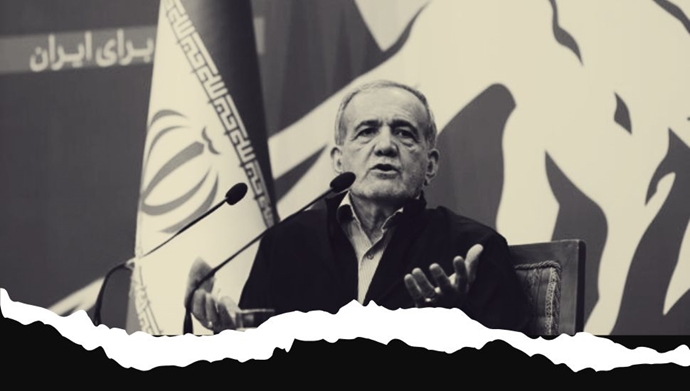

On Thursday, November 28, during a meeting with a group of regime officials, Iranian regime president Massoud Pezeshkian discussed the extensive crises facing the regime. He acknowledged that the situation is “getting worse by the day” and expressed his helplessness and entrapment in these deep crises. He said, “It’s been 45 years since the revolution, and the country’s problems are worsening by the day. If we had chosen the right path and taken it correctly, why are we here? Something is clearly wrong for us to be in this position. We are to blame… I am in the position I hold now, and I truly feel more tortured and pressured than ever.”
This is not the first time Pezeshkian has lamented being mired in crises. On October 20, he said, “They’ve created an indebted government, with imbalances in the banks, imbalances in the funds, and now we are left to fix it!” Now, nearly 40 days later, his own statements confirm that the situation has worsened further.
Describing this quagmire, on September 10, the state-run Shargh newspaper published an article titled “We’re Stuck,” written by former regime vice president Mostafa Hashemi-Taba. The article stated, “All the appearances and inner workings show that we’re stuck. This isn’t related to this government or that government, and everyone knows we’re stuck but won’t admit it.”
On November 13, Jahan-e-Sanat newspaper quoted economist Farshad Momeni as saying, “The government has been thrown into a quagmire where every effort to struggle only causes it to sink deeper… We’ve reached a point where Iranian businesses—whether at the family level, the company level, or the macroeconomic level—are heading toward disintegration. A review of discouraging economic news shows that the 14th government is stuck in a quagmire where every move, right or wrong, pushes it further down.”
The crises facing the regime extend beyond economic and social issues. Pezeshkian is also under severe political pressure, both internally and externally. Less than four months ago, under orders from Supreme Leader Ali Khamenei, the parliament gave Pezeshkian and his cabinet overwhelming approval. However, in fear of society’s explosive conditions, the parliament has now turned against him. One sign of this confrontation is the rejection of an amendment bill Pezeshkian submitted to secure Javad Zarif’s position in the government. The bill suffered a humiliating defeat with 207 negative votes.
Another indicator of this shift is the complete change in stance by Mohammad Bagher Ghalibaf, the parliament speaker. He has moved from supporting Pezeshkian during parliamentary struggles to openly opposing him. During a parliamentary session on November 27, Ghalibaf stated, “Zarif’s appointment is a violation; a legal infraction has undoubtedly occurred there, and this must be investigated. There is no doubt about it.”
Ghalibaf further commented, “The people expect us to confront inefficiency. If the government cannot manage the crises, the parliament must fulfill its supervisory duty” (Eghtesad News, November 28, 2024).
This “supervisory duty” was further clarified by MP Hossein Samasami, who raised the threat of impeachment during the November 27 session. Addressing Pezeshkian, he said, “From this podium, I warn you… we will be forced to use legal tools such as questioning and impeachment.”
Pezeshkian’s inability to address these crises cannot be attributed solely to the regime’s president. He is both an inheritor and an accomplice to the crimes, plunder, and exploitation spanning the past 45 years. As long as the system revolves around the principle of Velayat-e Faqih (Guardianship of the Islamic Jurist), neither Pezeshkian nor anyone else can resolve these issues. Instead, the situation will continue to worsen. This is especially true given the current external challenges and the deep strategic damage that has severely afflicted the regime.