

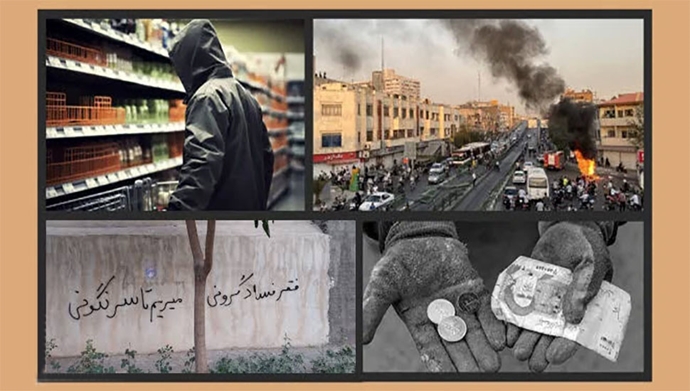

On March 18, the exchange rate for the U.S. dollar surpassed 1 million Iranian rials, and the regime-affiliated Tejarat News reported that the dollar was traded at 1,004,500 rials on Tuesday.
As the clock ticks closer to the end of the year (Persian New Year on March 20), prices are skyrocketing at an accelerating pace. There is no logical reason for this price surge other than the influence of “hidden hands behind the scenes.”
On March 11, a member of Iran’s parliament (Majlis) expressed concern over the growing economic hardship, warning about the public’s dwindling tolerance. He stated: “On the eve of the new year, economic concerns are more evident than ever. The uncontrolled rise in the prices of meat, chicken, holiday fruits, potatoes, and other essential goods has placed an enormous burden on different segments of society, especially the lower-income groups.”
Another member of the parliament added: “Uncontrolled inflation is causing immense difficulties for our people, shrinking their dinner tables more and more each day. Unfortunately, we are dealing more with officially sanctioned price hikes than with mere overpricing by vendors… Just this year, Persian calendar year 1403 [March 2024–March 2025], many goods have officially increased in price at least three to four times.”
The situation has deteriorated to the point that potatoes—one of the cheapest, most abundant, and most accessible agricultural products in Iran—are now being sold for 800,000 to 900,000 rials per kilogram. The regime-affiliated Taze News website wrote on February 19: “New disgrace: Potatoes are now being sold in installments.”
On March 29, Jamaran News quoted a government-affiliated economist as saying: “Mafia-like entities exploit every possible means to make money at the expense of the people. They export potatoes at 150,000 rials per kilogram and immediately re-import them at 300,000 rials per kilogram! They are emptying people’s pockets as much as they can.”
The fact that meat prices are approaching 10 million rials per kilogram and that potatoes have turned into a luxury item is not the result of famine or an agricultural crisis. It cannot be explained by conventional supply-and-demand principles either. The only explanation for this relentless price surge is that the same 1 million rials that used to buy one kilogram of meat has lost 90% of its value. This is daylight robbery by the government, carried out through the reckless printing of money without any backing.
Mehdi Toghiani, a member of parliament, commented: “When 70 trillion rials are created and spent irresponsibly every day, how can we expect inflation and currency devaluation not to rise?” (Gilan24, March 3).
To gain a clearer picture of the extent of money printing and systematic theft from people’s pockets, one need only look at statistics revealed in parliament by a member of the Economic Commission. He stated: “Over the past 50 years, liquidity in the U.S.—despite its massive dollar circulation worldwide—has increased 26 times. In Germany and France, it has quadrupled. However, in the same period, liquidity in Iran has skyrocketed by 170,000 times. This means that, on average, liquidity in Iran doubles every three years. Most of this uncontrolled money creation flows directly into speculative markets such as foreign exchange, gold, real estate, and automobiles, destroying production and reinforcing the vicious cycle of economic collapse.”
Another key driver of rampant inflation is the rising exchange rate of the dollar, which is deliberately manipulated by the regime to devalue the currency. On February 25, when the dollar reached 950,000 rials, MP Hossein-Ali Haji-Deligani admitted: “They wanted to profit from the currency price increase to fund the government budget.” When the interviewer asked in surprise, “Did they succeed?” Deligani replied: “Yes, when you used to sell dollars at 600,000 rials, and now it’s 950,000 rials, there’s a difference—of course, that extra money came straight out of the people’s pockets and went into the government’s treasury.”