

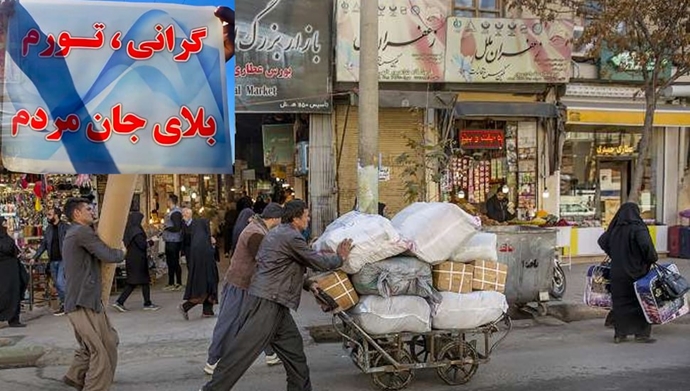

One year after Masoud Pezeshkian took office as the Iranian regime’s president, the hollow nature of his promises for economic reform has become undeniable. His administration’s first-year report card is a stark illustration of failure, a verdict now being echoed even within the regime’s own state-run media, which acknowledges that the promises of change have been swallowed by the grim realities on the ground.
The empty rhetoric of “imbalances”
Throughout his first year, Pezeshkian has tried to portray himself as a technocratic expert uniquely capable of solving Iran’s deep-seated crises. He has incessantly lectured on the country’s various “imbalances”—from the energy sector and budget deficits to taxation and failing pension funds—creating the impression that he was determined to uproot these problems. However, his endless complaints have produced no tangible solutions. The on-the-ground reality has proven far more stubborn than his rhetoric, revealing a government that continues to prioritize the regime’s survival over public welfare.
A crisis of priorities, not resources
The regime’s failure to address its chronic problems is not due to a lack of funds but to a deliberate and systematic misappropriation of national wealth. An article in the state-run Jahan-e Sanat newspaper on July 10, 2025, lamented this “incorrect prioritization.” It pointed out that with approximately $90 billion, Iran’s major cities could have been connected by a high-speed rail network. Instead, “not even one kilometer was added to this network.”
The reason is clear: the regime’s resources are not invested in sustainable development but are funneled into the institutions that prop up the ruling theocracy. The Islamic Revolutionary Guard Corps (IRGC), the vast apparatus of domestic suppression, regional proxy forces, and state-controlled religious foundations are the true beneficiaries of Iran’s wealth. This is the stark “on-the-ground reality” that even the regime’s own media outlets are now forced to admit.
Another powerless president in an unreformable system
Pezeshkian’s disastrous first year confirms a long-established truth: genuine reform is impossible within the clerical regime. The entire structure of the mullahs’ rule is built on a fundamental conflict between reform and survival. True structural changes would mean the collapse of the Supreme Leader’s absolute power. Institutions like the Guardian Council, the Expediency Council, and the IRGC exist precisely to prevent such changes.
Pezeshkian is not a reformer but simply the latest actor in an old play, another failed president serving as a façade for the absolute power of Ali Khamenei. His talk of fixing “imbalances” is nothing more than a cynical attempt to throw dust in the eyes of the public. As long as the regime’s power rests on ideology, corruption, and brute force, any president is merely a placeholder, tasked with managing a system that deprives the Iranian people of their rights for the sole purpose of preserving a rotten dictatorship.