

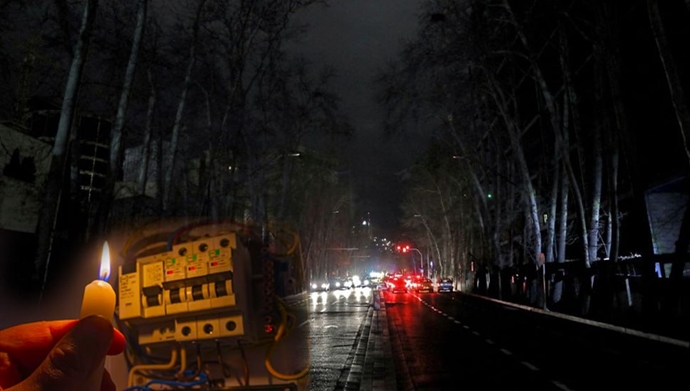

The mullahs’ regime has destroyed the country’s infrastructure for years with its destructive policies and systematic corruption. Today, the result of this plundering is clearly evident in the energy crisis—a crisis that, in addition to paralyzing industry and people’s livelihoods and causing fear and concern among regime insiders, increasingly risks overflowing the people’s cup of patience and erupting into anger and an uprising of a frustrated people.
On February 24, Ahmad Moradi, a member of the regime’s parliament, addressed the Iranian regime president Masoud Pezeshkian, whose job has been reduced to empty promises, reciting poetry, and praying for the long life of regime supreme leader Ali Khamenei. Moradi shouted: “Mr. Dr. Pezeshkian, the increase in inflation, exchange rates, and gold prices has broken the backs of the people. With this trend, people’s hope has turned into despair and hopelessness. Employment for young people has become unattainable, and building or buying a house has become impossible. Mr. Dr. Pezeshkian, the energy imbalance, household power outages, agricultural water well power outages, and gas shortages have truly become agonizing for the people.”
A few days earlier, on February 12, 2025, the regime’s media reported that “the cause of the power outages is the inability to provide adequate gas and diesel for power plants. Currently, diesel reserves in power plants have reached their lowest levels, and more than 8,000 megawatts of power plants across the country have been taken out of service due to lack of fuel.”
This admission shows that the ruling regime is not only incapable of managing energy resources, but due to its mafia-like policies, even the strategic reserves of power plants have been depleted.
The situation has reached a point where Tavanir, the Iranian regime’s organization for Management of Electric Power Generation and Transmission, announced in a statement on February 12, 2025 that “The restrictions created in the process of supplying and transferring gas to power plants in order to maintain network stability” have caused power outages for “subscribers in Tehran.”
This official admission clearly shows that it is too late and that this ruling regime not only does not want to solve the energy crisis, but even if it wanted to, it could not solve such a problem with its structure and policies.
Therefore, as always, it takes the price from the people.
Mostafa Rajabi Mashhadi, CEO of Tavanir, said on February 24, 2025, “The full implementation of electricity consumption management programs is necessary in all industrial, domestic, agricultural, administrative, and commercial sectors in the country.”
He then defined the “full implementation of Pezeshkian’s programs” with this sentence: “A 50% reduction in electricity consumption compared to the same period last year” by the people.
The severity of the crisis has caused regime officials to blame each other.
So much so that such phrases are included in the headlines of the official newspapers of the government: “The Ministries of Oil and Energy show evasion of accountability with projection in connection with power outages, and instead of agreeing on solving the problem, Mohsen Paknejad and Abbas Aliabadi are looking to make each other appear guilty.” (Eghtesad News, February 13, 2025)
On the other hand, while the people are fed up with this crisis, Khamenei’s representatives on Friday prayer pulpits, like animals that sense the danger of an earthquake in advance, say in horror: “Suddenly you see that things have reached a point where all the cries (of the people) are directed at the Islamic Republic!” (Alireza Ebadi, Friday Prayer Leader of Birjand, February 22, 2025); and they also drag the enemy of the regime into the middle, saying: “The enemy turns the people’s trade demands into security and political issues! (i.e., the desire for regime change)”; we must be very careful! (Ahmad Mahmoudi, Friday Prayer Leader of Isfahan, February 22, 2025).
In the end, the power outage crisis is not just a technical or management problem, but an explosive fuse in the heart of a dissatisfied society ready for an uprising.
With its destructive policies, the mullahs’ regime has brought a country rich in energy resources to a point where its people live in darkness, blackouts, and cold.
All indications are that the fuel crisis and power outages, along with high prices, corruption, repression, crime, etc., will turn into a spark for an explosion.